
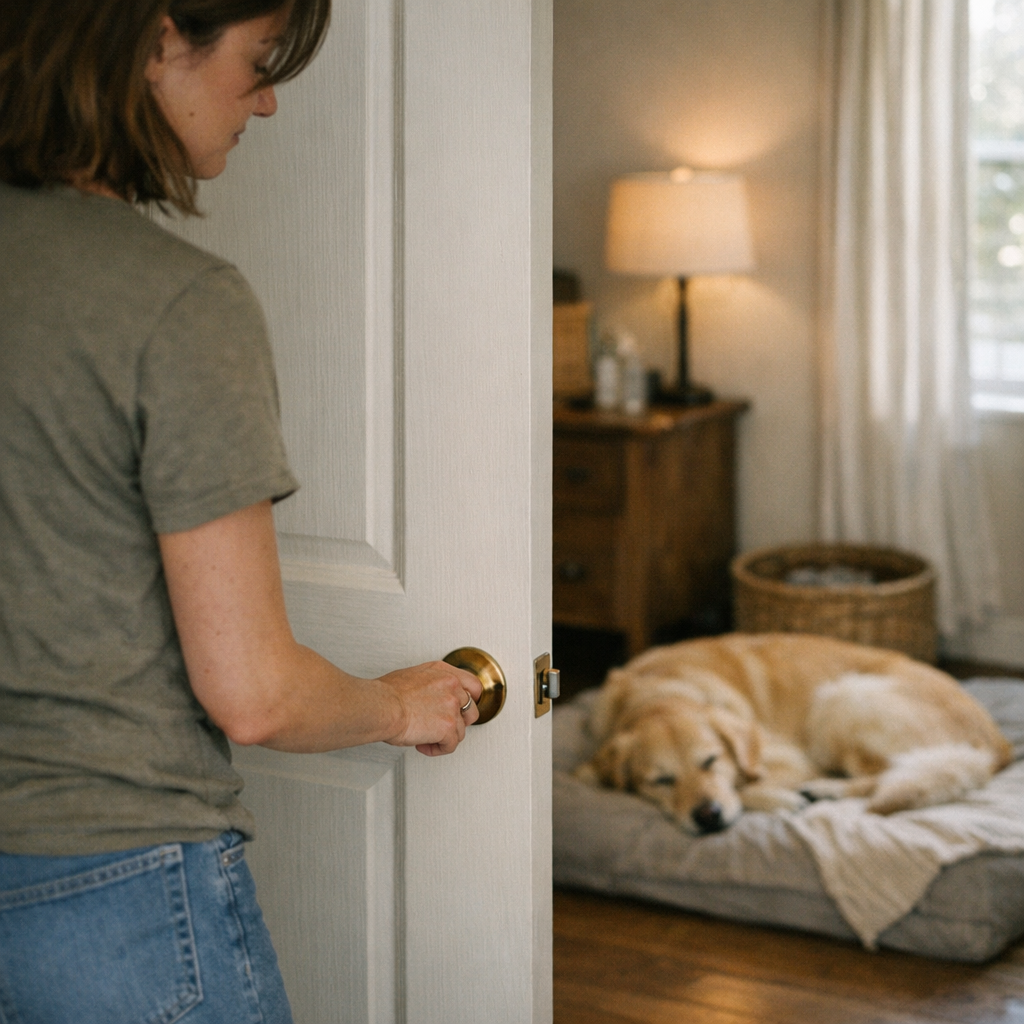
The way you close the door before your dog’s rest time isn’t just a finishing gesture—it’s the real divider between a room that supports deep rest and a corner that keeps leaking distractions. If you’ve stood in that doorway, debating whether a quiet tug is enough or catching your dog’s half-raised head after every hallway noise, you know what’s really at stake. You can line up the right bed, arrange water just so, and keep the space clear—yet it only takes a careless, barely-closed door to undo the entire reset. Every loose latch, every open crack invites the outside back in: paw taps, the restless head dip, the constant “are we done yet?” stare. The difference isn’t cosmetic; it’s the line between a routine that actually resets the house and one that quietly drains your patience.
The Familiar Friction: When the Door Never Quite Settles the Room
Most rest setups look right from afar. Bed’s in place, traffic path is clear, your dog drops into a curl, but that uneasy energy hangs around: is it really rest, or just monitoring from a different angle?
Real friction: You close the door—too quickly or just enough—start down the hall, and within moments, the pattern repeats. The muffled sound of dog nails against the floor, a shifting shadow under the door seam, the echo of your own steps or fridge door traveling straight through the gap. Instead of calming down, your dog’s body tenses: ears up, ready for anything. Restlessness sets in before you even make a cup of coffee. The “closed” door fails to block the swirl of movement outside, leaving your dog to decode every laugh, cupboard shut, or stray voice. Settlement becomes surveillance: the same cycle, every afternoon, every bedtime, no matter how neat the corner looks to you.
Why the Door Close Impacts Your Dog’s Rest (and Your Routine)
This isn’t about eliminating all noise—it’s about sending the right signal at the right moment. When you close the door softly, fully, and with purpose, your dog recognizes a boundary: the rest shift. Any hesitation—the door bouncing off the jamb, a rattled handle, or a careless gap—broadcasts uncertainty. That small difference replays: predictable rest versus repeated interruption. Over just a few uses, patterns lock in. The dog who learns the door will quietly click and stay closed becomes the dog who sets down faster, lasts longer between wakeups, and requires less rescuing. Let it slip, and familiar frictions creep back in:
- Circling, shifting, or repeated “testing” to check if the coast is clear
- Heads popping up for every distant step
- Extended watchfulness, not actual relaxation
- Breaks that get broken for everyone else—reset after reset
Real-World Complications: It’s Not Just the Door
The setup is more than a shut door. Bed placement, sound lanes, and the spaces where dog and human flow cross paths all stack up. Put the bed flush to the door, and every nudge or vibration jolts your dog awake. Space it back with a clear buffer—half a meter or more—suddenly, distant sounds fade, drafts drop out, and the physical divide becomes real. It’s not just about making things look calmer—it’s about making sure the setup blocks the daily friction points you can’t see until you run the routine for real. The edge cases add up: one misplaced bed, one blocked bowl, one door that never quite stays shut, and the cost piles onto every day you try to get your dog to settle.
The Unseen Downside: Friction Accumulates
A door left mostly closed seems minor—until it drains an hour across a week. Your dog looks fine, but small flaws show up every cycle:
- Door not tight? Every pass in the hallway or kitchen triggers a micro-wake
- Shortened nap: the dog stands in the doorway, half in and half out, waiting for you
- Chopped-up flow: you pause prepping food, dealing with bags, or moving laundry to resettle the dog over and over
- Rest morphs into pacing, circling, or vigilance—no one gets a break
This is the compounding drag: the space looks prepped but can’t actually buy you, or your dog, a stretch of peace before something pulls you right back to square one.
The Small Adjustment That Changes the Routine
The real-world fix is simple: guide your dog to their spot, close the door fully, gently but with a final “click,” and make sure no gear (no bowl, no bed, no crate wall) is jammed up against the action zone. That small half-meter of bedding distance from the door buffer absorbs shakes, cuts sounds, and sets eligibility for rest that sticks.
After even a few runs, the payoffs are obvious:
- Fewer “half-lift” responses to random sounds outside
- More uninterrupted downtime, fewer accidental get-ups
- The dog stops dashing to the door every time something shifts outside
This isn’t effortless at first. Busy days make it easier to push and move on, but the quick reset—slow door, buffer space—becomes self-sustaining. Over time, less owner intervention is needed. Calm becomes the norm, not the exception inherited only after the third failed attempt.
The Price of Slipping Back: Why Consistency Matters
Letting habits go—propped door, bed inching forward, a lazy latch—undoes a week’s focus in one rushed errand. Every less-than-clean step brings the old pattern: standing by the crack, checking the hall light, waiting instead of resting. Only a consistent door close and setup routine keeps rest from slipping back into a noisy holding pattern.
Why Not Just Accept Some Noise? The Real Difference of a Clean Close
Acclimating to noise isn’t the same as shedding tension. For most setups, strict silence doesn’t help—but repeatable boundaries do. A firmly shut door signals a predictable block; a partial close leaves unknowns to manage. Your dog stops scanning only when the signals are always the same. A missed signal (door not fully closed, slam, or rattle) reintroduces background static—forcing them to keep one ear and half their brain tuned for the next interruption.
Everyday Broken Flow: A Setup That Looks Fine But Works Slowly
The same logic shows up everywhere: reaching for a leash but knocking into scattered wipes, grabbing for a post-walk towel and finding it buried, or losing time reshuffling bowls that keep drifting into walkways. A rest setup can be neat but slow to use—a tidy corner that still involutes your routine with avoidable slowdowns. If you’re repeatedly blocked at key moments (walks, cleanup, settling down, crate resets), the space isn’t supporting the flow, it’s resisting it. The cost is rarely dramatic, but always felt in the background drag it creates.
Refining the Flow: Practical Adjustments Anyone Can Make
Better flow doesn’t mean more rules or new gear—it means fixing the points you actually trip over. For rest routines, that means:
- Always closing the door gently, completely, without shortcuts
- Keeping bed, crate, and bowls out of the door’s immediate sweep and buffer zone
- Tracking which outside noises consistently disrupt calm, then moving the setup to reduce their impact before friction builds up
- Owning the friction up front—don’t chase lost calm after it’s already gone
The goal isn’t an immaculate space, but a setup that holds firm against the same repeat problems—so you don’t spend each day correcting what the routine could have prevented on its own.
Small Tweaks, Lasting Payoff
It rarely takes dramatic change: just a quieter, slower door, a rest zone with a buffer, and gear that stays out of the main action path. The rest is about removing the reasons to reset—letting comfort and routine support each other, not clash. Most days, that’s enough to keep the next hour calm, and the next routine less likely to run off track.
Find rest setups, cleanup gear, and routine-ready solutions made for real-life routines at DogPile.