
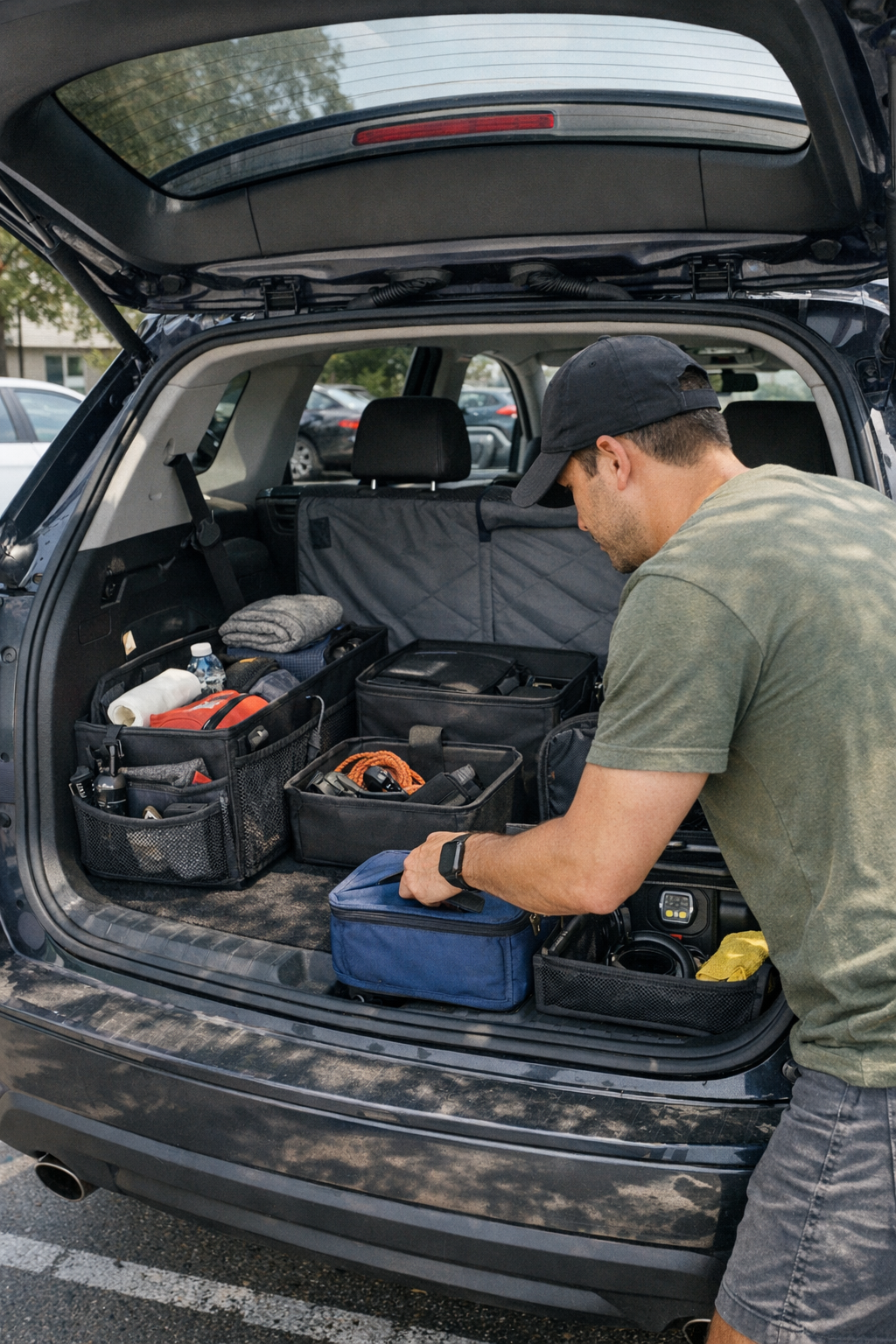
You can cram a car with organizers, trays, pockets—yet it takes only a few days of real driving for the system to start slowing you down. What looked streamlined on day one quickly shows cracks: cables vanish below crowded compartments, small essentials wedge beneath stacked inserts, and a phone tossed “anywhere” bounces to the least reachable spot. The interior looks under control but daily routines grind against hidden barriers you didn’t design for. Suddenly, everyday basics—charging, quick drop-offs, loading up, cleaning out—become a quiet juggling act, not the smooth reset you pictured.
When a Packed Car Feels Less Usable
If you’ve ever lined a car with bins and pockets, you know the drill: Monday’s setup looks tight, but by Thursday you’re breaking your own flow. What starts as control turns into unexpected friction:
- Have to move a tray just to grab a parking stub at the window.
- Charging becomes “untangle the cable” before plugging in, every single drive.
- A well-meaning storage bin near the seat now blocks your foot or catches your bag on the way in.
None of these slowdowns make headlines, but over back-to-back errands and rushed mornings, the drag is real. Every stop is a quick test: does your setup keep pace, or do you catch yourself hesitating, shifting, or forcing a workaround?
Spotting the Real Trouble Zones
The friction always surfaces where your hands expect freedom: beside the charger, next to the seat edge, or front and center. Real weak spots stand out over repeated use:
- Charging ports blocked by storage: Cables snake underneath or around, so you juggle organizers to power up your phone. The cord stretches, connectors fatigue faster, and a quick plug-in now takes attention.
- The reach zone clutter: The area from seat edge to shifter fills with keys, cards, sanitizer, transit passes. Clean lines turn to a rush-hour scramble as you fish for the one item that’s always out of reach.
- Cargo and trunk corners overloaded: One oversized box or cargo divider cuts the loading angle, forcing you to tip bags or reposition every grocery run—making unloading slower, not easier.
A car that photographs as “organized” can, in practice, slow every instinctive move. Those seconds stack up, wearing out your patience and making car time feel less in sync with your actual routine.
The Case for Leaving One Spot Empty
Counterintuitive but true: intentionally leaving a key area open near the charge port or the center console often unlocks the biggest relief. When this zone is kept free—
- You can drop your phone or badge in one motion, not a shuffle.
- Cables have space to flex, so there’s no daily ritual of untwist and adjust.
- Rush handoffs—groceries, knotted cords, paperwork—land on an open pad, not crammed beside or under trays you have to slide out of the way.
The gain shows up in the unnoticed: sliding into the seat without sidestepping bins, reaching to charge in one clean arc, picking up paperwork without first clearing obstacles. The interruption fades—and that’s when the organization actually helps you keep moving.
Where the Daily Grind Proves the Point
The pattern repeats: you jump in mid-errand, arms full, and immediately hit an obstacle. Every flat surface is “claimed” by a tray or charger, so items you need most end up balanced on piles or dropped into cupholders. If you lose a work pass or receipt, odds are it’s slipped under another insert before you can react. The design you built to fight clutter quietly blocks your own routine—what’s clean in theory is clumsy in motion.
Leaving one space open lets the car flex with your week: bulky deliveries Monday, extra shoes Thursday, dog leash and wipes on Saturday. The empty slot absorbs the overflow, protects access, and lets the routine bend without constant rearrangement. Function stops fighting flow.
Organization as a Living System—Not a Finished Picture
In cars, “tidy” and “easy” rarely line up for long. A setup that’s bliss on unboxing can gum up after a few cycles of drive, load, park, repeat. The spots that look best at rest often become bottlenecks when you move fast. A cargo grid makes bags stand up, but can slow unloading when you’ve got three more stops. Seat-side organizers trap trash, but block a smooth exit and pinch your leg every re-entry. Features that seem helpful on day one can turn into silent sources of friction after a few laps around town.
How One Clear Section Changes the Rhythm
Real feedback comes fast: leave just a small area open near your charger or seat—suddenly there’s less “fighting” with your storage. No more bumping a tray to lay down your phone, no more digging for keys through a nest of bins at a red light. On high-pressure days packed with errands or family pickups, that open spot becomes a pressure-release valve; it’s where clutter pauses, where the quick items land, where cleanup doesn’t involve first unblocking organizers.
Over time, your routines smooth out—clutter can’t bounce back into active zones, and you fit loading, unloading, and re-entry into fewer steps. The car stops resisting and starts responding.
Adjusting for Real Routines—Not Just Static Order
Skip the temptation to fill every gap. Instead, find the pinch-point—the spot where you fumble, pause, or mutter every week. That’s the place to leave clear. You’ll see it when busy mornings stop tripping you up, and when shared rides stop involving a mini cleanup.
Order isn’t about packing every space; it’s about what keeps working under daily pressure. Leave a section intentionally untouched, and you’ll discover the most valuable zone in your car isn’t an extra bin—it’s the open patch that soaks up overflow, cuts friction, and recovers smoothly. With each drive, that small absence becomes the biggest difference.