
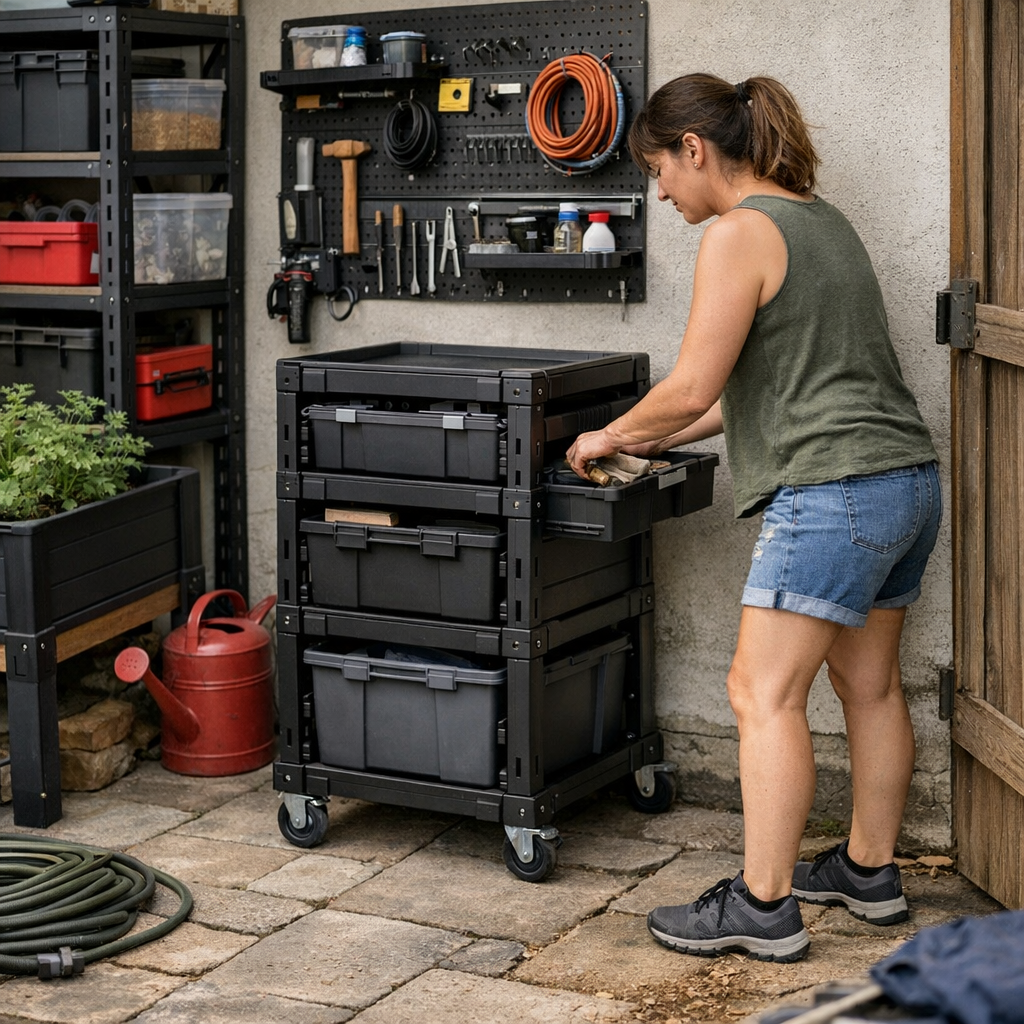
Roll in another bin, add a cart with wheels, and suddenly your workshop or garage looks under control. The promise: portable storage makes everything flow. The reality—at least by week two—is messier. Carts stray into walkways, bins slip off their marks, and what seemed flexible starts blocking your every move. That “easy” storage upgrade turns into another round of shifting, nudging, and working around your own organization—especially where every project starts and ends with hands full in tight quarters. In spaces that get daily use, friction creeps in quickly, and the smallest roadblocks repeat until they slow you down without you noticing why.
When “Moveable” Means Constant Rearrangement
The first day with new rolling units feels great—everything aligned, clear floor space, all your gear in arm’s reach. It’s only after the routine sets in that you spot the cracks. The cart that drifts six inches into the center of the walkway. The bin wedged tight under a workbench. That moment when you twist around a sharp cabinet edge yet again, running out of patience along with elbow room. One shelf blocks another, or you’re forced to shuffle three carts just to get to the socket set you needed in the first place.
These repeated speed bumps—nudging carts out of the way, sorting bins that have migrated, climbing over low-rolling obstacles—turn your setup into a series of slow-motion detours. By week’s end, you’re spending as much time resetting as you are working, with “portable” units adding complexity instead of cutting it.
The Drift Effect: Why Storage Stops Staying Put
Real flexibility needs real boundaries. Without any anchor points, every move you make gradually undoes your original order. You finish a landscape project on a muddy day, and now one cart sits at an angle, its wheels gummed up, blocking part of the shed door. Or you return from a supply run, wheel in an extra bin, and realize you’re stacking it awkwardly in a dark corner simply because nothing else fits. Every small misalignment compounds: the rolling shelves you loved at first now have to be corralled before any real work can start.
This is the drift effect—the subtle, repeated movement of each unit, scattering your organizational effort. At a certain point, you’re not accessing storage; you’re managing where your storage goes and how to get it back in line, each time you need a tool or want to sweep the floor.
Looks Organized, But Gets in the Way
That crisp row of bins looked perfect on set-up day. But now, you break stride to pull the wrong one, or you’re elbow-deep in reshuffling just to reach one tucked behind another. The layout seemed right on paper; in practice, bins overlap, catch on coarse mats, or must be unstacked in a specific order or nothing fits.
The day-one footprint rarely holds up to actual use. You start sliding overflow into the nearest “dead corner.” Carts left parked halfway across the room mark your path like traffic cones. The result: a zone that appears tidy, but forces you to move more things more often, adding hidden work to every routine cleanup or start.
Outdoor and Workshop Setups: Where Surfaces Sabotage You
Backyard and shed storage raises the stakes: weather and tough surfaces fight you with every return trip. Rain brings in mud, and soon wheels grind or stop dead over a lump of dried grass. Uneven pavers trip bins up; a rack shifted by one storm now blocks the mower’s path. By Wednesday, your cart is twisted just enough to catch on the shed doorframe, and the bins that rolled out for tools have settled wherever you left them—requiring a full restack just to find the shovel or hedge clippers.
The constant reshuffling isn’t just a nuisance. Each interruption—bending for a stuck wheel, restaging bins for access, clearing the way after wind or rain—steals a bit of momentum. Portability without reliable return just means more chaos moving around the room, less time getting anything done.
Get Real: Why Anchoring Makes Everything Easier
The real fix isn’t bolting everything down—it’s guiding every piece back exactly where it works best, every time. Swap out loosely parked carts for those with anchoring systems: lockable wheels, low-profile guides, or simple docking rails. Suddenly, you stop chasing bins across the room. Each unit returns to its mark—usually without even thinking—so you navigate through clear, predictable paths. That click of a wheel lock or the subtle guide of a rail does more than prevent drift; it resets your zone after every use, snapping storage back into alignment automatically.
It sounds like a small change, but the effect is outsized. Fewer detours, fewer scattered overflow piles, fewer stalls when you should be working. Resets become almost invisible: you push a cart back and it locks in, your walkway stays open, and you stop managing your storage and start using it. The right anchor points—however simple—turn a roaming stack of bins into a genuine system you don’t have to babysit.
How to Know Your Storage Is Failing Your Routine
Ask yourself: are you sliding the same bin around just to access something behind it, every single time? Are awkward stacks building up in the corners you meant to keep clear? Has your work zone gradually narrowed, pinched by mobile units that never seem to return to their exact slot?
If the answer is yes, your storage is now in your way—forcing you to constantly adapt the flow to work around the solution. Even mounting some shelves to clear space helps only if everything is sized for actual repeated grabs. Too many non-matching bins or carts inevitably means friction returns: overlapping units, forgotten tools, oddball footprints breaking up a usable wall. Consistency, not variety, is what keeps things working. A zone that can be reset in seconds always beats one that just looks neat after a three-hour cleanup.
Building a Setup That Lasts Beyond Day One
The only test that matters is how the setup handles routine, not just reset. The right portable storage keeps your main zones clear, lets you put things back fast without puzzle-solving, and means you’re not rearranging bins just to do simple jobs. When carts dock where you expect, when units stop drifting and routine resets happen almost by muscle memory, your storage finally fades into the background—supporting your pace, not slowing it.
In practice, that means less reshuffling, fewer overflow piles, easier movement, and a shop or backyard where you spend more time doing, less time managing around dead corners and wandering bins. It pays off every day you don’t think about it—because the setup now fits your flow, not the other way around.
Find modular storage solutions for real working spaces at StackNest.