
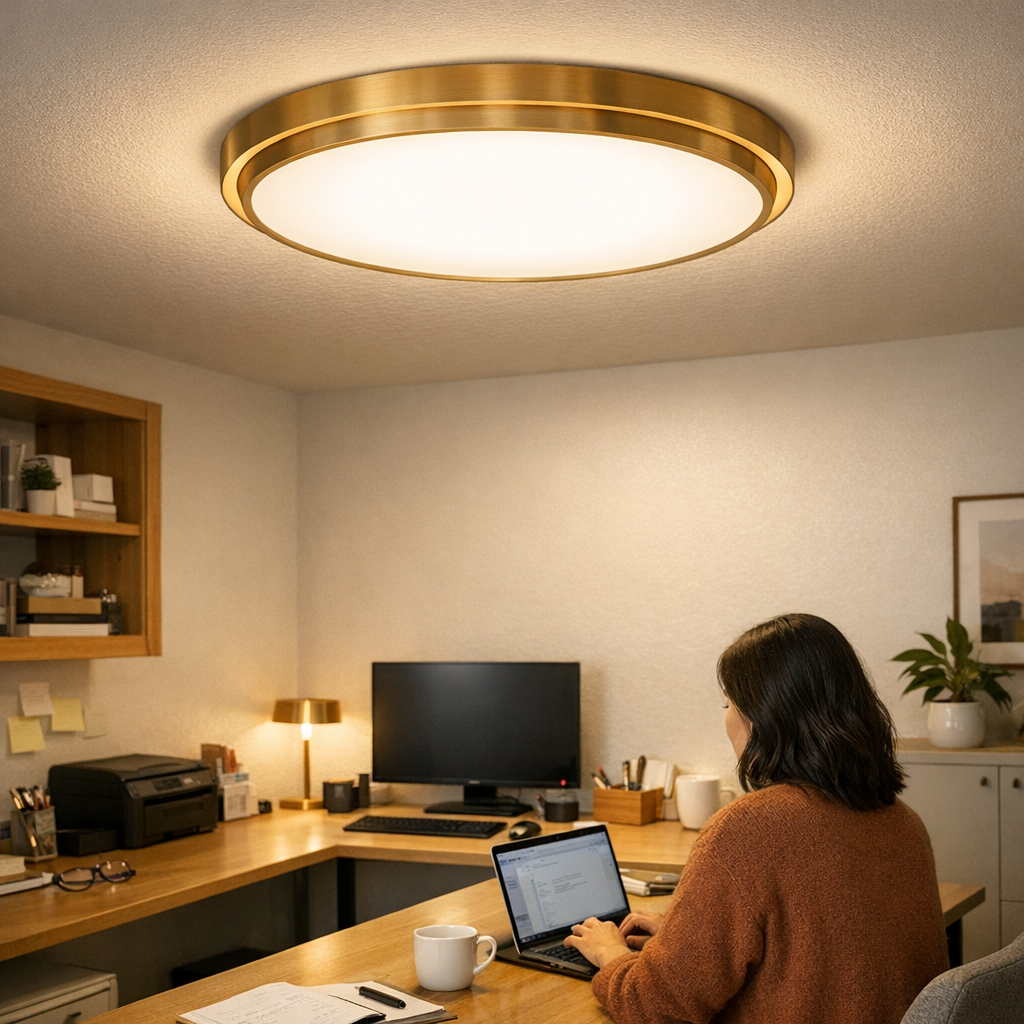
If your desk light forces you to shuffle papers just to see the edges, or every new lamp turns into another cable to dodge, your lighting isn’t just unfinished—it’s interrupting your routine. Most indoor setups—desk lamps in easy reach, sconces high above, a “statement” fixture overhead—promise coverage but crumble in daily use. You think it’s enough, until each night you’re chasing usable light: one zone too bright, another too dim, cords snaking over the floor, and the relief of a “clean” surface outweighed by constant adjustment. What looked resolved at first begins to break down the minute real work, reading, or cleanup starts stacking up.
Patchwork Light: Looking Good, Feeling Annoying
A room lined with lamps and wall lights might impress at first glance, but the cracks show up fast. Stand back and everything looks organized—until the daily routine exposes stubborn friction. The work zone splits: a bright monitor leaves the keyboard in a fog; a kitchen shelf casts a shadow right where you prep; a lamp staged for “ambience” can’t light the whole table, so you angle things, move chairs, or—again—reach for a plug-in extension.
You’ll recognize these routine friction points:
- Glare from an angle that still leaves you working in your own shadow
- Shelf lighting that lights the wall but ghosts the storage edge
- Extension cords crossing the only clear path or pooling under the desk edge
- A lamp that keeps migrating—first for dinner, then for homework, then back again
This isn’t a rare complaint—it’s the normal drag in multi-light setups. Instead of focusing on the task, you spend minutes each day chasing the one spot with enough coverage, untangling the latest run of cables, or shifting your seat to avoid a dark stretch. The “finished” look becomes just another maintenance loop.
Why Single Fixtures Outperform the Patchwork
A single linear or panel ceiling fixture cuts through these headaches by delivering wide, even light where patchwork setups simply can’t. You trade stacks of lamps for predictable coverage: every desk edge visible, every shelf lit to the back, cables fixed out of sight. It’s not subtle—after a week, you stop noticing problems and start using the whole space for its intended purpose.
- Edge-to-edge visibility: No more lurking dimness at the far side of a table or the back shelf—everything is evenly lit from the start.
- No cable chaos: Overhead or under-cabinet mounting means you stop dodging cords, with chargers and devices stored in logical, reachable spots.
- Persistent clarity: Surfaces stay usable through every shift in activity, even as you move gear, shuffle projects, or share the space—it’s no longer about adjusting for the light.
The Routine Test: Day-In, Day-Out Use
The real difference appears not on installation day, but with repeated use. Picture a shared work area: desk, shelf, a corner for projects. Patchwork lighting lines the periphery—a floor lamp on standby, sconce above the storage. At night, you reach toward the paper pile only to pause at the dim edge. You plug in a device, but the cord trails across where someone needs to step. Moving a fixture helps for a bit, but never settles the space. The pattern repeats: you compromise or reorganize every day, all because the light hasn’t adapted to your routine.
The same dynamic surfaces in kitchens where the countertop’s usable line is safer in the middle of the day but falls apart at dusk, or living rooms where reading light works for one seat, then leaves everyone else in unclear shadow. These are not just annoyances—they’re daily collisions between a design that appears functional and one that actually is.
How Linear and Panel Solutions Change the Space
Swapping clusters of unrelated lights for one well-placed linear or panel fixture transforms the entire workflow. In a real-world shared desk, replacing old lamps and a solo sconce with a low-profile LED panel immediately made every square inch accessible—no more stacking folders to lift a lamp, no more taping cords out of the way. The change was immediate: you could finally reach both sides of the desk without bumping into hardware, and surfaces that used to sit in shadow became instantly usable.
- All surfaces get their share: Full, even light replaces awkward bright spots and forgotten corners.
- Cables fade from view: The logic of the setup supports workflow, not clutter—everything routed and out of daily reach.
- No more scramble: The lights stay put and the need for late-night rearrangement vanishes; everything is prepared for the actual mix of tasks you throw at it.
A Real-World Tip: Don’t Trust “Even” Without Testing It
Lighting deceives in photos—a ceiling panel might look centered while the working edge sits in gloom, or under-shelf strips blaze a distracting line on glossy counters. Before you shrug and call a setup done, walk the room while working: reach, shift, open what you usually open, and check every corner. Only by matching the light’s reach to your routine will the hidden gaps reveal themselves.
Typical Patchwork Problems (and Why They Persist)
Why do so many “layered” setups keep derailing routines? The answer: predictable, persistent patterns the decor never solves.
- Shadow lines that reappear every time you change the activity—even after another lamp is added.
- Reflected glare where jobs and surfaces overlap—a page that shines white, a screen that glows but leaves the desktop lost in haze.
- Cables forced into high-traffic paths because every new device “needs” a different plug route.
- Temporary workarounds stacking up: books propping a lamp, cord tape damaging the floor, or an extra flashlight always nearby.
The core mistake: confusing a neat, symmetric placement with reliable functionality. Patchwork setups call attention to themselves—the moment your arm reaches just outside the light’s range, or you trip on the same extension, you’re reminded just how unresolved the space actually is.
Are More Lamps or Smaller Fixtures the Answer?
Not really. More table lamps and decentralized LEDs solve very little. Each new unit means another source of offset glare, another reach for a switch, and the same neglected edges—especially along long desks or wherever cabinetry fragments the layout.
Small lights only help if their coverage areas merge smoothly—but in most surface-based setups, they leave either cross-glare or a missed strip. You end up shuffling, realigning, and chasing workable light instead of getting a space that finally works for you.
What Actually Fixes the Real Problem?
The fix is behavioral as much as structural: Mount a linear or panel fixture in clear line with your practical use—not just centered in the ceiling or shelf. For a desk or table near the wall, run the light parallel along the main edge. For shelving that cuts into the room, orient fixtures so that every active area sees direct, uniform coverage. Only by matching lighting paths to actual movement and routine—not just furniture shape—do you eliminate the gaps that patchwork always leaves behind.
Everyday Headaches Your Lighting Should Eliminate
- Moving a lamp—again—mid-task just to chase clear coverage.
- Bumping or snagging a cord that never quite disappears.
- Leaning toward the only “good” light instead of spreading out naturally.
- Rooms that photograph as “complete” but force endless fiddling in actual use.
Replacing scattered fixtures with a continuous linear or panel ceiling light usually erases these low-grade aches, not just reduces them. You stop noticing where the light “fails”; you start using the space without planning each move around the next shadow line. The clarity and ease don’t just look better—they function better, every day.
Lighting That Matches Real Use—Not Just a Finished Photo
Linear and panel fixtures aren’t a design upgrade—they’re the move that removes cable clutter, shadow patterns, and forgotten corners for good. When glare is managed and coverage runs wall to wall, you stop treating the lighting as a project and start treating the space as ready for anything: reading, work, group projects, chopping, cleanup, or in-between tasks nobody bothers to photograph.
If your lighting looks organized but keeps pulling you back into awkward workarounds and shadowy edges, it’s time for a direct fix. Choose lighting that matches your working routines, not just the floorplan. The change is immediate and keeps paying off—one less irritation, one less adjustment, and a room you can actually use in full.
Visit LightSupport for practical panel, linear, and everyday lighting solutions that