
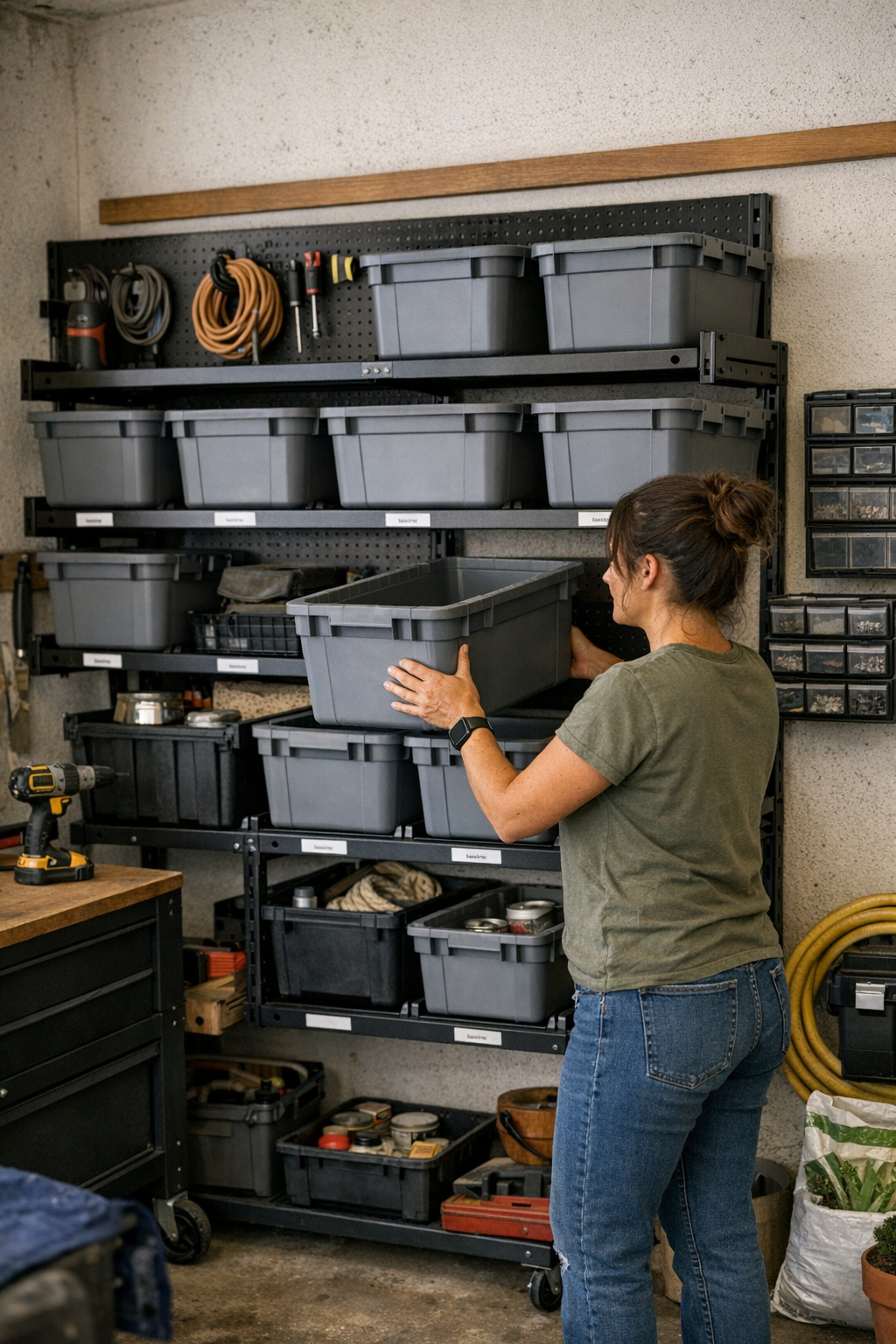
No storage system reveals its weakness faster than a row of bins after a few weeks in the wild. That first weekend—installing matching containers, aligning shelves, standing back to admire the order—feels like a personal win. But days later, real life tugs the system off track. A bin lands by the garage door “just for now.” Another trails off to a worktable’s edge after an unfinished project. By mid-month, you’re back to dodging bins in walkways, shifting rolling carts sideways, or stretching awkwardly around a blocking tote just to reach a drill. What started out looking organized begins to interrupt your routine every time you need to move, reset, or just find a tool. It’s not a dramatic collapse—just a slow leak as clarity gives way to creeping clutter, blocking movement and bleeding away that satisfying sense of control.
When “Temporary” Bin Spots Turn Permanent
That familiar slip—setting a bin down “just until tomorrow”—becomes the first domino. You’re tired after finishing up late, or someone else is helping and makes a guess. A single bin strays into a high-traffic strip near the bench. Another finds its way into a corner that never really worked. Over time, bins collect like driftwood: stacking up behind cabinet doors, sprawling into dead corners, creeping into the center aisle. What was wall-mounted to open the floor now causes you to sidestep, reroute, or slide a parked cart just to restore order after a small task. And there’s always that one shadow zone under the lowest shelf—a “temporary” pile that never finds its way home.
This scatter isn’t just annoying. It adds hidden costs to every session. Frequent reshuffling slows you down: you’re pausing to clear a path, guessing where someone parked the extension cord bin, or dealing with a stack that’s migrated dangerously close to the car or mower. The setup still stores things, but it doesn’t serve your real routine. Reset time stretches and the space slowly fills with awkward workarounds—quick fixes that only deepen the mess.
Every Bin Needs a Fixed Home—No Exceptions
Real modular storage lives and dies by “return addresses.” If every tote doesn’t have an obvious, enforced home, the system turns on you. Not just any open shelf, but a labeled, can’t-miss spot for each category—visible, specific, and not up for debate. Without it, every session nudges things further off course. Each trip back to the bench chips away at predictability, until you’re never sure what you’ll have to clear next.
The difference is night and day: struggle with bins that play musical chairs, and a simple supply run becomes a puzzle. Have to dig out the fasteners bin? Shift two others first, then restack, and hope you don’t end up with more orphans blocking another corner. The system “saves space” on day one, but wastes minutes and multiplies frustration with every new project. The area fills with awkward footprints and phantom obstacles—never quite your setup, always a little in your way.
How a Real System Handles Everyday Mess
The test always comes after a heavy-use weekend. Maybe you’ve hauled out bins for gloves, seeds, brackets, bits—all scattershot as you move between jobs. If there’s no fixed zone, the reset means searching: is the paint gear still on the mower deck, did the bin of screws get lost behind the step ladder, is the tub of garden ties hiding by the freezer? Each time you finish, you waste half your energy just tracking things down—or, worse, piling bins in “open” spots that never quite free up again.
When every bin’s return is mapped, cleanup takes on a different rhythm. No wasted searching, no last-minute fumbles. Labeled shelves, rails, or wall grids cue your muscle memory—bin goes here, that one right there—eliminating decisions and getting your zone reset instantly. Over weeks of use, this is what keeps the setup alive: not just a tidy look for visitors, but a friction-free routine for you, every session.
Small Tweaks That Hold the Line
Big re-installs aren’t what keep storage working. Tiny interventions are. A short rail on the shelf front stops bins from sliding into walkways, especially in a rush. Oversized, dead-simple labels vote against lazy drops in the wrong place. Each cue short-circuits the drift, turning clean-up from a mental chore into a no-brainer: everything just feels wrong if you put it outside its zone. The result isn’t perfection—there’ll still be the odd stray—but the system gently nudges bins back where they belong, session after session.
If mobility is king, wall grids and modular racks let you lift bins up off the ground, keeping floor patterns clear even as the setup shifts. With ordinary shelves, even taped outlines claim territory—no “floaters” edging into the aisle or swallowing up access to tools. The aim isn’t to corral every bin perfectly, but to keep the whole pattern readable and resettable—reducing the need for repeated reshuffling and frantic last-minute searches.
Clarity Beats Perfection, Every Session
Chasing the “best” storage product rarely beats simply making the system readable. Wall mounts, marked floor spots, tape-defined return zones—it’s the cues that win. When it’s dead obvious where a bin belongs, you never gamble: no bins blocking a cabinet, no gardening gear stranded behind power tools, no reaching around the wrong container for the part you actually need. Clarity trades a little style for real, daily breathing room.
This is how the mess stays measured. The system shrugs off small lapses, cleanup times shrink, and the layout keeps working through dozens of on-the-fly changes. The difference isn’t once-and-done neatness, but an everyday routine that doesn’t get harder with each new task or set of hands in the space.
Routine Wins: Less Drift, Actual Working Space
In the end, a return address for every bin isn’t just an organizer’s trick—it puts a shield around your space. No more bins becoming trip hazards, no more wall sections turning into generic piles, no more movement zones sacrificed to overflow. You feel it on every reset: the path is clear, bins aren’t lost, you spend less time wrestling with the setup (even on your most scattered days). The improvement isn’t in some catalog-perfect look, but in a layout that grants a little more breathing room, a little less scrambling, every session.
Find storage that actually supports your routine: StackNest