
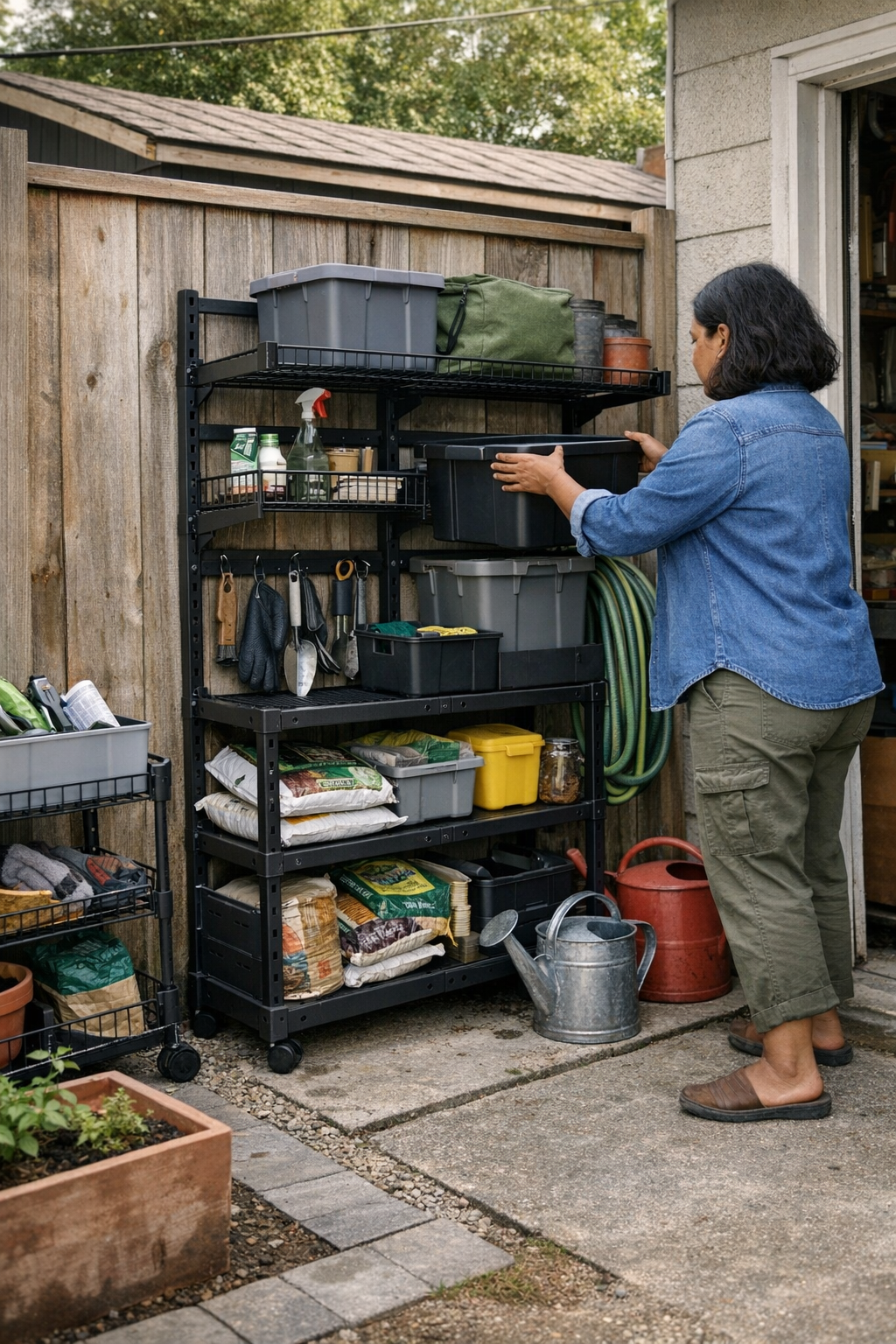
There’s a familiar disappointment in backyard organization: that crisp setup—bench, shed, or bins aligned along the fence—turns chaotic faster than anyone admits. The side yard finally looks clear, the patio edge seems under control. But a few weeks of rain, a spring gear swap, or a surprise delivery throws off the balance. Suddenly, the “organized” space is nothing but a slow obstacle course, one bag of soil or jump rope away from complete overflow.
When “Organized Enough” Fails: The Quiet Friction Behind Fixed Storage
Rigid storage units always promise relief. And at first, they deliver: a wall of bins, a big shed, a neat row along the garage. Then the first cold snap hits, and boots pile up against jammed doors. The gardening bin, already tight, becomes a jumble—hand rakes on top of gloves on top of tangled hose. Suddenly, every simple walk to the back gate means skirting a heap of helmets or shifting a toolbox just to get out.
“Good enough” quickly becomes too cramped to move through. What should be a one-minute grab-and-go turns into squeezing past bikes tilting into the path, or stacking bins on top of each other to dig out the one trowel you actually use. The clear walkway is a faded memory. More stuff lands in the open because there’s no way left to tidy up fast. The more you use the space, the messier it feels, until “resetting” means moving half the shed just to close the door again.
The True Shape of Shared Outdoor Storage
No real outdoor zone has one purpose. The side passage by the garage? One day, it’s for yard waste; the next, it’s the home for soccer nets or a box of leftover bricks. New gear—borrowed ladders, kids’ toys, a bag of compost—gets wedged into whatever corner is emptiest. Each arrival disturbs what little order you had, and before long, a single use means wrestling past unrelated gear just to get anything in or out.
Fixed setups never absorb these weekly surprises. Instead, they hide off-season stuff out of reach and convert once-clear corners into catch-all piles nobody wants to sort. The trouble always shows up in the way you move:
- Unloading every other bin to reach one tool you use every day
- Returning a broom, then finding its space already swallowed by bike pumps and cones
- Changing your path because garden shears now live in a shoe pile by the back step
Resetting stops being a quick pass and becomes a real project—a chore you put off until you’re boxed in by clutter, again.
Flexibility in Practice: When Storage Stops Fighting Your Routine
The answer isn’t more storage—it’s a setup that can actually shift along with your routine. Modular shelves adjust for new buckets. Hooks slide as the kids’ gear rotates. Bins can be swapped, baskets can appear or disappear, and nothing’s locked into a single “right” spot.
Consider one notoriously jammed side yard: a wall-to-wall shelving unit meant to tame the chaos. In reality, boots sprawled underfoot, and any attempt to wheel out the mower meant shoving bags off the walkway. But when the solid shelves were replaced with adjustable wall rails and open storage, the whole traffic pattern changed. Tools went up on the wall at the right height. Toys moved as the season changed. Returning anything didn’t block the next task; even on busy days, the overflow never overwhelmed the path.
Shutting Down Overflow Corners and Shuffle Traps
When the storage is inflexible, dead corners fill up quick—plastic tubs hidden under benches, stray gloves by the shed, “stuff puddles” that only get cleared after weeks of stepping over them. With a flexible approach, when camping gear or a stack of balls starts to overflow one spot, you can simply shift hooks, bump up a shelf, or bring in a bin. The storage grows or tightens up as needed. Resetting stops being a forced overhaul—now it’s a matter of moving one piece instead of unstacking the whole wall.
Season Change: The Stress Test for Every Setup
No storage system takes a beating like it does when the season flips. Spring rains in, and suddenly the snow gear once buried in the back is blocking all the rakes. Summer water toys, ignored since September, show up again and edge out whatever you need for garden work. The “out of sight” logic collapses—what worked last month is now exactly in your way.
Classic example: neat bench along the fence, fine in May, but by June, overrun—soccer balls, planters, and garden tools heaped in, nothing easy to grab. In one small yard, every tool run meant unloading random balls and flower pots stacked on top of the gear you actually needed. A simple swap to a rail-and-hook wall system solved the daily battle. Suddenly, tools hung in view, balls floated out of the walking path, and there were no longer any mystery piles lurking in the corner. The space adjusted itself, not the other way around.
Small Fixes That Rewrite Daily Use
Flexible storage doesn’t mean a huge rework. Take the bin you always use—a black hole of boots and garden tools that’s shoulder-deep and never truly empty. Raise a shelf. Move the tools onto the wall. That single change clears ankle-high clutter and lets you see what’s actually available before anything piles up again. Now, when a soccer game ends and muddy shovels come back all at once, putting things away becomes fast, not another Tetris round you dread.
The Real Test—Does Your Setup Keep Up?
If you’re forced to reshuffle boxes, balance bikes in doorways, or set aside time every month for crisis-level cleanups, your storage isn’t matched to reality. Rigid setups only behave if nothing ever changes—and real outdoor use is nothing but change. Weather, hobbies, growing kids, spring projects: the space is only as useful as it is adaptable. Flexible systems offer less time wasted on resets and more days where clean-up is almost automatic.
What Practical Gains Actually Look Like
- Vertical wall storage reclaims the floor—noticeably, not just in theory—so you can actually walk through day after day.
- Hooks, rails, and shelving that move by the season mean you can adjust in minutes; no more putting off fixes for “later.”
- Bins grouped by actual use make daily gear grabs fast—no more endless sorting for a lost tool.
These aren’t perfect fixes—awkward corners never disappear—but the daily struggle fades. Floor clutter stops building up overnight. Reset flow speeds up. Outdoor life feels workable instead of work. What matters isn’t a flawless look, it’s whether your storage bounces back from real, repeated use—without making every Saturday a cleanup marathon.
It’s Function That Lasts, Not Just a Tidy Snapshot
Plenty of backyards and side-yard strips look pristine for a few days, right after a fresh setup or a deep clean. The truth shows in the daily return—does the system move with real life, or fight against it? The difference isn’t subtle. When bins overflow and walkways narrow, it’s proof: fitting the space isn’t the same as fitting the way your family actually uses it. The best storage isn’t the biggest or the flashiest. It’s the one you barely think about—not because it’s invisible, but because it quietly keeps the chaos at bay, no matter what the week throws at it.
Explore practical outdoor storage that fits around real, lived-in routines at TidyYard.