
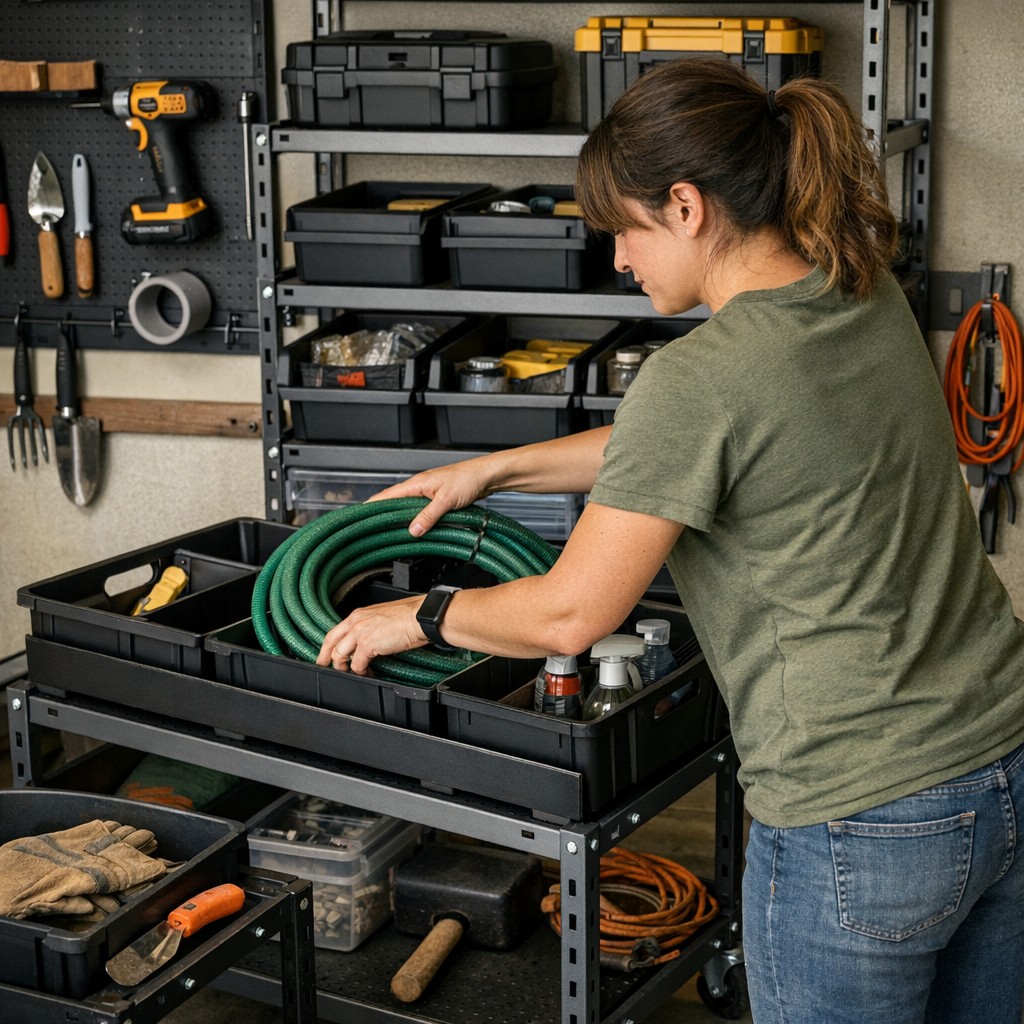
Every garage, backyard shed, and workshop starts with the hope that a clean layout will save your sanity—but most setups aren’t built for real routine. Install all the wall racks and modular bins you want; those crisp zones unravel within days. Carts drift into walkways, gloves end up teetering over the edge of a shelf, and one supposedly clear corner becomes a dumping ground for overflow. The moment actual daily use intrudes, you see how quickly “organized” turns into “organized-if-you-don’t-touch-anything.” And in the middle of this slow slide into disorder, it’s often the smallest piece—the lip, strip, or divider—that makes the only difference between constant reshuffling and a layout that holds up.
Where Order Breaks Down: Daily Routines vs. Real Storage
At day’s end in any tight garage, the flaws reveal themselves. The bins are labeled, sure—but one slapdash return and a bag of seed rolls halfway across a shelf. The coats, rakes, and hoses you assigned to those hooks have a way of creeping into neighboring zones. By Tuesday, the path you cleared now requires nudging a rolling cart aside just to open your car door. Those sharp storage lines fade, replaced by drift: sports gear crossing into tool space, scrap wood leaning into the aisle, paint trays edging their way under your workbench again.
This isn’t some one-off mess. Let it go for a week, and the system you celebrated on day one degenerates. Tools cling to the wrong bin, lightweight parts nosedive onto the floor, and high-traffic areas demand careful navigation around a slow-spreading pile of whatever didn’t quite fit elsewhere. The plan was crisp, but there’s no anchor—just invisible boundaries that mean less with every careless drop-off. Instead of “reset” being a five-minute fix, it becomes an hour of tedious sorting and backtracking.
Why Subtle Boundaries Change Everything
What separates spaces that work from ones that sag under use? It’s often a low lip at the front of a shelf, or an inch-high edge running along the bottom of a wall rack. Add a slim, flexible divider to a mobile cart, and suddenly gloves stay with gloves—screws aren’t migrating into the charger bin. Instead of scanning the chaos every time you reach for the right fitting, you know the spot will still belong to what’s supposed to be there. Movement is smoother, grabbing and returning becomes quicker, and you aren’t forced to slow down just to keep the zones from bleeding into each other.
Forget concrete barriers—locked-in boundaries turn a practical area into a rigid maze. The difference-maker is always that low-profile, easily-shifted edge: enough to catch a sliding tool, light enough to adjust in seconds when your routines shift. These aren’t about boxing you in—they’re about keeping chaos from spilling over and letting your system absorb a little real-life mess without losing flow or clarity.
The Weeklong Test: With or Without Boundaries
Start with a typical wall: hooks on the left, bins in the middle, shelf at the base. For a day or two, everything lands close to its “home.” But then someone drops a hand spade with the cleaning rags. Coils of extension cords slip across their area and block access to a charger. A pruning saw hangs half-on, half-off a rack slot, meaning you need two hands just to get the tool you actually want. Busy hands, tired eyes, and rushed routines—these let tiny slips stack up until traffic jams block the path and overflow piles in the one corner you need clear.
Now add a low edge to that shelf, a couple drop-in dividers to bins, and see what changes. No more hoses sliding down to the floor or hand tools sneaking into unrelated storage. Push a rake back in a hurry—it stops just where it should. Overflow still happens, but it’s capped, not cascading into the next zone. Midweek reshuffles shrink to a two-minute sweep, not an hour. Those early morning grabs don’t come with a tangle, a topple, or the need to move half a cart just to get outside.
The Real Cost of Chaos: How Blurred Lines Slow You Down
Once zones smear and floor space clogs, every move gets harder. Shifting carts just to clear the route, reaching around a stubborn cabinet edge, or sidestepping rogue gear turns the easiest routines into mini-detours. One high-traffic shelf that lets items wander will jam your whole reset flow. A once-open wall becomes dead space, blocked by overflow. And the time you carved out for the work itself gets eaten by the endless reshuffling of items that keep abandoning their “homes.” The space fits on paper—but in practice, you’re wasting time and energy fighting against your own setup.
Spotting Trouble: Signs Your System Needs a Boundary
- The cart you shuffle aside every evening just to keep the walkway passable
- One shelf or wall zone always overflowing, swallowing up neighboring bins
- Loose parts and lightweight tools dropping to the ground instead of staying put
- Zone drift—spaces that start distinct but blur together by Friday
- Resets getting slower, with “missing” items and more mess to sort every week
If you’re nodding along, a boundary or two—just enough to hold the line—could mean the difference between routine flow and recurring frustration.
Designing Boundaries That Actually Help
Not every boundary works. The right ones are quick to adjust, simple to remove when needed, and subtle enough to keep items contained without boxing you in. Go too tall, and you’ll struggle to load and unload; make them fixed, and your system can’t evolve. An ideal edge holds gear in its place but disappears the moment you need to rework your setup—whether that’s for a new season, a new project, or simply because your routine changed.
Organize for Living, Not Just Looking Neat
A space that simply stores things but disrupts your flow isn’t organized—it just hides the chaos until you need to work. True order bends with your habits. It makes moving, returning, grabbing, and resetting faster and less frustrating. Smart, physical guides absorb the mess of daily life, turning the busiest work zone or backyard wall into an area that works week after week—not just five minutes after cleaning. Imperfection is real, but so is a zone that actually stays useful once you walk away.
Get modular storage solutions made for real-world use at StackNest.