
If you grind, sand, cut, or finish in a workshop, you know the drill: Floors swept, surfaces wiped, tools put away—by all appearances, the shop feels clean. But barely a week later, you run your palm over the bench and catch that stubborn film of dust. Corners have that telltale powder. Cloths pick up streaks. Even with the most obsessive cleanup routine, fine debris worms its way back in. Again and again, your projects suffer—coating turns streaky, sanding grips uneven, grinder bits start to labor mid-run. The gritty truth? More often than not, the simplest fix is right above your head: the fan that’s just out of place.
The Hidden Complication: Misplaced Air
No one blames the fan at first. After early sanding rounds, the air looks clear. Maybe the sander glides, the drills run smooth, your finish looks perfect. But after half a dozen cycles, those little signs return. The sander starts to catch. Brush bristles pull up dust where you just wiped. Varnish flashes with pinprick grit; drill bits come out less crisp than before. Every round seems to need more force, more finesse, more patience—while the air still looks okay. Behind the scenes, a misplaced vent or extractor lets the finest debris escape. What you don’t see builds up, quietly sabotaging control and tool performance every time you reach for them.
That creeping micro-dust isn’t just cosmetic—it’s the enemy of smooth workflow and sharp results. It drains your effort, leads you toward needless troubleshooting, and slowly steals energy from your best-run shop.
Airflow Where It Matters Most
What actually changes the game? Position your fan or extraction right where work happens—directly above the sanding, drilling, cutting, or finishing zone. If the vent lines up with the exact spot where dust or vapor rises, every session gets cleaner by default. The extraction sweeps debris before it drifts. Saws cut with less drag. Sandpaper lasts longer. Your finish starts pristine and stays clear, even after several passes.
This effect multiplies in dedicated shops where most work happens on one bench or panel saw. Even a fan a meter off to the side lets dust carve out invisible drifts and corners, only to float back or embed on the next pass. The extra friction isn’t obvious on day one—but at week’s end, after a series of routine projects, it’s the difference between surfaces that glide and tools that start to choke.
How a Meter Makes or Breaks the Routine
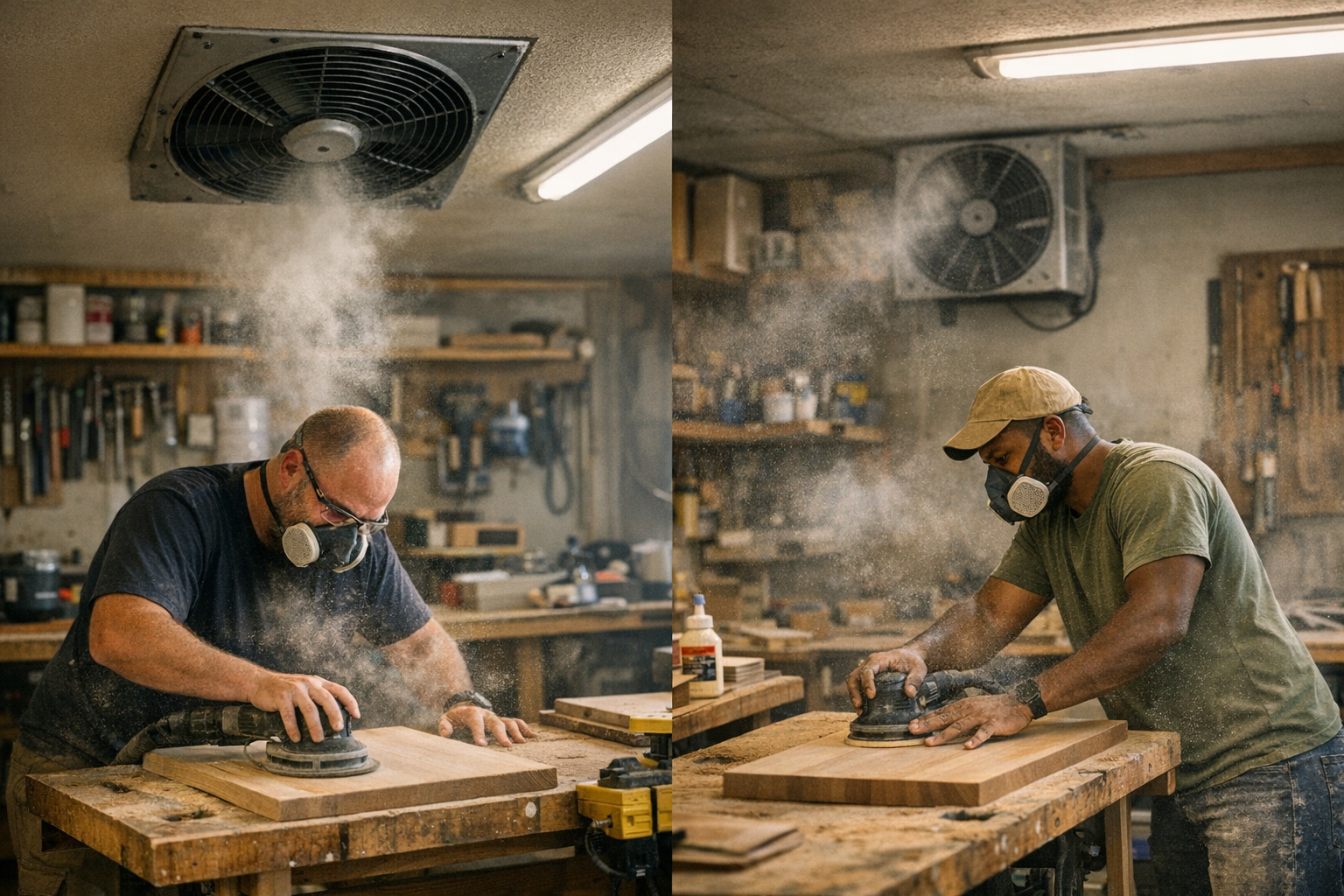
Imagine two nearly identical shops. Both run pine panels through sanders, apply finishes, swap out bits and blades on a set order. One key difference: The first has a fan straight over the workbench. The second has the same fan, but a meter to the side.
- With direct exhaust, dust gets snatched away at the source. The sander needs less pressure. The drill bites clean and fast. Every finish goes down smooth, no stray grit. End-of-day cleanup means a sweep, not a second scrub.
- Just one meter off, dust lingers under the bench and along tool racks. Sandpaper picks up invisible grit. Fingertips pick up fine debris every time you reposition, forcing you to re-wipe before staining or fastening. Before you know it, you’re pausing mid-project to shake out masks, swap filters, or get new rags. Progress gets interrupted—by cleaning, not work.
That slight fan misplacement steadily compounds hassle. Each job creates a little extra drag, a slower tool, an extra cleaning break. Multiply that by each round, and you’re working harder for less precision and less satisfaction.
Do You Need to Reposition Your Fan?
The red flags show up in the middle of the job: finish that won’t lay flat, sander or grinder that seems to catch for no reason, drills feeling warmer in the hand. Fine particles coat even the best masks or goggles. Tack cloths go dirty before a full pass. You find yourself making one more sanding run, one more wipe, just to restore the finish you expect.
Real-World Fix: Simple Moves, Tangible Payoff
Last year, in a cramped garage shop, I tracked when and where airborne dust was most visible. It wasn’t hanging in the air hours after, but escaping right as I lifted the sander or grinder off a freshly prepped board. Rerouting the vent 1.2 meters directly above the sanding action, cleanup was cut down by two-thirds. What once took thirty minutes, now wrapped in ten. More than time: sandpaper needed less swapping, drill bits didn’t heat up as quickly, and my hands stopped picking up stray dust on every pass. Finish quality held up—even running three or four jobs back to back.
Try before you commit: Before locking in a new vent or fan, grab a shop fan or portable extractor and move it directly over your main dust point. Watch which zones stay cleanest, and use a strip of masking tape to mark the most effective spot. That’s where you’ll see the true difference—before drilling, cutting, or mounting anything permanent.
Extraction Precision = Better Tools, Better Work
Dialed-in airflow does more than clear the air. It helps drills keep their bite, blades maintain full control, and sanders run cooler and cleaner. Less invisible grit means cordless tools hold battery longer, and their vents—or your lungs—don’t clog halfway through a task. It’s a small adjustment for a concrete payoff: better control, less fatigue, longer accessory life, and faster, uninterrupted flow from start to finish.
What feels like a minor tweak—moving a fan less than a meter—directly shapes every pass you make and every result you get. The proof isn’t just in surface shine; it’s in how your tools sound, how your grip feels, and how your cleanup shrinks from a chore to a quick reset. Over dozens of jobs, you’ll see it: close enough isn’t nearly close enough.
Find practical workshop equipment and ventilation solutions at Gumboll.