
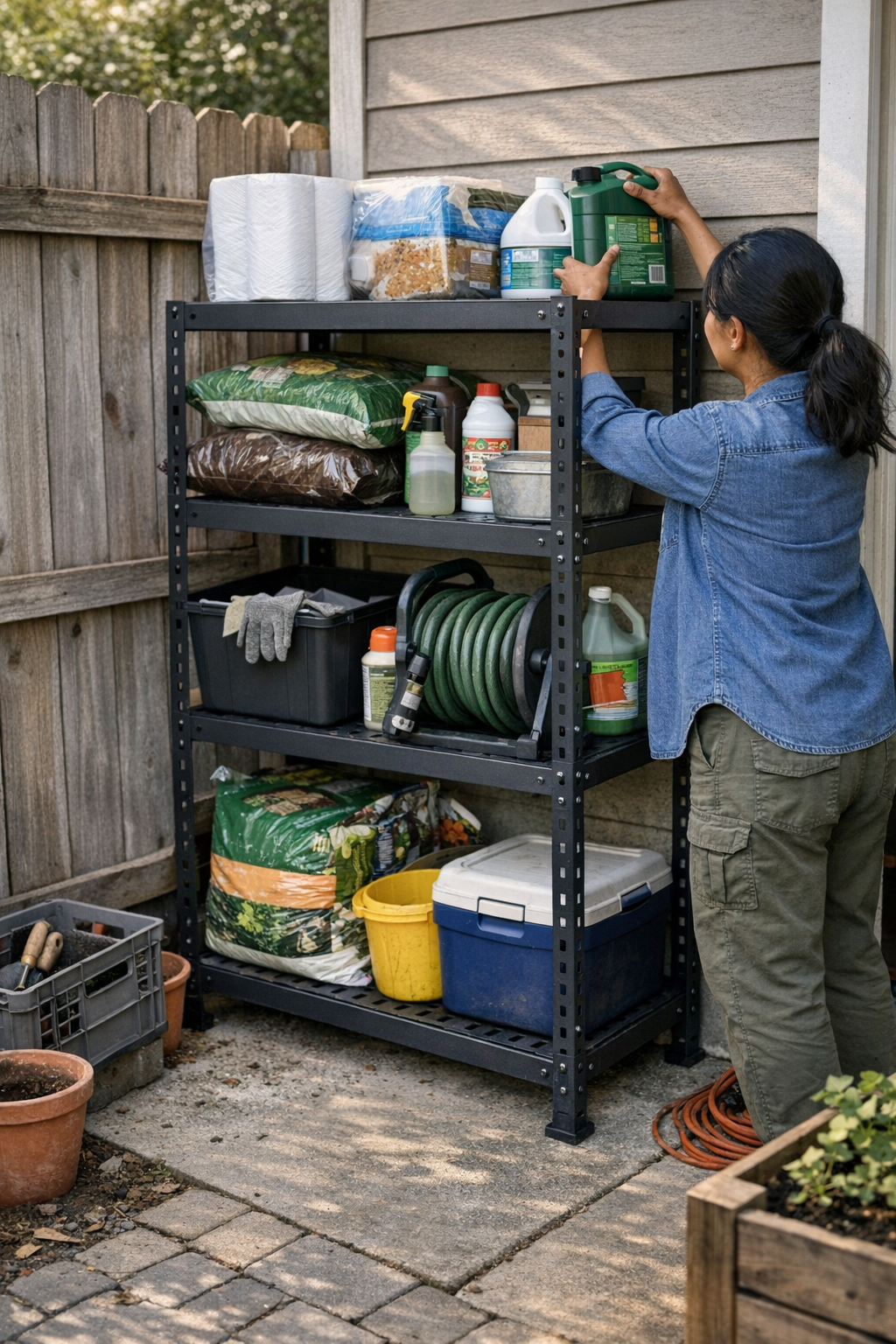
Most shelving breaks down not in a dramatic moment—but in the slow, daily tension between storage and use. The racks that look perfect when empty start to sag when the third case of paper towels arrives. Loading and restocking doesn’t reveal their flaws all at once; instead, shelves dip, categories blur, and overflow creeps forward until the original “system” is quietly defeated by real-life routines. An area that seemed organized by sight becomes a friction zone after a single grocery haul or big-box delivery. And no one wants to be the person rearranging spilled cleaning supplies wedged behind last week’s bulk buy.
From “Sorted” to Stuck: Where Bulk Storage Breaks Down Fast
Visit any high-traffic storage zone—mudroom cubbies, a narrow basement stretch, or the utility hallway shelf—and watch what happens after a busy week. Neat rows unravel into catchalls. The most common storage failures show up quickly, and often with three visible consequences:
- Bowed shelves under real weight: Stack up warehouse specials—detergent jugs, twelve-packs, bags of salt—and the midspan sags. The shelf holds, but every new box feels like a dare. Joint creaks become background noise. It never quite looks right again.
- Front-row crowding, blind-back syndrome: Everything ends up at the edge where you can reach with one hand. Less-used items get entombed at the back. They’re easy to forget and hard to retrieve without shuffling through a pile-up in front.
- Blocked access and drifting zones: When fits are tight or items overhang, users improvise—snacks end up next to fertilizer, toolboxes crowd next to boxes of cereal. Mistakes become contagious. The next person copying yesterday’s shortcut inadvertently pushes the whole area further into chaos.
Everyday Routines, Everyday Interruptions
Inside storage problems aren’t about spectacular failures—they’re about persistent, grinding slowdowns. You reach for the same laundry refill twice, not because it’s truly buried, but because it migrated behind a stack of off-season boots. The one shelf meant to hold extras becomes the home of expired batteries, random tape rolls, and last-ditch items dropped anywhere they’ll balance. The area may look generous in square footage, but awkward movements give away the real problem: sidestepping one shelf to get to another, stooping to dig out a package lost behind sagging bars, or abandoning an item because nothing fits smoothly back. By Wednesday, even a routine reset feels like a disruptive event—“just put it down for now” becomes the new normal.
Lightweight Looks, Heavy Frustration: The Underrated Weakness of Floor Storage
Initial appearances deceive. Floor racks lined against a wall seem ready—until a week’s worth of supplies lands. Stack heavier boxes and you notice it: a slight sag turns into a visible dip, bottles start to wobble near the edges, placing a new load nudges others dangerously off kilter. Soon the most accessible edge becomes a traffic jam, while backup stock disappears into the unreachable back. Every retrieval risks a chain reaction of supplies shifting, and the logic behind the original setup unravels in shared use. The result: the area crowds at the front, categories muddle, and the confidence you had in your “sorted” space evaporates by the third restock cycle.
Shared Zones, Shared Chaos: Mudrooms and Utility Corners in Practice
No mudroom or utility area belongs to just one person. Bulk dog food, an overflow of cleaners, someone attempting to wedge another pack of paper towels into an already-bending shelf: every contributor unwittingly tests the weakest point. Eventually, that corner becomes the designated overflow—an unspoken signal that “anything goes here.” Once one return is awkward, every other user follows suit. Kids and adults alike default to stacking wherever space is barely available; categories dissolve. By the time anyone tries to restock or clean up, backup items are either lost to the back row or doubled up at the edge, while the same congestion and reset burden lingers week after week.
The Reset Spiral: Why Instability Magnifies Mess
If a shelf gives way or blocks up after a handful of restocks, regular maintenance turns adversarial. Users skim from the top layer, avoid planned returns, improvise space, and gradually disconnect the area’s original logic from its daily use. This isn’t just untidiness—it’s a routine-breaking roadblock. The difference between a workable storage area and a frustration trap is less about total capacity and more about how well the structure holds up to unpredictable, repeated, multi-user demand.
Turning Friction Into Flow: Details That Make Heavy Duty Shelving Work
What actually stops this spiral? It’s not a generic “stronger” rack; it’s structural details that respond to real-use pressure. One inside-storage fix meant swapping in a shelf with thick-gauge steel and actual welded crossbars—no more imaginary support lines. By leaving at least a five-inch clear strip at the front, every item got a usable path in and out. Shoving faded as a habit. Even family skeptics started returning things to the right zone, mostly because it took less effort to do things right than to improvise a fix. The system didn’t just look tougher; it changed the flow and the fallback behavior in real time.
- Reinforced shelves with real crossbars—no mid-span slump, even under deep or heavy loads.
- Medium-depth design for visible, single-row access—so no hiding lesser-used items behind a bulk wall that blocks retrieval.
- Open clearance at the front edge—making natural return paths possible and stopping “dump wherever” before it starts.
These tweaks may look minor on a product spec sheet, but you notice when reshuffles disappear, battery boxes stop piling up at the overflow edge, and everyone—even the least-organized housemate—starts following the system because it’s actually easier than doing it wrong.
When Organization Holds Up, Routines Actually Get Easier
The difference between “looks organized” and “functions under stress” turns up after a few unpredictable weeks. A truly heavy-duty storage rack, with open retrieval space and visible zones, absorbs a flood of new items without buckling—and more importantly, it streamlines resets to a single, fast sweep instead of a dreaded overhaul. No setup is immune to clutter, but design that resists bowing, blocking, or bottlenecking keeps small problems from snowballing into big ones.
If you’re reassessing your own shelves, focus less on first impressions and more on what happens after the next big stock-up. Does your system still let everyone find and return items with minimal reshuffling? Or do you find yourself bending, shifting, and restacking day after day? The “hidden cost” of the wrong setup isn’t just wasted space—it’s wasted time, repeated frustration, and supplies lost to chaos. The right utility shelving turns pressure points into smooth routines, and that feel is worth keeping in the flow.
Explore more utility shelving options at Gridry.