
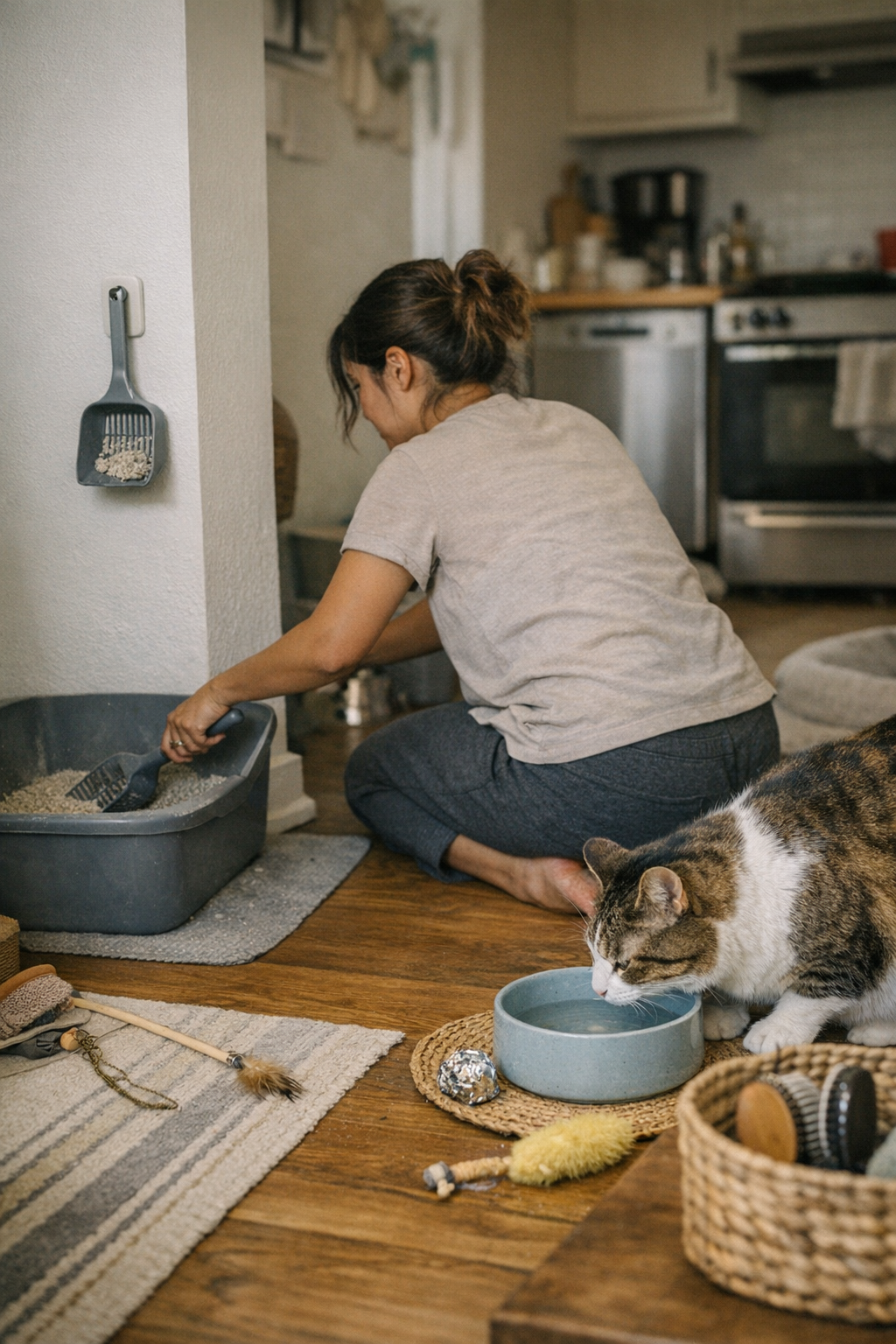
One central storage pouch for cat essentials sounds efficient—until real routines collide. The pouch stays zipped and out of sight, and for a day or two, everything looks easier: clean visual lines, nothing scattered. But as soon as you’re running late, refilling a water bowl, and spot a trace of litter tracked into the hallway, friction hits. What feels “contained” on day one becomes a source of frustration by mid-week. The flaw isn’t the look; it’s that the one-pouch setup can’t keep up with repeated, overlapping indoor-cat routines. Every feeding reset or cleanup exposes what’s missing: your tools aren’t where you actually need them.
The Illusion of Easy Access: When “Organized” Slows You Down
On paper, a single pouch seems like it should keep chaos in check. Litter scoop, grooming brush, wipes, a few favorite toys—packaged up, stashed away, and theoretically always ready. That sense of calm lasts only until routines stack up. When you clean up after breakfast and refill the water, but the pouch is across the apartment—or yesterday’s supply didn’t make it back at all—the setup becomes a small daily obstacle.
Real overlap exposes the weakness. You’re kneeling by the litter box and realize the brush you meant to grab is still by the couch. Or you refill the bowl, spot a mess, and the wipes are in the pouch… that you set down in the bedroom. Visual order quickly becomes a hunt for missing basics—a system that answers yesterday’s needs, but not this morning’s pressure points.
How One-Pouch Simplicity Unravels: Scenes from Real Indoor Cat Routines
Searching for What You Need—Again and Again
Every reset, the same pattern unfolds. Maybe the litter scoop got left by the kitchen trash. Elsewhere, the brush vanished after a quick session in the bedroom. Open the pouch—sometimes it’s full, other times it’s nearly empty because supplies scattered wherever they last got used. Suddenly, paw wipes have drifted to the window ledge (where your cat sunbathed), a toy blocks the path to the litter mat, and what looks organized devolves into a cycle of searching and double-backing—especially when you’re hurrying out the door.
The tidy promise quickly stumbles over lived reality. “Where did I put…?” becomes a recurring, silent frustration, not just with one item but with half the daily routine. Even a small, misplaced tool can stall a whole process, stretching a minutes-long reset into a round of retracing steps.
Overlap Means Extra Steps—More Than You Bargained For
The drag isn’t only about the extra walk—it’s about being forced to break routine. Kitchen as litter zone, living room as feeding and play space, bedroom as grooming spot: moving between these with a pouch in tow is never as seamless as it sounds. When the pouch’s “home base” is in the wrong room, you can’t just grab and go; you pause, detour, and lose momentum.
Even in a clutter-free room, essentials start lingering where you last used them. Toy mice collect at the water bowl. The scoop sits out “just this once” by the litter box, then gets forgotten there. The pouch’s neatness starts to feel like a mirage—a reset that takes more steps, not fewer.
Routine Friction: The Hidden Cost of “Put Away”
The one-pouch habit creates hidden tension between visual order and how indoor-cat care really works. Cat items don’t travel together. The scoop wants to stay near the box. Brushes drift to where your cat relaxes. Toys scatter further with every new play burst. Each tool’s “official” home is rarely where you actually reach for it.
Routine breaks down when each item must be returned to a pouch that never follows the real routine. By Friday, the pouch is half-empty, spare wipes are perched by the feeding mat, and you end up re-hunting everything, rethinking your cleanup flow midstream. “I’ll just put it away later” becomes everyday noise—and eventually, postponing chores that demand too many return trips feels inevitable.
What Looks Neat Can Feel Slow
A spotless-looking home isn’t the same as one that works under real pressure. A single storage pouch solves aesthetic anxiety, not routine speed. Delays add up when tools aren’t instantly at hand; cleaning, feeding, or a quick play reset gets stitched together by what’s missing, not by what’s in the pouch.
Overlap Points: Where Room Function and Cat Setup Collide
Rooms serving double duty bring the weakness into sharp focus. A living room that doubles as play space means catnip toys migrate under chairs and wipes drift to the TV stand. The kitchen’s corner houses litter, but the pouch never follows you there unless you remember. Hallways become drop zones for items used mid-step and never put back. The more you try to centralize, the more everyday realities scatter supplies—and with every overlap, the chore takes longer and feels less manageable.
Pressure Points: When “Where Is It?” Becomes a Daily Problem
This daily shuffle isn’t just about forgotten items; it’s about routines breaking down because storage isn’t mapped to real pauses. If you’re constantly setting aside your cat’s care to “fish out” a tool, the system is signaling its own failure. The problem isn’t that your home isn’t organized—it’s that the organization isn’t where the work happens, and as chores overlap, the delays multiply instead of shrinking.
Rethinking the One-Pouch Reflex: Matching Storage to Routine
To fix the daily stumble, storage needs to match use—not just tidy up after. Map each tool to where hands reach for it: a scoop on a visible hook beside the box, brush in a shallow tray by the window seat, wipes always within arm’s reach of the mat. The old pouch can store backups or seasonal extras rather than the core daily essentials. The setup becomes durable under stress, not just presentable on inspection.
Placement Makes the Difference
Fine-tuning location is what changes the routine. The brush genuinely close to your cat’s rest zone gets used more often. Wipes next to the bowl mean fast corrections, not delayed wipe-downs. The time you save isn’t because you worked harder—it’s because you stopped looping the same path, searching for what should already be at arm’s length.
The “edge of the water bowl” stops being a clutter zone because every item has a friction-free home—not just a visual finish line. Resetting the room gets swifter, not through an overhaul, but by making each motion count. The friction point isn’t organized away by a single, central pouch; it’s engineered out by letting the storage pattern follow the way the day actually moves.
“Looks Fine” vs. “Works Right”: What Matters in Repeated Use
No indoor-cat setup looks untouched after a few rounds of real life. Mats drift, toys migrate, throws slide. The real test isn’t how smooth things look—but how little friction it takes to reset: can you restore calm without hunting for stray tools or doubling back across rooms?
One-pouch storage sounds tidy in theory, but as routines repeat, it pushes daily care slightly further out of reach. Real improvement appears when storage matches the breaks and pauses in actual use. A “liveable” routine isn’t perfectly neat—it’s one that recovers fast, forgives lapses, and makes care feel easier every round, not harder.
When the pouch holds only what truly travels, and the tools you use daily stay right where you need them, your setup becomes less of a reset project, more of a support system—ready when routines overlap, not just when the room is on display.
Find practical solutions for repeated indoor-cat routines and storage at StillWhisker.