
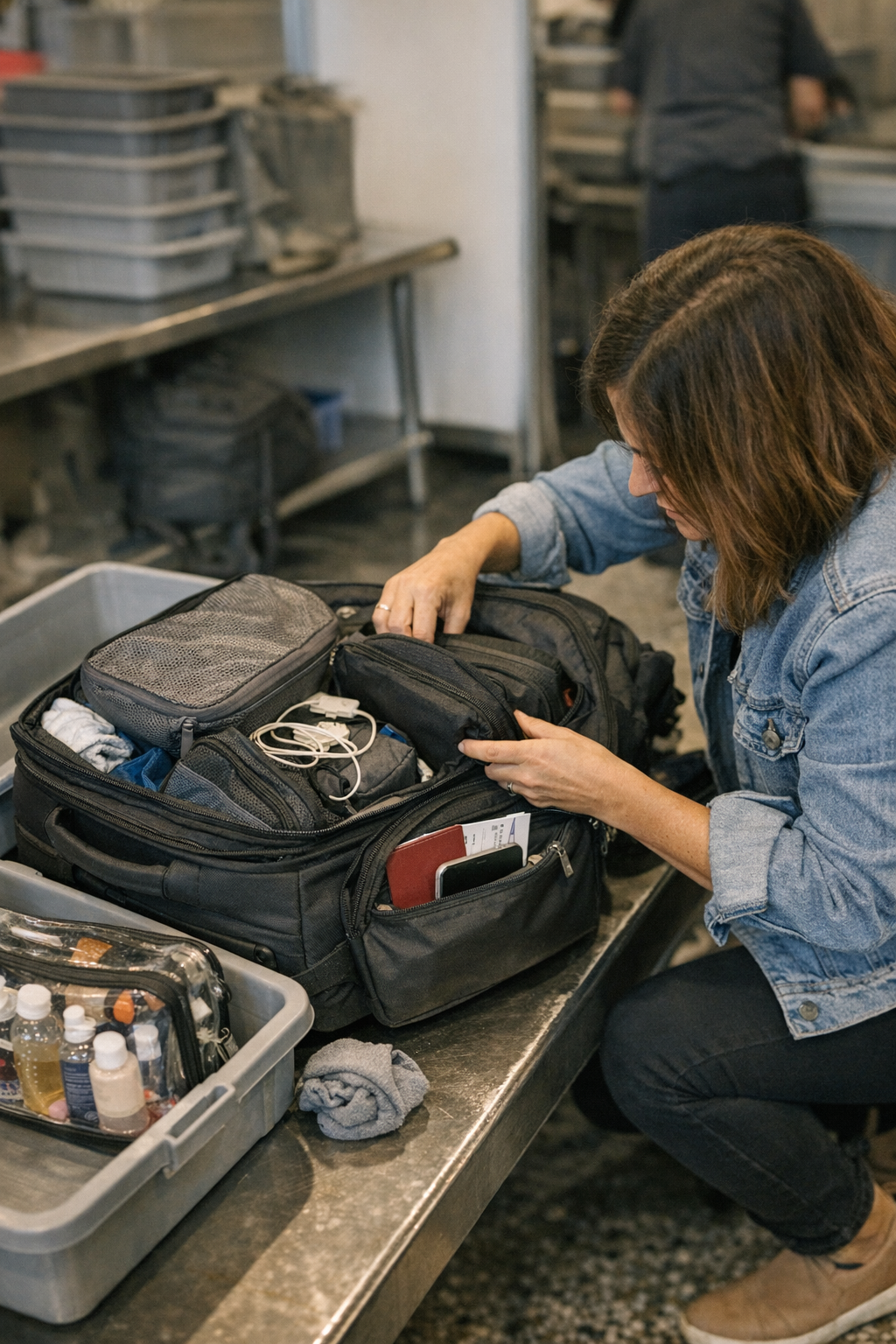
The carry-on that looks sharp and meticulously packed on your hotel bed can quickly become a weak link once you hit your second airport in a day. What feels efficient—stacked cubes, color-matched pouches, everything secreted away—often collapses at actual checkpoints: you’re stalled at security, knuckles deep in the main compartment, digging past three layers just to find your passport. That impressive hotel-room layout rarely survives the first boarding line, where every extra unzip, pouch-shuffle, or lost document not only slows you down, but leaves you blocking the line and cursing your packing logic.
When Visual Order Slows Actual Movement
It’s tempting to trust a bag that looks organized: rows of zipper pouches, precision-folded clothes, tech cords in their own sleeve. Laid out, it gives a sense of being ready for anything. But the friction appears as soon as you leave the controlled packing zone. Real travel exposes the gap between tidy arrangement and quick access—especially when you hit a fast-moving line or your connecting gate flashes an urgent update.
Repeated retrieval reveals where these setups break down. Needing your ID means unzipping three barriers you’d zipped with care that morning. You’re in the tray area, suddenly repacking on a lip that barely holds your bag, flanked by impatient travelers. Suddenly, that smartly nested cube is an obstacle. You pull one pouch, another shifts sideways, and your carefully built order unravels fast. The tidy stack becomes a clumsy search game—never obvious until you’re the reason the line stutters.
Packed to Impress vs. Packed for Uninterrupted Movement
Organization that photos well can sabotage you in the churn of travel. The look of control vanishes during the small crises: boarding lines that lurch forward, bins that close faster than you expect, the double-check for documents just a few feet from the gate. Every time you need a charger or wallet mid-line, you’re forced to trigger an unintended domino effect—grab two, maybe three containers, now repack them while one elbow keeps your spot in line. Worse, every “quick” access risks a misplaced item in the rush, teeing up hassle at the next checkpoint.
Compartmentalization kills visible mess, but it’s notorious for slowing the very actions you’ll repeat most. A setup that demands four steps for what should be muscle memory does no favors mid-transit. Once you’ve broken the order during a rushed repack, it rarely resets. Instead, each stop—security, boarding, customs—becomes slower and clumsier, even as your setup still looks ordered from above.
Noticing the Real Signs of Setup Drag
The cracks in your system show up in ordinary, repeated pain points:
- Your passport requires two nested-unzip moves—just when your place in the line is shrinking.
- Cords coil around documents, forcing an on-the-spot untangle with TSA bins stacking up.
- Packing cubes designed for control split up pairs—making every repack a new puzzle mid-trip.
- You’re halted at the airplane aisle, weighing whether you can dig for what you need or if the shuffling will set you back in the boarding bottleneck.
Layered Organization: The Hidden Cost of Control
Every pouch and cube promises order—until the fifth time you need the same item, and the “system” delivers new friction. Miss an essential on the first grab, and now it’s a full bag dig, main compartment splayed open as you fish past layers you once admired. With each checkpoint, that tightly packed arrangement becomes less a sign of efficiency than a routine interruption, especially when surrounded by travelers flowing past without a pause.
It’s a familiar pattern for anyone who has left for the airport with a bag that feels impressively secure: the first security stop, your setup demands a mini reset as soon as you reach for ID or boarding pass. The bag teeters on the tray, unzipped; items shuffle out of sequence. The odds you’ll repack in perfect order drop—and your next checkpoint will probably cost you another minute, all because “order” meant hiding what you need most under layers you don’t.
When Pretty Arrangement Clogs Real Retrieval
Clever layouts show off well—aligned pouches, sleek zippers, every type of item corralled. But on your third retrieval in under an hour, what matters is whether your hand lands right on what you need. With each added organizer, the chance for slowdowns grows. It’s rarely an issue—until access comes with pressure: the line moving, an announcement overhead, that friction building with every missed reach.
When Streamlined Access Outperforms the Illusion of Control
Flawless order is overrated compared to setups built for real movement. Progress comes from identifying what actually gets reached for again and again—passport, phone, charger, boarding pass—and making each instantly accessible. Placing those items in a quick-access sleeve or external zip panel, even at the expense of some “perfect” interior order, transforms the travel rhythm. Less choreography, more automatic grab-and-go.
In practice, each step you can eliminate reduces friction. Shifting from multi-layer unpacks to a single pull for must-have items—no matter how chaotic the rest looks—makes a bigger difference than most new packing tech combined. You retrieve without ceremony, reload without hesitation, and sidestep the slow creep of minor irritations that add up with every checkpoint, boarding, and repack cycle.
How a Smarter Structure Pays Off in Plain Travel
The payoff feels real in regular travel frictions:
- At security, a passport always comes out of an outer sleeve—never a buried pouch.
- For boarding, you manage phone and ID in one reach—free from the distracted, one-handed rummage that signals a clog in your system.
- On arrival, essentials return to their pocket faithfully, not lost in a swirl of reorganized cubes or half-zipped pouches.
- During seat entry, you pull headphones, pen, or snacks in a move so smooth you barely pause, leaving your neighbors undisturbed and your aisle unblocked.
Choosing Setup That Lasts Beyond First Impressions
Packing for order often reveals its limits by the third checkpoint or after a single forced repack. Real improvement doesn’t mean tossing organization, but rebalancing where fast access matters and giving high-frequency items their own fast lane. You let go of a little surface perfection to gain real, repeatable efficiency—not just at first use, but every time movement ramps up.
If your current layout forces repeated two-handed grabs, unlocks the wrong zippers, or makes you repack on unstable surfaces, those tiny problems compound until a minor delay becomes a routine drag. The best carry-on setups aren’t just tidy at rest—they deliver under motion, checkpoint to gate to seat. Stay alert to the friction, and tweak until your bag moves as smoothly as you try to travel.
Explore practical carry-on upgrades at CarryOnSupply.