
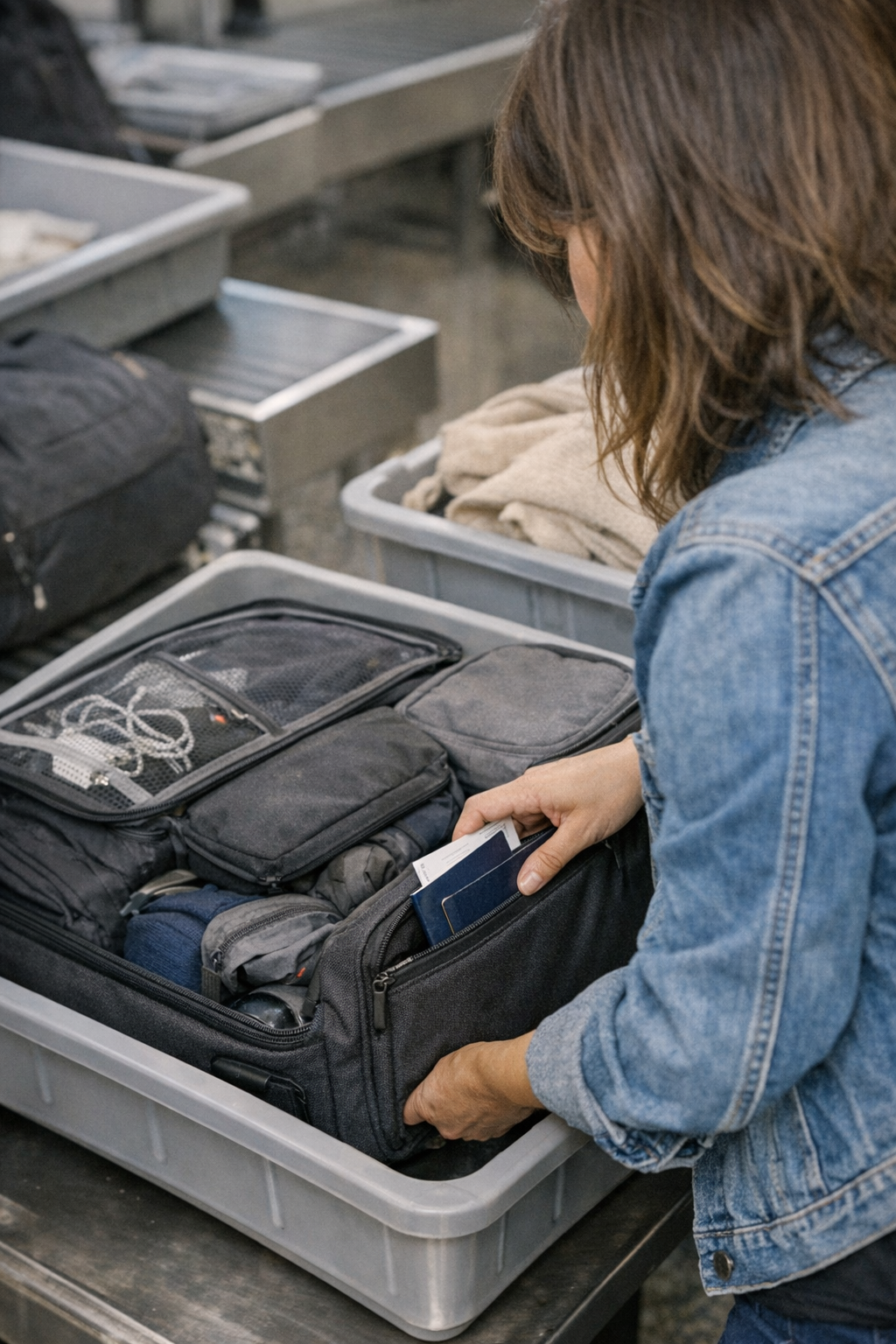
The difference between a carry-on that looks organized in your living room and one that actually keeps up with you at the airport is immediately obvious the first time you fumble for your passport at a checkpoint or get blocked by a tangled charger while the line compresses behind you. Neat cubes, perfectly stacked pouches, color-coordinated pockets—none of it matters if you’re forced to unzip three sections just to find your ID under pressure. That friction isn’t theoretical. It shows up every time airport security lines surge or a boarding gate check returns out of nowhere, revealing the limits of setups that felt flawless at home.
When an “Organized” Carry-On Slows You Down
At home, every item feels accounted for, pouches stack precisely, and there’s comfort in seeing a clean packing grid. All of that order falls apart when airport routines demand fast, blind access. The real test comes the moment you dig for headphones as the boarding line inches forward, or you panic-scan your bag for your ID at a checkpoint.
Layered organizers and stacked cubes feel efficient in theory, but in motion, they become speed bumps. Shared pouches—passport pressed up against device cords—mean repeated untangling. Every access asks you to break the system you hoped would keep you on pace.
The Real Cost of Overlapping Packing Strategies
Adding more organizers rarely solves the real problem. Visually, more layers suggest order, but travel exposes their weak points fast. Blocked zippers, tight wedge-pockets, and zippered sections that require a full unpack just to reach lip balm—every snag adds cumulative delay. Grabbing one thing means rearranging three. Under airport pressure or fatigue, each overlap turns into a new obstacle, compounding frustration instead of reducing it.
On-the-Move Friction: What Actually Happens
Picture this: You feel ready in the security queue—until the tray lands in front of you. Suddenly, your boarding pass is buried under a hoodie, passport jammed behind your backup battery, and your headphones hooked around a charger pouch. Three zippers now stand between you and the scanner. Structure that holds up when still collapses the moment you start moving.
Small Delays, Multiplying Stress
Airports don’t let you pause and reset. You pull out your e-reader in the crowd, toss it back in “for now,” and seconds later, a second security check means diving into a repacked, overstuffed pocket. The main compartment looks undisturbed—inside, you’ve started a cycle of tiny re-shuffles and lopsided cubes. “Organized” surfaces hide the reality: every small retrieval turns into a fresh mini-repack, adding micro-delays and repeating friction that builds as the trip goes on.
The Problem with All-In-One Outer Pockets
The slim outer pocket seems built for speed: just drop in everything you’ll need most. But once keys, charger, snacks, boarding pass, and passport start layering, it becomes a pocket of mutual blockage. The third reach-in is usually a mess—cables snag, slim documents disappear behind bulk, and even minimal contents force you to dump the pile just to find a card. Each retrieval gets slower, precision replaced by a scramble while the line waits behind you.
Finding a Flexible Travel Rhythm
The solution isn’t tighter cubes or prettier layouts. What consistently works is structural separation—single-purpose pockets for documents, shallow slots for critical items, organizers that let you grab by feel without visual searching or deep unzipping. Dedicate a top-access pocket to your passport and boarding pass, and repeat retrieval becomes mindless. Over a full trip, that’s minutes reclaimed—and tension sidestepped—every time a new checkpoint or gate call appears.
Retraining Your Hands for Blind Access
Real carry-on improvement means reaching by touch and returning items to place automatically, not stopping to check that every pouch is zipped or that nothing has collapsed. Once hands know where each essential lives—boarding pass, cable, balm—you recover time and cut stress not by packing “neater,” but by making the movement from item to item uninterrupted, even after hurried handling or turbulence resets your bag’s interior.
How Quick Fixes Actually Play Out
- Passport pocketed with device cords? Each document check comes with an untangling break, slowing boarding and triggering a cascade of repacking.
- Multipurpose pouches holding both documents and comfort items? Retrieval means emptying more than intended—often onto the airport tray, with strangers watching.
- Compression cubes for everything? Order on the outside, but every in-transit access becomes a slow unzip and repack, bottlenecking movement when you should be stepping forward.
A Real-World Adjustment That Changed the Flow
One practical fix: shifting passport and boarding pass from a deep side pocket to a shallow, top-access zip slot. Instantly, security and boarding drop from repeated unzips to a single motion, and hesitation nearly disappears. Items fall back into place—sometimes without even looking—so even after long hauls and gate changes, you rejoin the flow rather than fall out of step. The drag of lost seconds fades, replaced by a carry-on that quietly keeps pace with you, not against you.
Repacking Burden: The Hidden Cost of Over-Structuring
The “perfect” packing system is a false win if it forces full resets after every retrieval. If you’re pausing to realign a collapsed pouch or shuffle misaligned stacks just to restore order, the visual neatness is no comfort. True improvement is a setup that lets items be returned blindly—no visual check, no reset—resuming movement as soon as you’re done, not turning each retrieval into another round of forced organization.
Practical Takeaways for Smoother Carry-On Travel
- Designate a document-only pocket. Never pair travel ID, boarding pass, or tickets with cables or comfort items, no matter how orderly it looks.
- Separate tech, snacks, and comfort by feel, not sight. Use pouches or slots you can access blind—that aren’t buried, blocked, or sharing space with essentials.
- Reserve cubes and compression for bulk storage. Use them for backup clothing or one-time-access items—not for essentials you need during every transit segment.
The Real Test: Multiple Airport Cycles
The real worth of your packing setup isn’t its at-home photo—it’s how you move on your third or fourth airport run, when the same small obstacles start repeating. If the same delays appear every time you reach for a document or try to repack quickly, your system is waving a red flag.
Category separation and dedicated, shallow-access pockets remove repeated stumbling blocks, replacing performance anxiety with a flow you can trust. When your carry-on lets you move, reach, and reset without interruption, it becomes an extension of your travel, not a source of constant management. Each adjustment that cuts friction turns organization from a static look into real-world function—one airport, one exit row, one tray transfer at a time.