
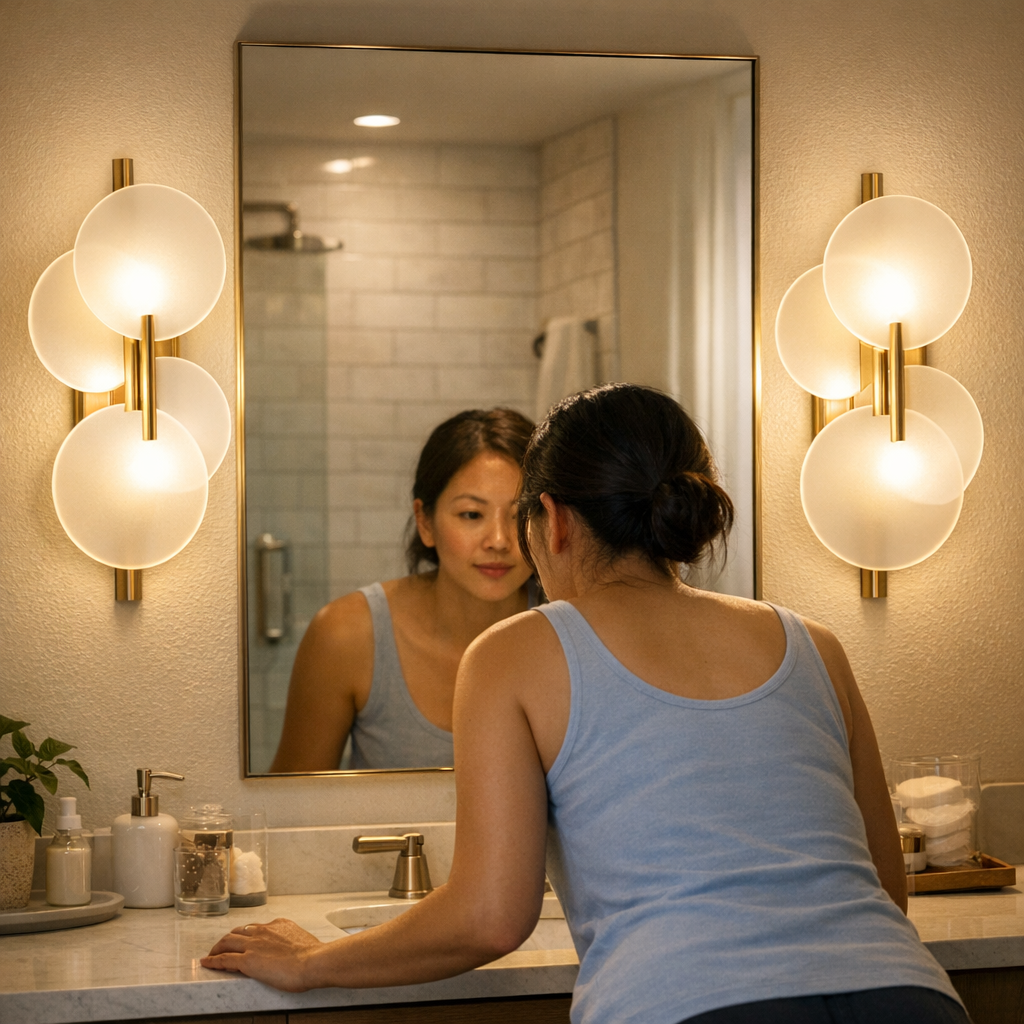
Most bathroom lighting fails not on the first day, but on the hundredth use. Step up to the mirror: the overhead bar looks clean, the room looks bright—not bad at a glance. But as you brush your teeth or lean in to shave, you squint against mirror glare, lose track of the sink’s far edge, and tilt your head to dodge a sharp reflection slicing straight across your line of sight. What was supposed to be better visibility is suddenly a daily obstacle. The light that promised an upgrade becomes a source of blurred outlines, awkward shifting, and searching for that one clear spot that never lasts.
Why Glare Becomes a Daily Problem—Not Just a Bad First Impression
The first days after swapping a fixture—maybe a flush overhead mount or a crisp LED bar—can trick you into thinking the problem is solved. The room pops, the glass gleams, and everything seems upgraded. Then real bathroom routines set in. You help a child reach the faucet and the mirror flashes a double image; you angle for a careful shave and a band of light lands right in your pupils. Instead of clarity, you inherit tangled reflections and uneven hot spots each time you move. The problem isn’t brightness, but misdirected light that creates new obstacles at every angle.
This isn’t a one-off irritation. Week after week, you find yourself contorting posture to escape the beam, delaying tasks for better light, or simply leaving the fixture off to avoid the headache. Gradually, basic routines grow inefficient—washing, grooming, even quick rinsing stalls as friction sneaks in. The inconvenience is rarely dramatic, but it is cumulative. Weak lighting structure turns into a pattern of missed details and slowed mornings.
Mounting and Placement: The Hidden Details That Fix (or Worsen) Glare
It’s not just about lumens or wattage. The position and support logic of every fixture—height, spread, and angle—control whether light works with you or fights the routine. Bathroom-rated fixtures serve a technical purpose in humid zones, but that’s not the whole story. Design and placement shape the experience:
- Fixture too close to the mirror: Your own light source becomes an enemy—reflected directly at you, it competes with the original, doubling visual noise right where focus matters most.
- Bad mounting height or angle: Even the “right” fixture can skim across the glass, spotlighting your eyes and leaving patches of harsh, unhelpful brightness instead of true, even illumination.
Busy mornings expose these flaws: two people crowd the sink, and suddenly everyone is angling for the “good” spot, chasing away glare instead of just using the room. The wrong placement turns quick tasks into small battles for clarity.
Common Setups: Why Single Overhead Fixtures Fail Routines
The streamlined promise of an overhead bar, flush ceiling mount, or centered LED seems simple: keep the sink clear, throw light across the whole worktop. But this setup breaks down the minute you try to use it for anything precise. That “crisp” new strip throws two bright streaks in the mirror, multiplying shadow doubles and drowning out the lines you actually need to see—edges of stubble, mascara, stray toothpaste drop. The more centered the bar, the worse it gets: light beams at your face, corners fall into gray, and the reflection never fully cooperates.
Typical routines make this obvious: someone leans in to inspect a blemish and gets hit by direct glare; another person resorts to moving bottles to find lost brushes hiding in patches the light never reaches. Even the neatest install leaves cable lines trailing across a wall or bundled under a shelf—tucked away at first, but catching the eye and adding small visual friction each day.
Living with a Subpar Bathroom Light: The Real Repeated-Cost
Weeks in, the limitations multiply. Children stand on tiptoe, dodging shadows that will not leave their faces. Adults wipe streaks from the glass edge they never clearly saw. The illusion of “brighter” disappears: you trade one frustration for another—now with more contrast lines in the mirror and missed spots everywhere else. What passes for a resolved setup in photos falls short every time the real-life routine demands clarity, fast cleanup, or simultaneous use.
Humidity, messy hands, and splatter only magnify every flaw. Wires once invisible slide into view near the sink, while mounting hardware draws focus instead of fading out. Not only does the space look more cluttered after a few weeks, but it also begins to feel harder to actually use—turning background support into a daily irritant.
A Small Change That Makes a Lasting Difference: Rethinking Fixture Placement
What finally broke the glare cycle wasn’t bumping up the bulb wattage, but changing where light meets the room. Swapping the overhead bar for a pair of wall-rated sconces, mounted about a hand’s width from the mirror edges, moved the light source out of the reflection and directly onto the face.
The improvement was immediate and practical: the sink and counter stayed evenly lit, no more shifting to dodge a reflection, and even on rushed mornings the mirror stopped flashing stripes at eye level. Mounting cables vanished below sightlines, and the “invisible” aspects of the install—hardware, supports, brackets—all finally stayed invisible. Small layout corrections did more for clarity and comfort than endless tweaks to bulb strength or fixture design ever could.
Real-World Tips for Better Bathroom Visibility
- Direct light toward people, not glass: Side sconces or wall panels just outside the mirror’s edge prevent the worst of cross-reflection and keep facial details visible, especially in shared use or quick checkups.
- Stick with support hardware made for bathrooms: Steamy rooms punish generic or makeshift setups—bathroom-specific mounts, secure cables, and protective housings last longer and reduce friction as routines repeat.
- Audit cables and corners after a week: Install that seemed “clean” on day one might turn distracting by day seven. Revisit the run of wires and the look of brackets; if they jump out at you, they’ll slow you down tomorrow.
Why Shadow-Free Surfaces Matter More Than “Total Brightness”
Routines fall apart not from lack of light, but from bad lighting structure. Overhead bars and mirror-top strips almost always leave behind shadow bands, double reflections, or glare that gets progressively worse with every use. Well-placed support lighting—side bulbs, wall sconces, even under-shelf lights—fix the structure that overheads cannot: they stop shadows under the eyes, keep the sink perimeter clean, and let small details stand out. In rushed mornings, quick grooming checks, or messy cleanups, that functional clarity pays off more than any upgrade in raw brightness.
If you’re still avoiding part of the mirror, dodging stray cables, or fighting dim corners in a bathroom that looks “done,” the lighting isn’t solving the problem—it’s just moved it to a new spot. Bathroom setups that pull their weight are built around real routines, not just surface appearance or first-day photos.
For more setup supports, lighting solutions, and mounting ideas that bring visibility and comfort to real-world routines, visit LightSupport.