
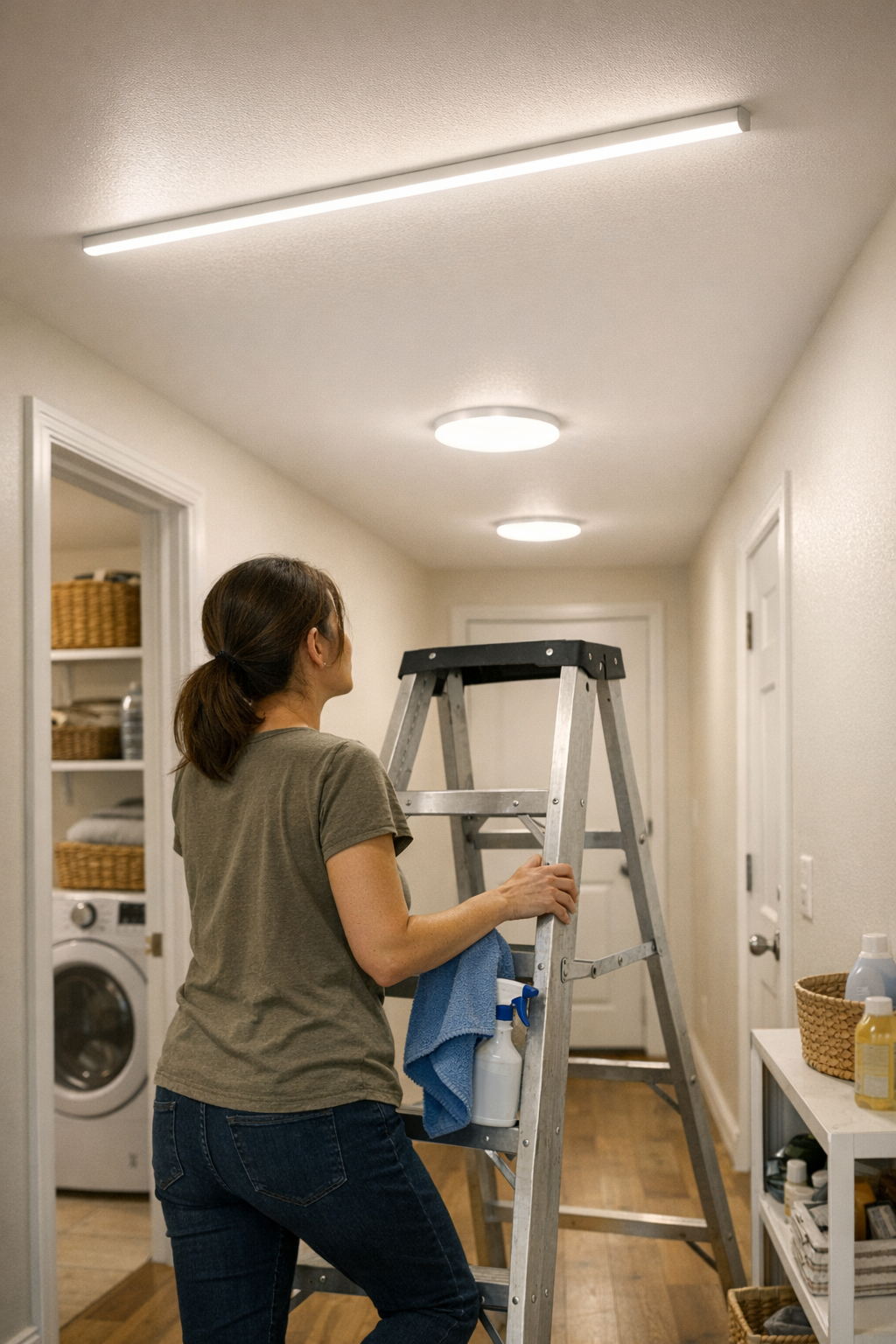
The ceiling looks lit—until you actually start moving through the space. In hallways, stairwells, or utility corners, that’s where “good enough” lighting turns into a daily source of slip-ups. A centrally mounted flush or semi-flush fixture tricks the eye into seeing clarity at a glance, but that effect collapses the moment your routine changes: hands full of laundry, a box, anything awkward. Peripheral vision swallows up shoes left at the hallway edge. Glare catches your eyes mid-turn. Edges of a staircase fade; the far wall of a laundry room stays a murky void. Every second-guessing pause—at a stair turn, by the closet door, approaching the washer—signals that what looked “bright” from the doorway actually leaves movement, safety, and routine in the shadows. The fixture’s specs promise coverage, but repeated use exposes its real gaps.
Why “Bright” Isn’t Enough: Hallways and Stairs That Interrupt Movement
Brightness by itself is only the surface test—easy to pass during an empty walkthrough, easy to fail during real-life routines. The actual challenge is coverage. One ceiling fixture dead center lights a hallway or stairwell enough for empty rooms, but not for crossing with both hands occupied after dusk or during a rainy afternoon. The failure point isn’t the bulb’s output; it’s where the light never lands.
With a single fixture, shadows cluster where corners meet thresholds, closet edges, or the start of a staircase. Carrying anything bulky—basket, ladder, box—suddenly means stepping blind at one or both ends. Even a new, high-output bulb shines mostly in the center, while the periphery stays unpredictable. Glare adds a second kind of friction: a semi-flush lamp at eye height throws a harsh reflection or hot stripe across a glossy wall, making you angle your head away from where you actually need to see. Movement becomes self-conscious. You hesitate by the stairs, slow down at the turn, or squint to map a path you thought was “lit.”
Accumulating Friction: Where Incomplete Lighting Repeats Small Failures
Poor lighting doesn’t betray itself on installation day—it shows up the fourth, tenth, twentieth time you move through the same spot holding something larger than a phone. A staircase throws a steep shadow across the step you need; in laundry rooms, the far side of the washer sinks into gloom. Narrow hallways amplify the problem, turning your own body into an obstacle that blocks the thin beam or throws half the floor into darkness. You scan for missing shoes or an uneven step, not because the bulbs are old, but because the setup simply doesn’t reach where you live. Patterns emerge: you always pause at the upstairs turn, tilt your head around glare, fumble for an invisible light switch, or re-position laundry to see the machine controls. Over time, these aren’t minor quirks—they become the landscape of daily irritation and near-miss stumbles.
Unlit Angles: How Gaps Turn Familiar Paths Into Risk Zones
Every staircase and hallway has recognizably weak spots—the place where a beam stops short, a dark fringe forms by the door, or a glare zone masks the next tread. These aren’t rare; they’re embedded in the design when fixture placement or style isn’t mapped around real movement.
- Juggling a ladder through a narrow stair? The fixture creates new shadows exactly where your sightline falls, breaking up a clear read on each step.
- Carrying a basket through a utility hallway? The middle glows, but both ends of your route fade. The last step to the door becomes a guess in partial darkness.
- Boxes up the stairs? Top-lighting throws your shadow right over the next tread, obscuring depth, making each climb feel riskier than it should.
These friction points aren’t design flaws on paper—they’re failures of real-life support. The annoyance isn’t lower brightness, but the abrupt loss of usable, predictable light exactly where routines press against the limits. Each interruption chips away at the comfort and confidence you expect from your own space.
How to Stop Lighting From Becoming the Bottleneck in Movement
The easiest mistake is to prescribe “more light” when the problem is poorly directed or insufficiently distributed light. The practical fix: rethink placement and spread, not just wattage or lumens.
Placement solves what output can’t: In high-traffic hallways, swapping from a single ceiling light to a pair—so each end of the run gets at least a meter of its own true coverage—rewires the entire space. Shadow lines dissolve. Turning a corner with a bulky load stops feeling like an act of faith. The edge of the utility area, the last stair, and the threshold into the laundry are all consistently readable. Corners no longer operate as trapdoors for dropped shoes or loose edges—you see what’s underfoot without conscious effort, daylight or not.
Stairwells, angled passages, and wide laundry zones fail for the same reason: spacing that leaves the ends or turns in semi-permanent half-light. Overlap is the answer. If one fixture’s spread doesn’t quite reach, double up: ceiling panel at the far wall, secondary flush mount at the entry, or a hardwired wall light supporting at the turn. Predictable, unbroken visibility turns every motion—down the stairs, across the laundry, into the utility closet—from an uncertain maneuver into a smooth, automatic one. “More lumens” won’t protect from a shadowed riser or a darkened machine edge; a smarter spread will.
Fixture Types: Making the Function Show Up Where It Matters
Flush mount ceiling lights win in low ceiling or corridor environments by pushing out even light where movement happens, avoiding bulb-in-eyeline bursts of glare. Semi-flush mounts and wall sconces can fill wider or angled spaces—only if aimed so they overlap coverage without creating fresh glare or dark patches at the boundaries. In long halls, a staggered arrangement lets each unit compensate for its neighbor’s edge, especially at doorways, turns, or alcoves where shadow otherwise pools. Wall sconces or hardwired fixtures are genuinely useful only if walls aren’t blocked; otherwise, they become more style marker than real support. For most movement, ceiling mounts are the backbone—seeing the whole route, not just the decorative corners.
Checklist: Signs Your Lighting Isn’t Keeping Up
- You pause at stair turns or landing bends, unsure of your step, despite the room looking “done.”
- You shield your eyes or angle away to dodge glare while walking, not just standing.
- One end of a corridor always feels duller—noticeable with any speed or on cloudy afternoons.
- Utility or laundry corners force you to lean or hunt for a dropped sock that’s swallowed by shadow.
- The room cleans up nicely, but you can’t safely carry a chair or wide laundry bin from end to end without hesitating.
These signals all point to the same constraint: lighting that checks the box for room “illumination,” but repeatedly fails at real-wayfinding, working, or cleaning. What matters isn’t how the space appears; it’s whether you move through it automatically—no head-tilt, no squinting, no second guesses on your next step.
Simple Shifts for Real-World Lighting: Lessons From Daily Use
- Space fixtures to erase shadow traps. Two points of light in a corridor or at a stairway landing break up longstanding gloom; the trick is to overlap their coverage, banishing both the dim edges and the harsh midline glare.
- Target the walking surface, not just the look. Mount fixtures and aim bulbs so the light lands on the route—stairs, corridor floors, laundry room edges—rather than glowing from afar or bouncing pointlessly off crown molding.
- Test the setup as it’s used—not just empty. Walk the hall with a laundry basket, climb the stairs with a tote, open the closet with a box in hand. Weaknesses show up fast: shadowed treads, dark closet entry, or a blinding spot no walkthrough could reveal.
- Skip the overdecorated fixture in working zones. If “style” comes at the cost of safe, even spread—if the glow vanishes where your feet fall—the daily inconvenience will outweigh any design pop.
The Difference You Feel: From “Lit” to Actually Usable
A room that only looks bright is easily exposed by regular routines—the pause at the stair, the squint in the hallway, the lean to see what the main bulb misses. A lighting setup proves itself the fifth time you move a laundry basket, carry cleaning supplies, or simply walk a path after dark. Success is simple: you stop thinking about the light because every corner, step, and surface shows up. No guessing, no glare, no hesitation. That’s the difference between visible light and predictable function—what makes a setup feel finished in use, not just in photos.
LightHelper builds lighting for these real-world movement zones.