
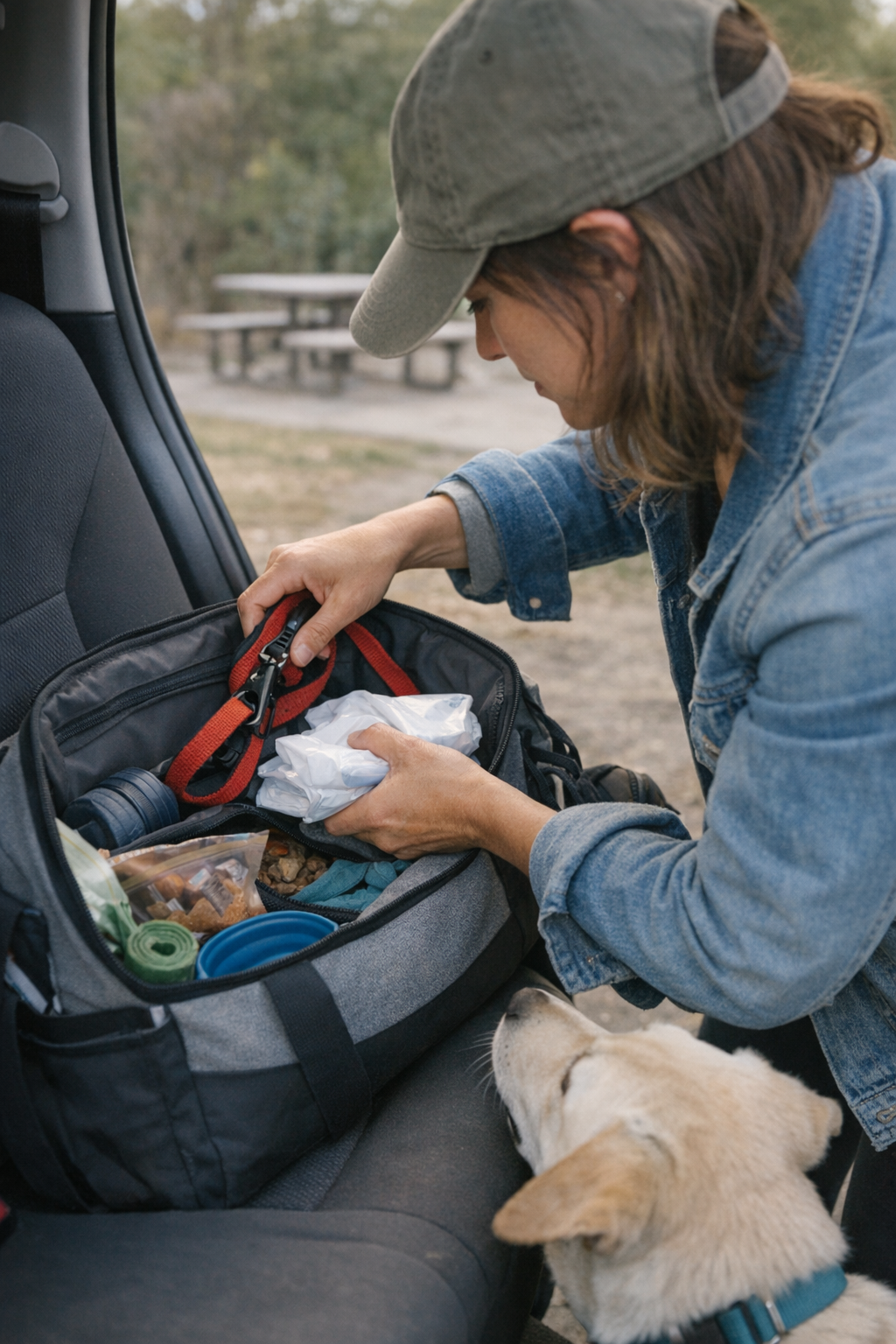
Every “organized” pet-travel setup looks ready in your hallway. Every leash, wipe, bowl, and toy zipped into its own spot—until you actually hit the road. Fast-forward to the first curbside pit stop or gas station loop: what began as sorted turns into a series of reaching grabs, blocked zippers, and items buried under the wrong pouch. You’re not calmly retrieving a leash—you’re contorting your wrist past stiff dividers while your dog hovers, reading every hesitation as confusion. The packed bag that looked dialed now drags you into a struggle every time movement breaks, stalls, or restarts. This is the gap: what functions on paper often stalls in real motion, and nowhere does it show faster than during repeated, everyday stops—and that’s exactly where smart PawGoTravel setups try to redraw the line.
When a Neat Setup Fumbles in Real Time
At home, any travel kit can look travel-ready. On the move, repeated stops expose every weak link. The leash that started atop the stack is wedged under a folded blanket by the second gas station. Wipes you tucked for easy cleanup now hide behind a collapsible water bowl, just as you need them, one-handed, for a muddy paw. Treats once in reach manage to slip beneath heavier gear. The difference between “organized” and “usable” is clearest during these real, repeated stops—the orderly plan unravels when you need speed, not symmetry.
The Routine That Exposes Every Flaw
Short trips, frequent pauses, and in-and-out-of-the-car cycles repeatedly stress your packing logic. Hooks for leashes claim to keep things “secure”—until you twist the carrier to reach for one and get caught in a web of straps. Owner items—phone, keys, wallet—slide into pet-space, so urgent grabs force you to shove essentials aside just to find a bag or treat. Cleanup gear? Trapped under a comfort toy during the only two seconds you have to react to a mess. Each movement becomes a micro-obstacle. By midday, you’re not repacking the bag because of disaster, but because the layout simply can’t keep up with motion.
Your dog isn’t oblivious to the friction. Every missed beat—waiting as you invert the carrier, watching you fish for items—teaches your pet to brace for delay. Each extra second handling “organization” erodes the flow that makes travel work for both of you.
Recognizing the Repeated Pain Points
What actually separates an efficient travel setup from an ongoing hassle? Not the number of zippered pockets or how “neatly” things stow, but whether you can instinctively reach essentials, every single time:
- Wrong-first grabs: Hand finds the obvious zipper, but the leash is elsewhere, out of sight and muscle-memory.
- Delayed cleanup: The wipes are always somewhere, but when speed counts, it takes a full-hand search or unzipping two layers.
- Owner-pet item overlap: Rummaging for a toy means brushing past your keys—messy on a moving day, forgettable at home.
- Comfort blocks function: A blanket meant for pet calm now blocks fast actions—you reposition it at every single stop.
Each small failure isn’t dramatic; it’s the friction that kills travel rhythm. Your “organized” start rarely survives the churn of real, repeated use.
Seat-Side Handling: The Unseen Bottleneck
Most travel gear gets its truest test at the car seat edge. Door open, bag half-on the seat, your pet ready to jump; any poor design in pocket angle or opening direction shows up instantly. If your quick-grab section faces away from the seat—requiring an awkward reach over a restless dog—every fast movement turns slow. “Logical” layouts made for tabletop access force you to rotate the bag, fumble, even tip out contents just to grab a leash. The difference rarely comes from extra compartments, but from how those compartments open and orient when you’re getting in or out, fast.
Pocket Choices and Small Structural Tweaks That Matter
Reducing repeated friction means shifting structure, not adding complexity. Flip the main access pocket so it faces your natural grab at the seat’s edge, and leash reach becomes one move, not a mini-search. Place wipes and quick-clean gear shallow—just one layer from the surface, never under heavy comfort items. These aren’t cosmetic changes; after five or ten stops, every second saved is a tiny win that keeps both your head and your pet’s routine clear. Tiny tweaks in layout fight the silent loop of missed grabs and forced rearrangements that add up over a trip.
The Difference Between Neatness and Usability
That day-one pride—everything zipped and perfect—only hides real movement problems until you reach the first clumsy stop. Need to move the same tangle of bedding again? Find the leash gone wandering after a turn? Still guessing which pouch holds the bags—after countless walks? If every repetition leaves you untangling, shifting, and searching, your setup looks organized but isn’t keeping pace. Workflow trumps appearance, every time. The proof isn’t a tidy bag, but a routine where each stop flows faster and the same snags never return.
Building a Setup That Moves With You—Not Against You
Repeated travel isn’t about perfection—it’s about setups that don’t constantly get in your own way. Structural wins are subtle: a bag returns to “ready” after every stop without a reset, you reach wipes without tilting everything on the seat, leash handoff is one move, not a dig. These aren’t headline innovations, but the difference stacks in hundreds of small travel moments. When every repeated stop releases more motion—less interruption for you, less guessing for your pet—your setup starts working for real life, not for a photo. That’s the logic behind travel layouts that hold up under repeated use, not just first impressions.
For products and practical setups designed for real travel routines, explore PawGoTravel.