
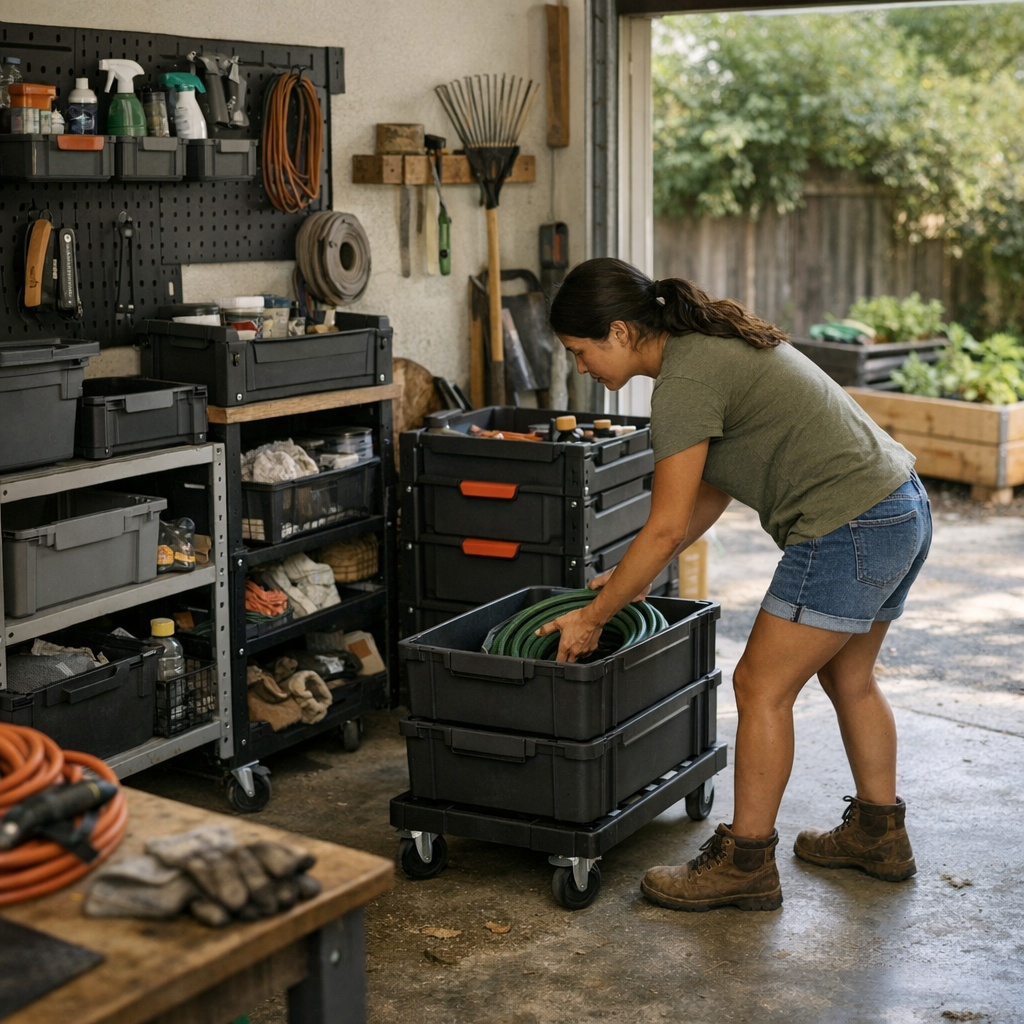
Every garage and workshop knows this story: The day you finally finish installing shelves, lining up bins, and sliding in that last cart, your space looks like something from a catalog. For about six hours, it stays “done.” Then real life rolls in—the first time you reach for a tool or return from a garden project, those sharp storage lines reveal their flaws. You edge a rolling cart out, only to nudge it sideways for clearance. Reaching the toolbox means leaning around a cabinet door that’s always half-blocked by stacked bins. What felt like a win quickly unravels into a series of tiny workarounds. The room is “organized,” but using it is more work than it should be.
When “Organized” Isn’t Actually Useable
The problems sneak up in the middle of busy routines. One weekday afternoon, you go to stash the extension cord, but there’s no clear path—last weekend’s project cart is half in the way, backed up against bins blocking the shelf you need. You bump a tower of containers relocating one just to reach another. Putting items away at the end of the day becomes a two-step shuffle: move the overflow to clear the walkway, drop your tools, then put back what you moved in the first place.
You start to notice the pattern every time you return from a project: the “tight” setup forces you into awkward reaches, forced sidesteps, or stacking odds and ends where they don’t quite belong. The logic that looked smart at rest makes every in-and-out reset a slow dance—tools linger on the bench, bags collect at the door, and the one open corner morphs into a silent disaster zone.
Why Neat Isn’t Enough—The Friction Behind the Facade
The frustration isn’t about clutter itself. It’s what the setup quietly steals: freedom of movement, predictable access, and a quick reset. Wall racks and cabinets flush with the drywall look sleek, but they can choke the walking path. Stacked bins feel efficient until you need the one at the bottom. Even mobile carts that “fit” the floor plan become obstacles—never gliding home without a nudge, never quite tucking away on the first try.
- Walkways narrow to tightrope width, forcing awkward sideways steps and shoulder-checks
- Bins need shifting before you even reach what they’re storing
- Carts demand pivoting, pulling, pushing just to return them to a “parking spot”
- Overflow—the inevitable extra tarp, unopened package, or random tool—settles in dead wall zones and corners, never really joining the system
A layout that looks sharp at rest can become an obstacle course in motion. Routine use exposes every hidden choke point, turning basic storage into a low-key, high-frequency hassle.
The Real Cost of Resetting—And Resetting Again
Every setup that’s “efficient” in theory but awkward in use demands constant shifting. If taking out or returning items involves sliding three containers, rerouting a cart, or pushing through a pinched walkway, there’s no such thing as a quick reset. The bigger the routine—the more tools, lawn care, sports equipment, or seasonal gear moves in and out—the more this friction multiplies. Corners become holding zones. Wall space gets half-used, never really accessible. Each week, the setup feels a bit heavier to manage.
What should be a two-minute reset—returning tools, clearing a path, restoring order—starts taking five, ten, fifteen minutes. Instead of efficiency, you breed congestion. Neatness turns into an obligation instead of a help. Over time, every return becomes a negotiation with the layout, quietly piling on frustration and making true order feel out of reach.
The Shift: Designing for Movement, Not Just Storage
Real breakthroughs don’t come from adding yet another shelf. They come from surrendering the fantasy of perfect density and making space for movement and return. After a string of resets that leave you sweating, you start carving a 12-inch margin clear along the paths you actually walk—no stacking “just one more” bin, no pushing carts up against critical shelves. Suddenly, the rolling cart slips in on the first attempt, instead of bouncing off the baseboard. Stowing that seasonal hose takes seconds, not a round of bin-Tetris. Overflow finds a place to land for triage, not for long-term limbo. There’s an immediate, lived-in ease to the space. It’s less about looking sharp and more about working right—reset after reset.
How to Spot a Setup That’s Slowly Failing
- Carts require awkward maneuvers to park or retrieve—sometimes left half-in the way “until next time”
- Walkways disappear under piles or stacks intended to “go somewhere else soon”
- Bins end up as semi-permanent barricades, hiding everything behind them
- Corners become graveyards for stuff you can’t deal with right away
If every step feels like a small negotiation, or if you find yourself constantly justifying why things can’t go back where they belong, your system is signaling it’s too rigid. Leave real, measured gaps along major movement zones and resist the urge to fill to the edges. The everyday flow—rolling, retrieving, returning—should happen without second thought.
Building Order That Stays Put
Perfect symmetry and wall-to-wall bins market themselves as “done,” but they rarely survive repeated use. The setups that actually stay organized don’t choke every inch; they provide genuine breathing room for movement and overflow. The result? Easier resets, shorter cleanup sessions, and a layout that adapts when plans change. What you lose in showroom lines, you gain in a steadier workflow and fewer moments hunting or shifting what’s “in the way.”
Test Your Setup—Not Just for Looks, But for Traffic
After installing your system, put it through a normal week: bring in your tools, stow away groceries, run a quick project. Where do you hesitate? What always ends up temporarily out of place? Notice which paths actually stay open and which ones jam up. A consistent inch of open floor or a shorter bin column can deliver more long-term order than any additional unit stuck in the margins.
Order That Moves With You
True organization shows itself when you’re in motion—pushing a cart through, grabbing gear mid-job, resetting fast before the next task. It’s not just about looking tidy but about freeing you from unnecessary reshuffling. When your layout respects how your routines actually flow, order sticks. The space helps you out, not just show off.
Find storage solutions built for real movement at StackNest.