
When Entryway Storage Starts Slowing Everyone Down
The entryway is supposed to make coming and going smooth—a place to kick off shoes without thinking, grab them again, and keep moving. But what happens after a normal week of school runs, grocery trips, and weather surprises? Even the best shoe setup—the one that looked perfect after last Sunday’s reset—can unravel in a matter of days. The real friction isn’t the obvious pileup; it’s the constant little slowdowns: shoes you have to dig for, pairs that crowd each other out, and the routine quietly sabotaged by a system that doesn’t flex with real life.
Where the Trouble Really Starts: Shoe Racks vs. Open Shelves in Practice
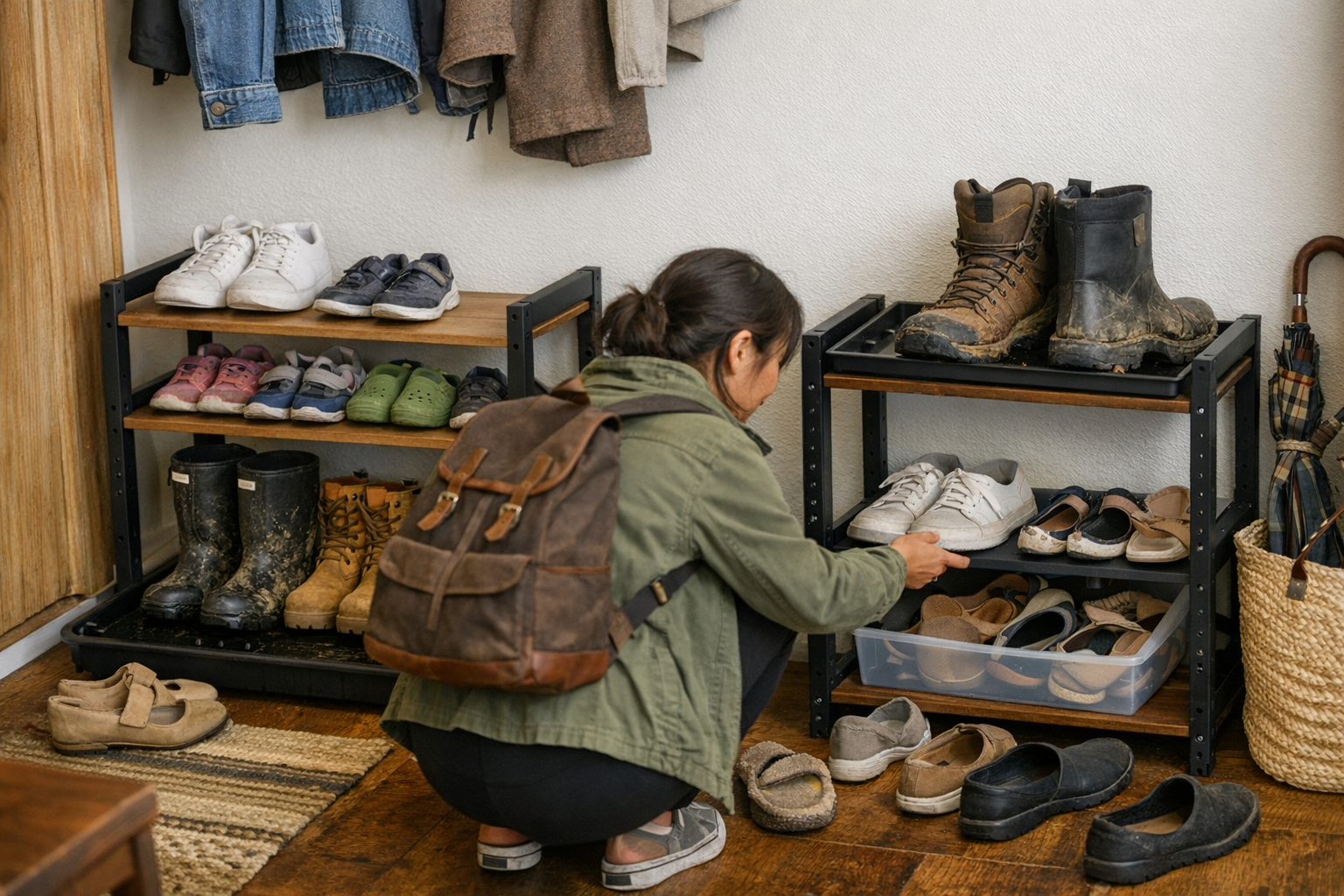
The promise of a shoe rack is tempting: everything lined up, every pair visible, nothing touching. For a brief stretch, maybe it holds. But by Wednesday: one pair of size 12s hogs two slots, kids’ shoes double up, and that “defined space” gets overrun. The rack’s order asks you to play along—if a boot doesn’t fit, tough. You find yourself shifting three pairs just to fit one back, or tossing shoes off-balance, watching the neat rows sag by Friday.
Shoe racks are built for routine, but real households don’t move in straight lines. Their structure can actually make resets harder. You can’t just toss and go—every slot resists overflow, but life keeps bringing more to the door.
Open shelves seem like a fix—no wiggling, no precise fitting. You drop shoes wherever, boots finally have a landing place, nothing has to sit upright. It feels liberated until the floor under the shelf starts to disappear. Pairs spread, migrate, and soon nothing’s where you expect. Pulling out a daily pair means shifting a slide of shoes or untangling sandals from laces. What started as an “anything goes” landing turns into a daily scavenger hunt.
Midweek Mayhem: When Reset Fails and Clutter Spreads
Come Thursday morning, the scene repeats: shoes jammed at the ends of the rack—none in the middle. The only slot left holds winter boots, months out of season. In a rush, someone kicks their sneakers onto the floor because the rack is full (again). Open shelves aren’t spared, either: kid shoes pile up on the bottom, adult shoes drift to the side, a wet pair leaks behind the bench. By the end of the day, you’re moving stacks to reach what you actually wear, and the overflow colonizes new corners.
This isn’t a breakdown, exactly. It’s a slow spread—each shortcut (I’ll fix it later, just toss it there) making the system heavier. Instead of a quick grab-and-go, you’re now committed to daily minor reorganizing before leaving the house.
The Silent Warning Signs of a Broken System
Lost time is the tip-off. When you catch yourself always fishing behind three other pairs, scooping shoes off the floor, or navigating a jumble just to find two matching sneakers—it’s not just messy, it’s friction you pay for every day. These aren’t rare failures; they’re routine symptoms that the storage logic gave up long before you did.
The Real Divide: Boundaries or Bust
The core difference isn’t whether you pick a rack or a shelf. It’s whether there’s a boundary—a line shoes can’t sneak past. Racks promise structure, but can’t flex for off-script days. Shelves grant freedom, but let clutter sneak in sideways. When no one is assigned clear cleanup, Sunday resets wash away by Tuesday; when every pair stays “just in case,” chaos creeps in faster than you notice.
The result: either the setup demands precision you don’t have, or it offers endless leeway—and both quietly tire you out. In every case, default habits win: people drop shoes wherever is fastest, and the entryway starts to look (and feel) like a slow-motion game of Tetris you can’t finish.
Enforce a Limit: The Only Rule That Actually Works
After enough crowded hallways and failed resets, one change finally makes a difference: cap how many pairs live in the entryway. Not “theoretically,” but for real—say, eight pairs you actually wear. The overflow? It moves out. No exceptions, even for rain boots or impulse buys.
Suddenly, there’s a reason to put away the extras, to stop letting low-use pairs loaf around, to make resets fast. With a set number, it becomes frictionless: routine doesn’t require a total reorg—just a quick scan and a swap when new shoes come in. Even shelves get easier; with half as many pairs, you can spot what you need without rearranging a mountain. If boots don’t fit, they get their own corral, not forced into the main flow.
Make Categories Obvious—And Stick to Them
Assign zones that make sense: kids’ shoes down low, adult pairs at eye level, boots off to one side or on a drip tray. This isn’t about putting labels everywhere, but about making it easy to see when things drift. Out-of-season and “maybe next month” shoes move to a deeper closet—entryway space is only for what you reach for most.
For wet shoes, a tray keeps puddles from spreading. Keep pairs to a minimum per zone—layering too much is just a slow leak towards the same old mess. Leaving things accessible and not overly dense lets you do wipe-downs and micro-resets in a minute or two, not half an hour.
When to Admit It’s Not Working Anymore
These are the flags: You’re shifting pairs, not just grabbing them. You avoid the main rack because it’s more work than the floor. More shoes sit sideways than straight. You can’t remember the last time every pair had a clear spot. When boundary lines blur, the system isn’t just “lived in”—it’s overdue for a reset. Before the annoyance builds, clear out the surplus and tighten the cap again.
Build for the Reset You’ll Actually Do
The dream is an entryway that stays pristine. The reality that works is one that’s designed for quick, constant resets—because in real households, chaos is never farther than a busy week. The setup that actually lasts is the one with:
- A strict limit on daily-use shoes
- Zones set by use or person—not just available space
- No tolerance for overflow clogging the first grab
- Resets that take minutes, not willpower
This kind of entryway doesn’t pretend to be showroom perfect. It just puts order where you actually need it, survives the daily churn, and keeps the mess contained—so you get out the door faster, instead of fighting a losing game of storage whack-a-mole.
Shop ClosetWorks for practical entryway and closet storage solutions.