
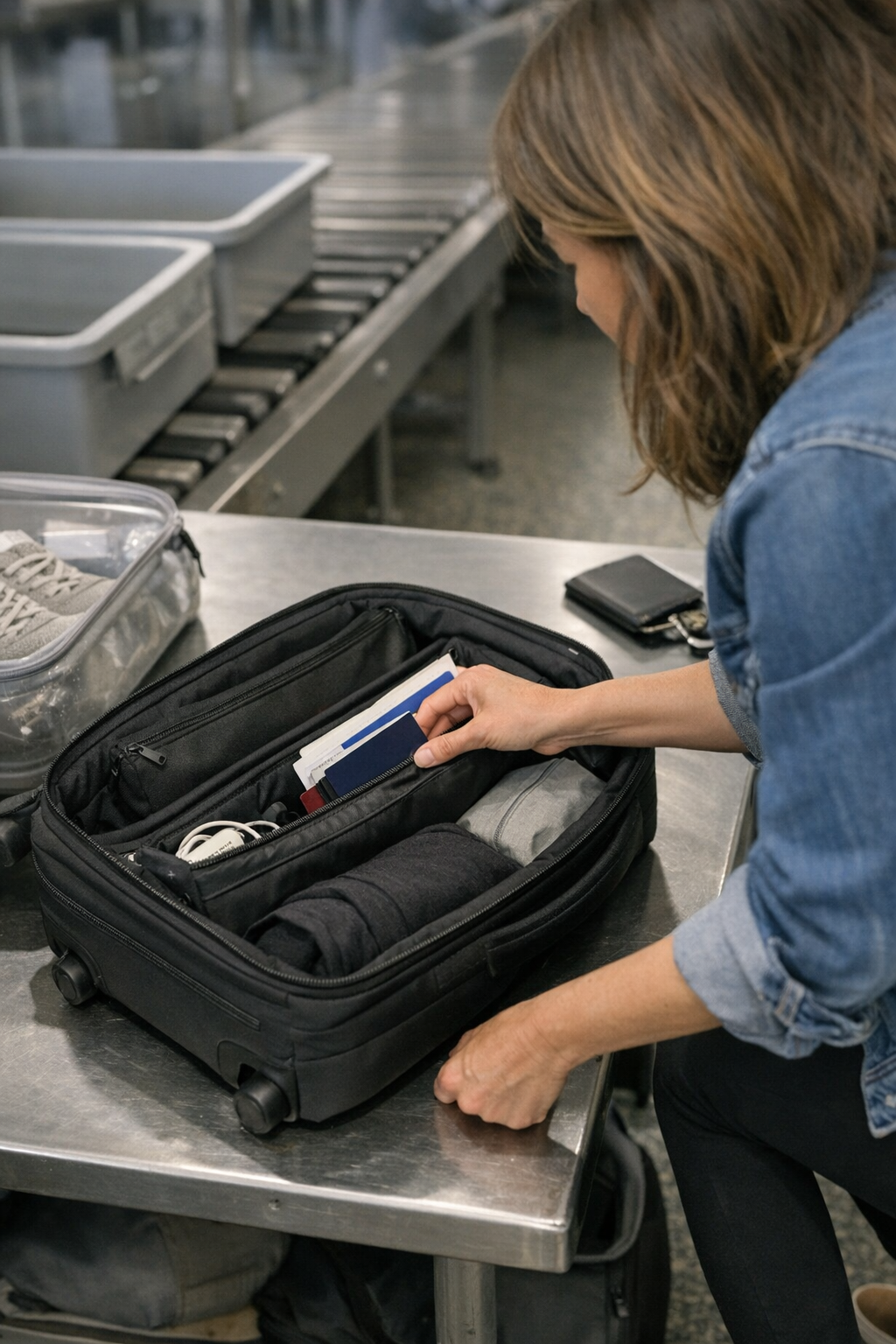
The first sign isn’t visual—it’s the moment your “organized” carry-on slows you down at the one place you can’t afford delay: airport security or boarding. You reach for your passport or phone and realize what looked tidy at the hotel is suddenly a clumsy, layered obstacle when speed matters. The neat stack of pouches and perfect zipper pulls fooled you in your room, but with three trays ahead, documents to show, and strangers close behind, every extra unzip or pouch shift costs time, pressure, and sometimes, your place in line. It’s the difference between packing for a catalog shot and packing for actual movement: the structure that feels manageable on a calm morning becomes a drag on every checkpoint, tray-transfer, or quick boarding transition.
When Order Slows You Down: Recognizing Hidden Movement Friction
It’s not mess that breaks your travel flow—it’s friction. The warning signs start after just a few document checks between curb and gate: a pouch blocks quick reach, or a neatly zipped compartment slows you by one futile motion too many. Your “quick access” pocket is jammed by a sideways organizer; a passport sleeve now sits under a tech pouch; the tidy stack slips and reshuffles every time you dig for ID. Seconds lost reopening and resealing bags at the tray add up fast, and line pressure makes each flustered search feel twice as long. This isn’t a one-off annoyance. It’s the same sequence—pause, shift, repack, reset—repeating until even the most careful setup feels heavy after a half hour of real-world use.
Real-World Example: The Line That Won’t Wait
Security at 6AM: trays everywhere, staff waving people through, dozens moving at once. You know your passport sleeve is “in the right spot,” but a tech pouch has edged over the zipper just enough to jam access. You fumble, unstack, and re-stack under the gaze of the impatient travelers behind you. Instead of breezing through, you’re holding up the line, reaching awkwardly, or worse, dropping a card because your setup has turned quick reach into a multi-step puzzle. With every checkpoint, you reassemble your so-called order—each round under time pressure, each round less convinced the arrangement works beyond the hotel room.
The ‘Light-Day’ Packing Mindset: Fewer Layers, Faster Movement
Flyers who move fastest don’t chase perfect visual order—they chase practical access, especially after recognizing how the wrong structure collapses under repeated strain. The light-day method throws out maximal sorting for minimal, logical layering. Instead of a vertical parade of pouches, the focus shifts to surface-level essentials: the few things you’ll actually need to reach between security, boarding, and seat entry. Passport, charger, ticket—each sits on the surface or right at the main zipper path. Everything else—snacks, backup cables, toiletries—gets assigned to lower-access, “long stop” zones where slow retrieval won’t matter. This isn’t a neatness downgrade; it’s an upgrade in how little you have to handle or shuffle under time pressure.
Why Flat Dividers Beat Pouch Stacks
The classic mistake: trusting a “one-pouch-per-function” system to work during real movement. But in the field, each stacked organizer adds an extra shuffle and every misplaced sleeve becomes a tiny obstacle course. Standing in an aisle or hunched over a tray, you realize that moving one pouch just to swipe your passport or headphone case is friction you can’t afford. Flat dividers or wide sleeves make a difference because they turn access into a single motion—an unzip, a reach, a done—no puzzle, no reshuffling, and no regrets after three or four real uses.
Packing That Stays Functional, Not Just Tidy
Structural weakness in a setup surfaces fast during travel sprints: checkpoint resets, last-minute document checks, or seat-side digs for essentials. Several cycles in, most travelers will notice:
- Visual order decays while friction mounts. Stacked pouches shift against each other, hiding the very pocket you need next.
- Routine access turns multi-step. Opening one pouch means moving another, then realigning everything before boarding pressure builds up behind you.
- Repacking steals your flow. What started as an “orderly” arrangement becomes a constant repack-and-reset cycle with each new movement.
- Stress and error rates rise. Wrong pocket, missing pen, misplaced USB drive—all because you’re shuffling more than you’re moving forward.
The Moment the System Breaks Down: Seat Entry and Overhead Bin Chaos
Boarding exposes anything your packing routine hid. Squeezed in the aisle, people behind, you search for two essentials—headphones, ticket stub—only to find everything requires a shuffle and a memory test. There’s no time to calmly unzip and search. Instead, you’re blocking traffic, digging past the well-meant “order,” wishing your carry-on worked for right-now instead of five minutes ago. What looked tidy at home slows down the entire boarding process, while fellow travelers wait for you to solve a puzzle you didn’t notice until it cost you real time and comfort.
Practical Shifts: How Small Layout Changes Beat Fancy Systems
You don’t need a new bag—you need a realignment. The breakthrough? Keep essentials right at the surface, always accessible with one zipper, no matter how rushed or crowded the setup gets. Sliding documents into a surface sleeve, anchoring your tech pouch sideways against a main edge, or keeping comfort items only in outermost zones cuts search, cut delay, and builds real trust in your own setup—regardless of what the bag looked like zipped at the hotel. Over repeating flights or tight transfers, these changes erase the “where’s my stuff?” pause and keep your movement fluid, not interrupted.
A Slimmer Tech Pouch Pays Off in Transit
Tech is the same story. Bulky, over-segmented pouches impress at leisure, but any organizer that buries cords or chargers you’ll actually use just adds to the clutter. Prune it to the must-use items—keep the pouch slim and flat, and wedge it into a side pocket, keeping prime access zones clear for documents and right-now needs. This isn’t about looking minimal—it’s about not losing time and patience every time you move, reach, or need to reset in line or in the seat.
Why ‘Neat’ Isn’t the Same as ‘Easy’: Over-Segmenting Creates Its Own Trap
Too many pockets and sub-pouches lure you into thinking “everything in its place” means “easy retrieval.” But over-segmentation introduces new friction: split-second confusion about which compartment holds a boarding pass, or micro-hesitation unzipping one case too many as the queue tightens. Each extra barrier is a new opportunity to fumble, mistime, or misplace. In peak moments or crowded spaces, the cost is measurable, even if it isn’t obvious when you packed.
Live Use Over Cosmetic Perfection
The light-day method puts functional movement above cosmetic perfection. You can spot a setup that works because after three or four checkpoint runs, it still delivers direct, reliable access—no repeated ceremony, no shuffling, no rising anxiety as you approach another tray or boarding call. Cosmetic order counts for less with every real use; flow and instinctive handling count for more. If your bag helps you move, not just repack, it’s doing its job. If not, the difference shows up somewhere between the third zipper pause and the final overhead-bin scramble.
The true test isn’t how your bag looks zipped and still—but how it handles at speed, under pressure, and after five or six cycles of real airport movement. A bag that stays functional in motion is what makes repeated travel less of an obstacle and more of a smooth sequence.