
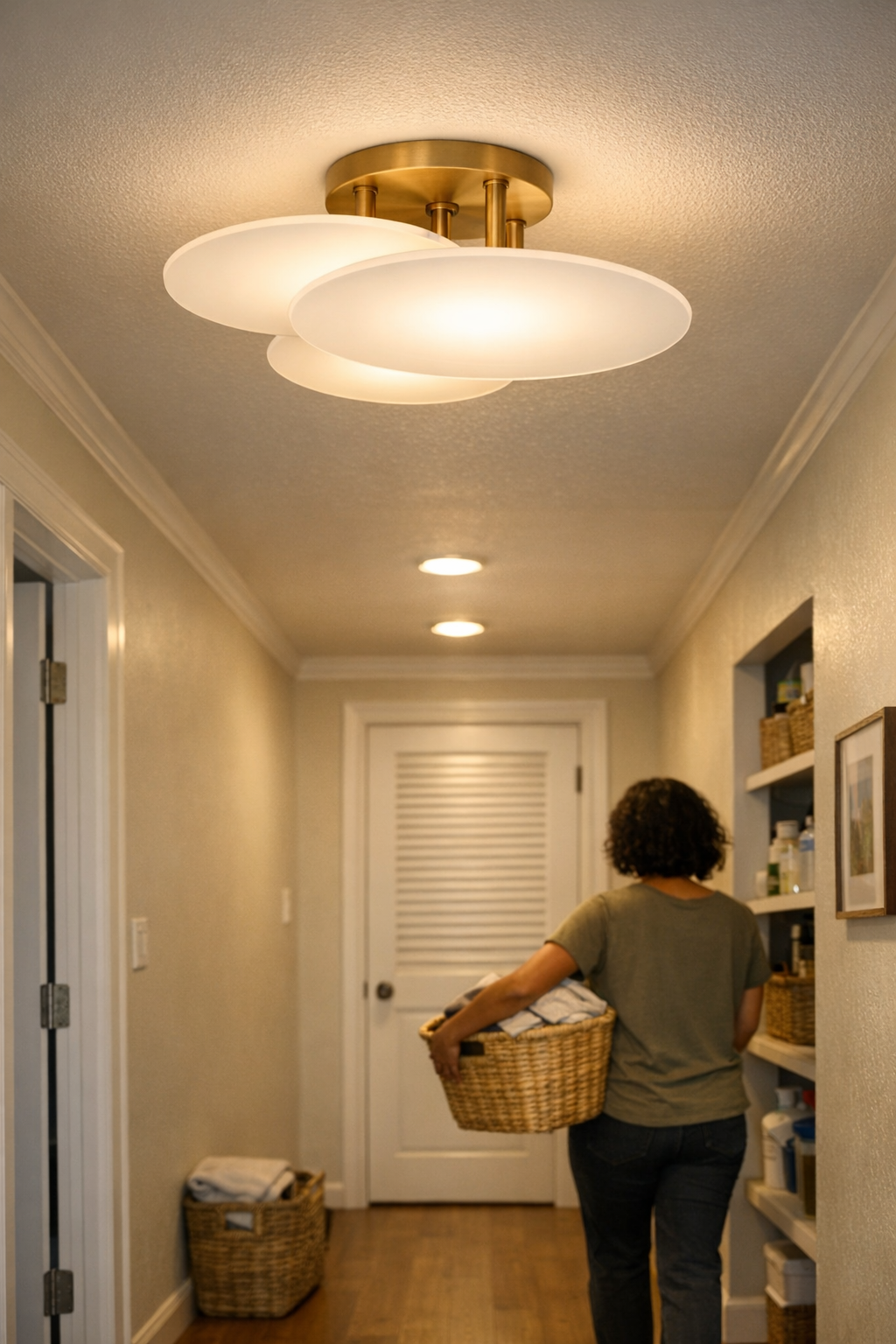
Corridor lighting rarely fails the day you put it in; it fails every week after, whenever daily movement exposes the cracks the install hid. The moment a cable sags in your sightline, or you find yourself squinting past glare just to carry laundry through a shallow stretch, it’s clear: a corridor that looks “done” can still act unfinished. One misplaced bracket or a too-neat line of fixtures can turn a hallway into a slow obstacle course—hesitating at the alcove, shifting your footing near an unlit edge, or hunting for a switch when your hands are full. These small breakdowns add friction to a space you cross ten times a day, making the difference between a corridor you trust and one you brace for.
When “Tidy” Lighting Fails Real Routines
Walk into any newly lit corridor and at first glance, it seems resolved—a perfect run of slim ceiling lights, matched sconces, cables aligned and flush. That order collapses once real use begins: arms loaded, night trips with awkward reach, the split-second need to see a threshold clearly. Suddenly, flaws you never noticed become routine detours:
- Shadowy gaps where a ceiling light falls short of the next doorway—you hesitate without meaning to
- Polished floor glare bouncing off the first step, just where you turn toward the entry
- A pocket of darkness beside the closet, never fully caught by any beam, making you fumble every single time
- Cables that sag just enough to grab your attention—or your shoulder—before the space itself even registers
The trouble rarely kicks in while you’re standing still. It finds you in all those small, moving moments: stepping between rooms, guiding a visitor, or just following the same path each night only to run into the same weak spots.
Why Even Symmetrical Setups Let You Down
Corridors often get installed by the rule: panels spaced even, brackets centered, symmetry enforced. Yet symmetry means nothing if it puts the gap right where traffic flows—doorway, closet, bend. The lighting looks organized from a distance, but as you walk, it splits reality: the “perfect” grid maps directly onto awkward seams. Brackets that disappear at first start to crowd your line of sight, or leave enough slack for cables to dip into reach. Glare isn’t always a bright spot on a wall—it can be a shifting distortion over tiles that breaks the space up, even though the fixtures themselves look “correct.”
Invisible Until You’re Moving
Lighting issues in a corridor almost never announce themselves at first. They emerge in the flow:
- Slowing instinctively by the supply closet because the shelf and switch are too dim
- Trying to shift a bulky box, only to pause at a dark line the fixture never covers
- Adjusting a cable for the fourth time because a bracket wasn’t placed where people really pass by
What appeared settled on day one becomes a source of delay and low-level annoyance—every single trip down the hall.
The Cost of Weak Transitions
The real trouble in corridor lighting starts at the edges—the handoff points between rooms, corners, and doorways. Near the kitchen junction or laundry turn, you notice yourself hesitating. Missing overlap around alcoves, closets, or even tight switch zones forces daily “stop-and-check” moments. Instead of a clear run, you’re squinting for illumination or waiting for a spill of light from another room. This isn’t headline drama—it’s that steady, background stress that repeats a dozen times a day, for every person using the hall.
Setup Decisions That Actually Make a Difference
Tweaking support and placement—rather than piling on more light—is the shift that actually dissolves friction. The difference comes from:
- Overlapping beams: Positioning fixtures so their coverage meets and slightly overlaps at critical points—by doors, switches, corners—blocks shadow seams and makes thresholds instantly visible.
- Support at high-traffic lines: Shifting a bracket off the “visual center” so it actually anchors a fixture over the corridor’s real walk path, ending sag and blank spots where people move most.
- Cable and mounting discipline: Swapping out a loose surface mount for a flush cable holder or bracket ensures cords stay out of view and don’t drift into the area you reach and move through every day.
Real fixes might mean taking down one continuous light bar and installing two overlapping ceiling panels to target the midpoint—or moving a wall fixture to finally throw coverage across each closet door. It’s rarely about adding volume; it’s about correcting for where the original install ignored human patterns.
One Small Adjustment, Big Day-to-Day Relief
After replacing a single run with overlapping ceiling panels and pulling a mounting bracket directly over the supply closet’s path, the old “hang” at the dim corner vanished. The corridor stopped dictating movement. In daily use—crossing with groceries or organizing shelves—there was no need for route-workarounds, no pausing for eyes to adjust. The far end of the hallway finally linked to the rest, blending smoothly instead of feeling like a separate, awkward zone.
What Actually Fixes Broken Corridor Lighting?
The real solution isn’t in maximizing output—it’s in reading the space. Watch for:
- The spot where people naturally hesitate or take extra care—often it’s not where the main beam lands
- Repeated workarounds: detour around cable slack, always reaching for a patch of usable light, nudging a fixture back into place
- Glare lines making reflection zones harsh, while the next step is left dim
By overlapping light at key points, bracketing for real movement, and keeping cable paths fixed and flush, you resolve the friction points. What you get isn’t just a cleaner look—it’s a corridor that disappears as an obstacle. Whether it’s shared apartment traffic or a work-from-home hallway, the effect is less resistance, more automatic movement, with fewer “corrections” demanded by the space itself.
Small Details, Repeated Impact
Corridor lighting rarely fails in dramatic ways. The discomfort is cumulative: a sagging support, a persistent dark patch at a junction, a cable that starts to snag. Maybe you lose only a second here and there, but across hundreds of trips, these seconds add up to a drag on focus and comfort. The fix is rarely more light; it’s shifting a bracket, nudging overlap, or locking down cable runs right where the routine breaks down.
The real difference: a corridor that doesn’t just look finished but feels natural to use again and again—ditch the visual friction, erase the hesitation, and let the setup finally serve the routine.
See practical solutions, accessories, and support for real corridor lighting at LightSupport.