
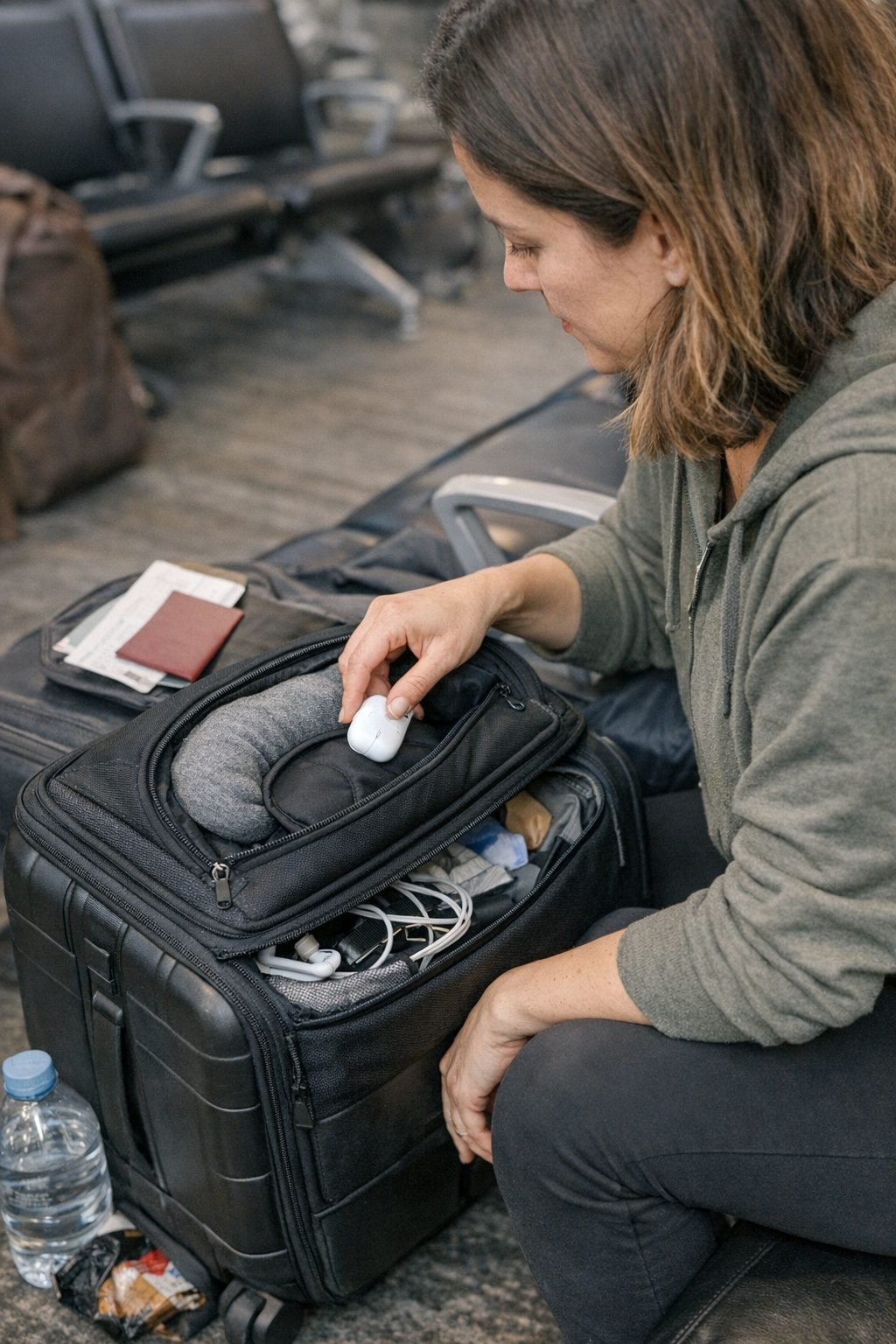
Your carry-on can look flawless when you zip it up at home. But the first airport checkpoint, boarding call, or in-flight rummage usually exposes the gaps in your packing plan. The tidy interior unravels the moment you have to grab your passport mid-queue, pull out headphones with one hand while standing, or race through another hurried document check—the bag resists, slows you down, blocks quick access in the exact moments you need to move fastest.
This gap—between looking organized and actually functioning on the move—turns into a grind you feel in every airport line and aisle. Stacking pouches and documents neatly is simple in a calm room, but as soon as you need your gate pass or painkillers, layers tangle, pockets overlap, and each retrieval becomes a minor disruption. You end up hunting through a main compartment and outer pockets, bumping seatmates, even holding up others—just to grab one thing.
When Visual Order Doesn’t Mean Quick Access
The illusion of control doesn’t last. That perfect packing moment evaporates the second you reach for your boarding pass trapped behind a pouch of chargers, or your sleep mask buried under snacks and cables. These aren’t dramatic breakdowns; each instance is a quick loss of flow. The real cost is in time and focus—shuffling stacks while your place in line inches forward, elbowing your way to a tray, or fumbling for yet another zipper as other travelers squeeze past.
Carry-ons that “look” organized at rest rarely stay efficient at speed. Every minor retrieval is slowed by decisions: which zipper next, which pouch to shift, what got buried since the last grab? At home, these interruptions barely register. In the fast blur of airport movement, hesitation multiplies—and the intended order quickly becomes its own obstacle.
The Repeated-Access Problem: Every Movement Counts
Every new phase—gate change, security, aisle shuffle—puts your carry-on setup to the test. The “all-in-one” compartment that seemed tidy at the start quickly collapses into a slow crawl: charger wraps around passport, rest kit buries travel docs, snacks pile onto headphones. Delay one retrieval and the next is even messier. The outside still looks fine—inside, you’re one grab away from another item spill, pouch shuffle, or missed slot that now blocks the thing you actually need.
Picture the most basic problem: during a gate wait, you want earbuds and a snack, but both share space with a neck pillow and your important documents. Every time you reach in, one pouch pushes behind another. When a critical item rolls under your seat, or you have to crouch and hunt through the bag again, you feel it—the outer order hides inner chaos that quickly builds with every use.
Real Friction in Everyday Carry-On Use
It’s not about spectacular failure. It’s the grind of cumulative, ordinary frictions:
- Unzipping one section and watching a stack of travel papers loosen and scatter
- Hauling the whole bag down from the bin for meds, only for cables or a snack wrapper to tumble out
- Balancing in the aisle, desperately digging for a sleep mask, knowing each item touched makes the next reset harder
None of these is a trip-ruiner, but with each round, resistance grows—and you start opening your bag with silent reluctance, just to avoid the next micro-mess.
Why Overlapping Storage Fails in Real Movement
The root drag is forced overlap. Packing rest, tech, snacks, and documents into shared spaces means every reach interrupts something else. Each grab is a low-level risk—not for losing the item you want, but for scattering the order you thought you controlled. It’s the difference between a bag that survives a layover grab and one that pulls half its contents with a Kindle, leaving you frantically tucking things back before your group gets called.
On a crowded flight, digging for one small thing—gum, antihistamine, tissue—too often means unpacking cables, flipping passports, and cluttering your own seat space. Attempts to “keep it neat” only highlight how little real order survives repeated access.
The Subtle Burden of Constant Repacking
The slowest problem of all? The ongoing need to reset your carry-on. True practical order means you can close up easily, with one move, after every access. Most setups fail the real travel test—one reach triggers a repack, one grab leads to a silent checklist: “Did I lose my doc stack? Is my cord pouch back in place?” Friction rises, small risks accumulate, and before long, you’re second-guessing simple retrievals or triple-checking you haven’t left essentials behind.
The Difference a Dedicated Access Zone Makes
The moment you separate your main in-transit essentials—rest gear, earbuds, tissues—into a single, distinct outer pocket or zone, the whole pattern shifts. Not just less chaos, but less worry each time you unzip. If that top-access section is used for only the items you need while moving—without layering over travel docs or tech—each retrieval is clean, and nothing behind gets disturbed.
Over a few cycles, the upgrade is clear: you stop pausing to recalculate pocket risk, repacks shrink to nothing, and you can move through boarding or security with smoother confidence. The difference isn’t about a picture-perfect bag—it’s about not having to dread or manage the next access moment, even when the airport is at its busiest.
The “Looks-Right” Setup vs. the “Works-Right” Setup
The ultimate difference shows up in repetition. A carry-on that “looks right” lined up at home rarely survives three in-transit resets. It’s the setup that lets you return each category—rest, docs, tech—into its own, non-overlapping spot that wins in real travel conditions. If you can get to what you need, swap it, and zip up all in one step—without collateral spill—you’ve moved from planned order to functional flow.
Practical Tip: Create Your Own No-Overlap Zone
Draw a line: assign your outer, fastest-access pocket for just one in-transit category, and keep it strict. If that pocket is the “rest zone”—mask, pillow, earbuds—leave docs and tech elsewhere. If you always grab a charger on the move, give it its own place at hand so it never tangles with pouches or gets buried under snacks. The real benefit is speed and certainty—not maximal “organization,” but minimal drag.
Result: retrievals become reflex, resets are single-move, and your carry-on starts to work for all the sub-tasks—boarding, seat squeeze, tray transfer, quick terminal walks—without constant interruption. It’s not about getting admired for neat pouches, but about ending that low-level dread every time you reach for something while the world moves around you.
For practical, tested carry-on tools and organizers tailored for repeat travel, visit CarryOnSupply.