
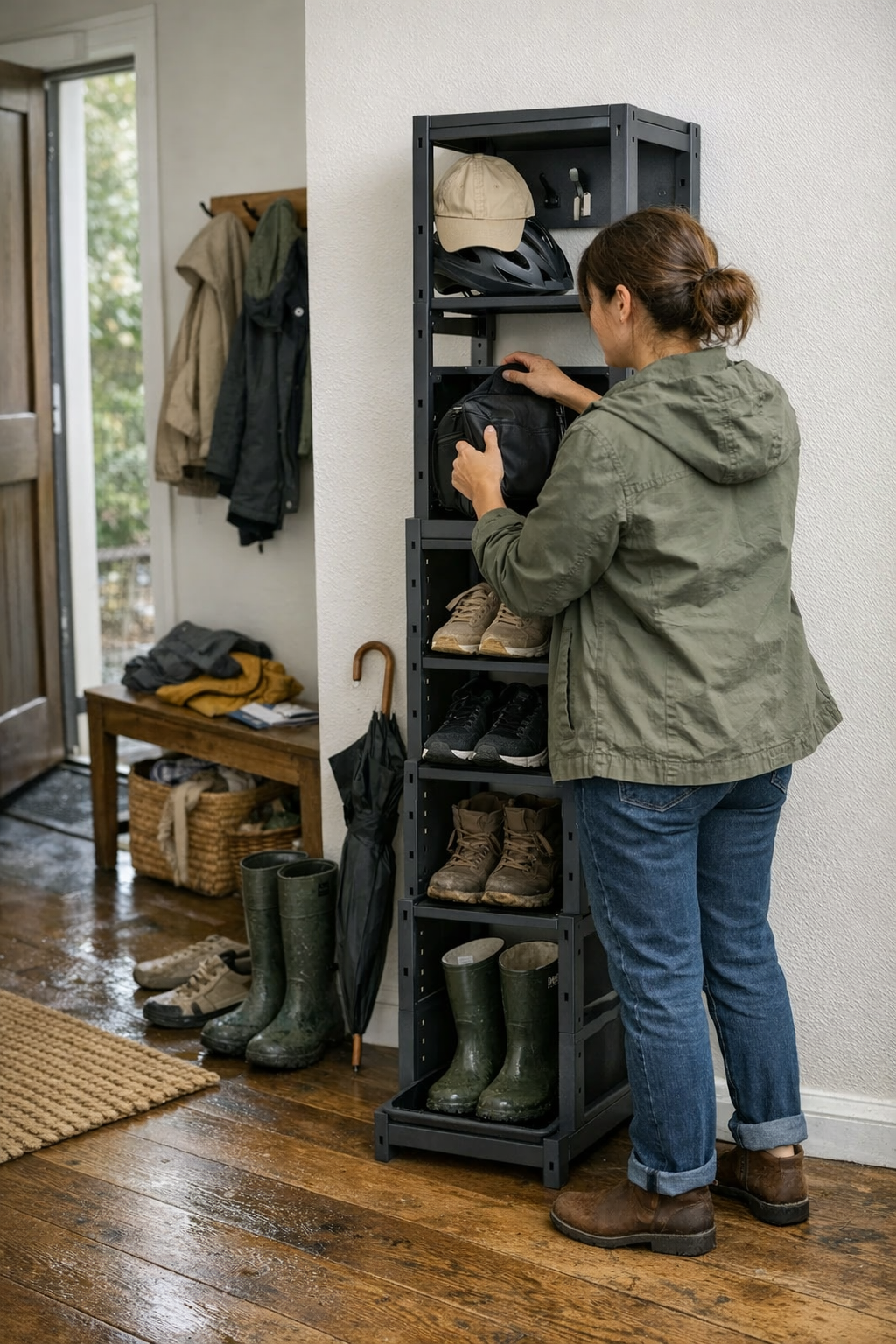
Clutter pressure starts right at your door. Even a tidy entryway turns unpredictable fast—one drop of a bag, one extra pair of shoes edging out, and suddenly the supposed “organized zone” collapses. If you know the pattern—bags slumping by the wall, shoes spreading beyond the mat, baskets filling up before the end of the week—you’re in the same cycle that frustrates nearly everyone with a busy threshold. The real problem isn’t just mess; it’s a system that can’t keep up with daily traffic. Most wide storage setups—big benches, sprawling racks, overstuffed bins—look controlled for a day, then start breaking down as soon as the real routine returns. Instead of controlling the chaos, they just shift it from one end of the entry to the other, forcing you into constant mini-resets just to keep the path open.
Why Wide Storage Breaks Down So Fast
Looking organized isn’t the same as working in real time. Wide benches invite a line of shoes, but that line doesn’t hold. By Wednesday, boots drift out; the bench turns into a lost-and-found where the last item pushed underneath becomes invisible. Mail collects on any flat tray until the original stack is hidden two layers deep. With each return, you don’t get a reset—you just layer more on top or nudge another bag into the only remaining corner. Add in wet weather and now shoes leave tracks, umbrellas lean against bags that slouched off the bench, and the small effort it takes to find your own gear multiplies into a daily bottleneck. Every time someone enters or leaves, you’re reminded: this isn’t just visual clutter. It slows you down and tightens the space with every use cycle.
When storage sprawls sideways, the “bus route” through the entry contracts. Shoes push past the mat, bags slip into the travel lane, and each new drop chokes off more walkable space. You’re not short on storage—you’re battling a setup that encourages drift, not return. Getting control means handling the same pile twice before you even get your shoes off. Most wide solutions give you one organized photo, but no resilience when everyone comes home within ten minutes of each other. Resets pile up, pressure increases, and eventually the only way through is by detouring around the overflow.
The Shift: A Slim Vertical Tower in the Entry Zone
Changing from horizontal spread to vertical storage flips the entryway logic. Instead of gear fanning out low and wide, it stacks up—off the floor, clearly slotted. Each shoe, bag, or helmet gets a single spot: no digging, no interleaving, no collapsed rows. The risk of losing control drops because every open cubby or shelf is visible on approach. Even with back-to-back arrivals, finding an open spot or seeing what’s overflowing becomes instant. There’s no confusion where gear belongs, and the moment a cubby can’t take more, that signal is obvious; stash overflow, and you’re caught in the act.
How a Tower Tackles the Spillover Problem
See it in action: it’s evening, three people dump bags and gear in quick sequence. The flat bench is exhausted after the first round—shoes spill out, jackets drop wherever, and the path shrinks minute by minute. The next person shuffles through to find no clear landing zone, so whatever they’re holding lands wherever it fits. Even if you reset as a ritual, wide storage can’t process arrivals this quickly; the mess snaps back overnight.
Shift to a vertical tower: as people walk in, boots land in standing cubbies, bikes helmets stack up—not in a pile, but in a single stack. The tower contains gear upright, so even late arrivals can spot usable slots. The walk path stays wide because nothing drifts into the flow zone; everything is either in the tower or obviously out of bounds. At the end of the day, the reset isn’t a big job. If someone tries to park a bag outside the system, it’s immediately visible—less temptation to “just drop it for now.”
What Changes With Daily Use?
The search-and-reset job shrinks. In a wide spread, the urge to drop-and-dash grows: benches soak up overflow, mail coats every tray, so every surface ends up competing for room. Vertical, standing-height storage rewrites the script: full cubby? It’s dealt with now, not “one day soon.” Lost item? It’s either there or it isn’t—no invisible pileups. The reset becomes self-policing: the space reveals what’s working and what’s failing with no guesswork required.
Movement in and out improves, too. Narrow vertical towers mean the entrance doesn’t choke up when two people squeeze past each other. You’re spared the shuffle around shoes or last night’s rain gear—and you don’t have to wedge bags out of the way by hand. The visual rhythm is clearer: compact columns, clean walkpath, no decentralized sprawl angling for your attention after every use.
Entry Spaces That Actually Work—Not Just Look Neat
Towers aren’t magic— they just create friction in the right place. If everyone’s habit is to ditch gear right inside the door or build up a shoe wall until you’re stuck, look at exactly where overflow escapes. The right tower only works if it’s within reach, sized to your actual use, and physically interrupts the old drop zones. Bad height, wrong location, or hidden behind the first obstacle? The old mess returns on day two. When it lines up with your home’s entry flow, congestion eases quickly—not because people transformed their habits, but because the structure finally matches the path they actually use.
This isn’t about strict order; it’s about storage that forces a split-second decision. If you can’t fit one more in the tower, you see it—no silent pile-ups. The best setups reveal their own limits without demanding major effort or strict chore charts. Once storage is truly visible and usable as part of walking in and out—no extra policing, no endless workarounds—movement stays smooth and you avoid the slow creep back to full-on clutter.
Real-World Tip: Let Repeated Friction Guide Setup
Start by watching what goes wrong, not by planning the ideal look. Are shoes always shoving past the edge? Are bags stacked on the bench and never making it to a hook? Does one hook or ledge draw too much overflow? Place a vertical tower exactly where your routine causes the most friction. If it’s not in the path of return, it will just become another underused solution sitting off to the side. After one week, notice: is gear actually staying put, or drifting right past the tower again? Adjust cubby size or shift the location before the routine fossilizes around the new system’s limits.
From Control to Convenience: Reset Becomes Quick and Obvious
Contrast just one week of living with these systems side by side. The horizontal bench or spread rack means a full tidy-up: stacking shoes, hunting loose bags, separating mail, and repositioning everything just to clear a path. With a slim tower, the small daily resets happen almost automatically—each slot reveals its state, and there’s nothing to rearrange beneath or behind. The walk path stays usable, frustration recedes, and you don’t face the sigh-inducing “where do I even start?” after each busy evening.
The gain isn’t perfection—it’s actually functional movement through your home’s friction zone. Open threshold, clear signals, and resets that are so much smaller you might finally stop dreading arrivals. The goal isn’t magazine-tidy: it’s an entry that stops demanding your attention at every turn—and doesn’t slow you down just to get inside or out the door.
Explore practical, vertical, and modular transition storage that fits real routines at Betweenry.