
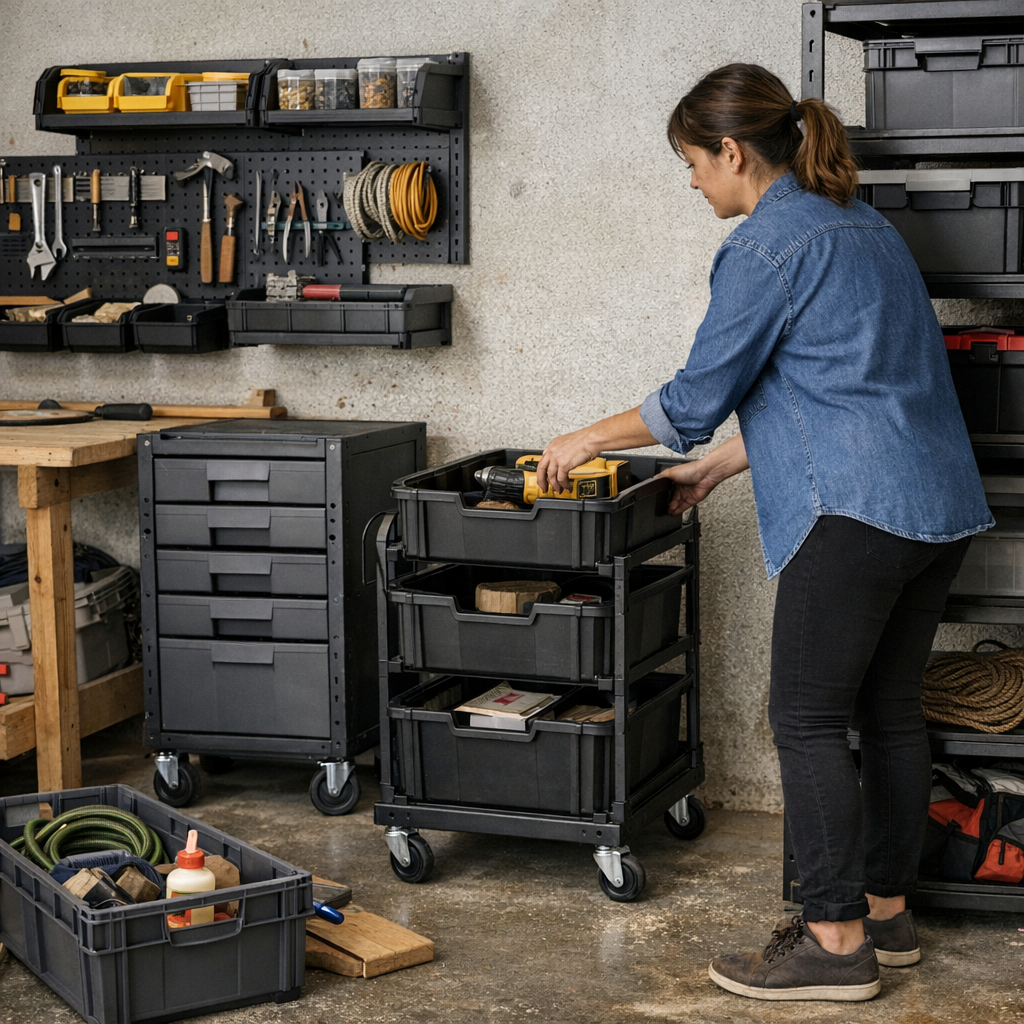
The day after you finish organizing a garage, workshop, or backroom, it feels like you’ve finally cracked the code: bins stacked neat, carts pushed flush, cabinets squared to the wall, nothing out of place. But give it one real week. Suddenly, the cart that’s supposed to tuck neatly under the bench always juts out just enough to block your stride, the edge of a cabinet becomes a repeat bruise on your hip, and a supposedly “clear” floor sprouts clusters of gear—stuff marooned in limbo because there’s no fast, obvious place for it. In the rush of real use, the optimism of an “organized” space collides with the friction points you didn’t see until you actually lived with them.
Looks Right, But Works Wrong: The Setup Disconnect
Most storage plans impress in the planning phase or that first fresh photo. Labeled zones. Uniform rows. All the standard “rules” apparently followed. But reality rewrites those rules by the third full round of unloading groceries, digging for a missing tool, or cleaning up after a weekend project. What was a “logical” arrangement on paper starts to show its flaws in the flow:
- You roll out the tool chest for access, then sidestep it again in the middle of the lane because it never quite slots back without effort.
- That deep cabinet alongside the doorway—great for storage, but you keep catching the handle every time you swing past with an armful.
- Bins are stacked to save space, but once they’re two-high, the bottom one rarely gets put away properly. “I’ll fix it later,” you promise—again.
- The back corner by the utility shelf becomes the designated overflow, with stray bags or boxes collecting until you force yourself to clear it out.
Organization isn’t a one-time act—it’s a living system. If you find yourself hesitating, slowing down, or skirting obstacles more as the week goes on, it’s a signal: your layout doesn’t match your actual patterns of movement and return.
The Nagging Friction of Everyday Reset
In real setups, tiny barriers add up quickly. Each moment you nudge a cart, slide a bin aside, or juggle two tools just to reach the third, the “organized” feel gives way to a cluttered routine:
- Oversized carts or mobile units that sounded versatile in theory, but in practice always seem to land where you need to walk, or block a door’s full swing. You start walking the long way—just to avoid another micro-battle with a misplaced handle.
- Wall panels crowded with hooks seem space-efficient, but grabbing that one wrench always means untangling a couple of hammers, or risking a rattle-and-crash as handles snag each other.
- Baskets and modular bins, bought to tidy up, become unstable piles—the top layer gets emptied easily, but the lower bin becomes a black hole for half-finished jobs.
Clutter never comes in as a tidal wave—it creeps in, the sum of daily detours and delayed returns. By Friday, the quick reset you promised yourself takes twice as long, and “for now” piles start to claim permanent territory.
When “Organized” Layouts Get in the Way
There’s a difference between “looks organized” and “actually fuels the routine.” It becomes clear after any burst of real work:
- The chest you aligned tightly on install now floats an inch out from the wall—always in just the wrong spot, always getting nudged but never really fixed.
- Baskets positioned for efficiency collect overflow when their groupings stop matching project realities. Their system stays pristine in theory but fails in rhythm.
- The deep utility shelf’s back edge becomes a blind spot that collects gear nobody remembers until the season changes.
Any time you’re juggling two objects to put one away, or go through the same awkward shuffle just to clear a walking path, it’s clear: the layout isn’t failing because it’s messy, but because it puts friction where your actual flow demands clarity.
Subtle Tweaks, Genuine Improvements
The best upgrades often aren’t dramatic—they’re surgical. Swapping a too-wide cart for a narrower one instantly frees up the main lane. Shifting a pegboard just six inches can eliminate the unnecessary corner-turn that made every reset awkward. Breaking up an overloaded bin cluster into visible, easily grabbed groupings can keep the return routine almost automatic, no second thoughts or extra shuffling required.
If you find yourself always pushing something aside or working around the same obstruction, identify it and try a small, focused change. You don’t usually need more storage; you need storage that stays out of your way—letting you move fast, put things back as you move, and avoid “for now” piles altogether.
Test Before You Commit: The Real-World Litmus
Before settling on a new position or layout, run through your typical end-of-day reset. If anything—even by a single step—interrupts your flow, nudge the unit or reposition the panel and try again. Over a month, each tiny reduction in friction compounds, making it less likely for clutter to sneak back in and far easier to keep the whole area genuinely usable, week after week.
When “Finished” Actually Means “Effortless”
In the end, the storage system that works isn’t the one you admire; it’s the one you never really notice. If resetting, clearing a pathway, or grabbing the gear you need fades into background habit—no shuffling, no detours, no second thoughts—that’s when your arrangement has clicked. The payoff isn’t just a neater space. It’s reclaiming your workflow, project after project, with less setup and less cleanup slowing you down.
The systems you stop thinking about are the ones that work best. Give your setup a few weeks. If your mind is on the work—not the storage—you’ll know you’ve crossed that line from “organized” to genuinely functional.
Find practical, real-world storage solutions at StackNest.