
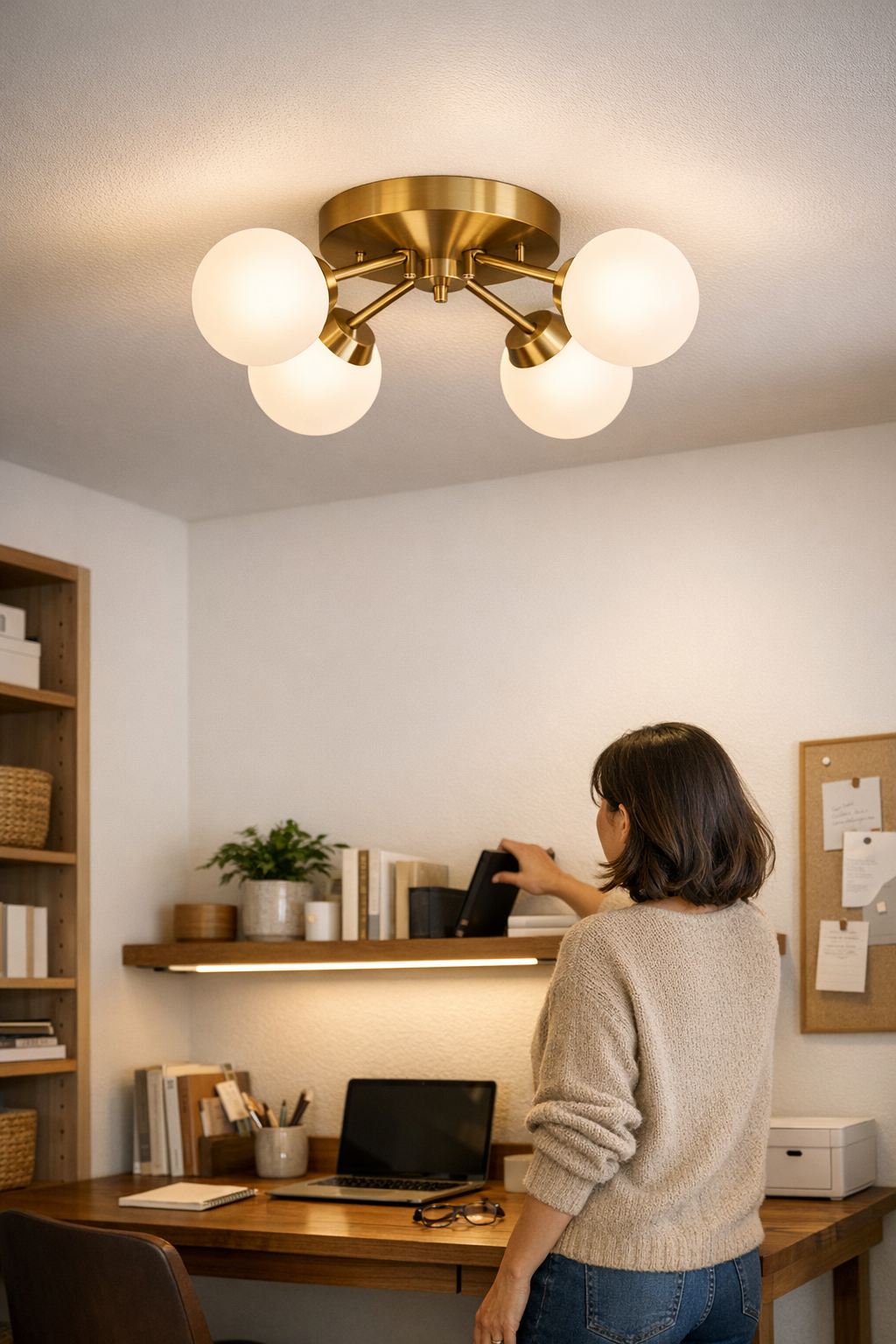
The light looks clean, but the edges keep messing with your routine. You swap in a flush-mount ceiling fixture, check every corner for shadows, and step back—everything seems even, the room brighter, setup “complete.” But the relief fades the next time you reach behind your desk: the outlet is there, but its edge is lost in a shadow the fixture never touches. Try grabbing a charger or notebook from the back of a shelf—suddenly you’re squinting, sliding your hand along a blurry line, second-guessing whether the end is there at all. The surface may look organized, but the cues you rely on—clear edges, visible boundaries—keep falling into a low-contrast haze. In every shared space or compact work zone, it’s the difference between a room that works and a room that quietly trips you up.
The Subtle Problem with “Clean” Ceiling Lighting
Wide flush-mounts, LED discs, and domes are designed to tidy ceilings and create a seamless flood of brightness. The appeal is real: minimal clutter, uniform glow, fewer visual distractions. But the tradeoff sneaks up fast. These fixtures flatten the room’s logic: shelf edges dissolve into nothing, charging cables run unseen across the floor, and organizers slip into the same soft field where nothing pops out. Step into a space “finished” by overhead diffusion, and you’ll spot the pattern—looks neat, but daily tasks start dragging. You spend extra seconds poking through a shadowed tray, inch a chair closer to see what’s tucked behind your monitor, or reach toward a lost USB cable thinking it’s still there. The more you use the room, the more little slip-ups add up. A setup that looked resolved interrupts you again and again.
Why Lighting Boundaries Matter for Real-World Use
Most people don’t discover lighting failure until daily movement exposes it. The real issue isn’t “is the room bright?”—it’s “can I see what matters, right where I use it?” Workspaces and shared rooms rely on visible cues created by light and shadow. Without them, you fumble the edge behind a monitor, miss a box sticking out under a shelf, or fail to see the gap where a dropped pen rolled away. Standard diffused ceilings swallow these edges whole. Everything glows, but the surfaces blend. In spaces that shift roles—work then craft, conversation then cleanup—losing that surface definition means losing speed and certainty. The desk that once felt clear now forces you to hunt for its outline; a shelf becomes a gray plateau instead of a usable divider.
Everyday Friction: A Lighting Scenario
Take a multipurpose family room: work zone, play zone, storage, all under one ceiling light. The glowing flush-mount makes the whole area look composed, but real use tells another story. Chargers vanish into the shadow under a bench, toys drift to the floor’s vague boundary, and you find yourself bent low, checking whether the remote’s tucked against the skirting or simply lost. Quick tasks stall out, and “resetting” the room turns into a loop of double-checking and frustration. The visual map you need—the sharp corners, shelf ends, bin margins—gets washed out, leaving decision fatigue just beneath the surface.
Linear and Panel Lights: Restoring Useful Edges
Upgrading a plain overhead fixture to a linear or panel ceiling light is less about how the room looks and more about whether the space works. Install a linear panel (say, 120 cm) above a desk or shelf in place of a dome, and the result is direct: desk and wall edges become visible; notebooks and cables no longer hide. The space regains orientation. Boundaries and structure reappear—not because the room is brighter, but because the light runs along the working edge rather than puddling at the center.
What flips the script is directional spread. Linear and panel fixtures, when mounted parallel to a key surface or zone, don’t flood everything equally. Instead, they define the long run of a shelf, the border of a desk, the back line of a shared table, without the glare or hot-spots of old strip lights. Now, the high-use areas are readable without bending or guesswork. You sweep a surface and spot stray items before cleaning becomes a hunt. The space functions—the setup starts to cooperate instead of quietly resisting routine use.
Support and Placement: Making the Fix Hold
The fixture matters, but so does the support. The biggest win is stolen by a simple miss: bad cable paths and bracket placement distract from the gain. Ceiling-hugging brackets and thoughtful routing—tucked along a wall, kept tight against trim—keep the fixture low-profile and out of mind. Leave a cable to snake across the open field, or mount hardware that projects awkwardly, and you’ve traded one distraction for another. The goal isn’t just a sharper surface but a room that doesn’t keep reminding you of its patchwork fixes.
Tip: Choose frosted covers for your linear or panel lights—diffusion matters. This avoids harsh contrast, but still carves out the lines and surfaces you need to see. Particularly useful in zones that flex, where routines overlap or you share space day after day.
Living with the Difference: Looks Polished vs. Feels Resolved
For most, the shift isn’t instant; it’s day-to-day relief. Swap to a linear or panel fixture and the subtle drag eases. Small items stay visible, chargers don’t slip out of sight, and the time lost “resetting” surfaces shrinks. Clear desk edges, shelf lines, and bin margins let you check what matters and move on. In contrast, rooms with old domes or globes demand workarounds: dragging a lamp close, nudging a chair for a better angle, or endlessly tidying because clutter never actually leaves—just slips beyond the general glow. The difference? It’s not what you see in a photo, it’s what you stop repeating every day.
Real-World Fixes for Common Lighting Setbacks
- If you keep shifting the main light: Pause and check what’s missing—surface and edge clarity, not just brightness. The wrong fixture forces you to move, tense, or reposition just to see your own workspace.
- Cable and bracket headaches: Use the lowest-profile hardware you can fit, run cords along walls or behind trim, and avoid stretching lines across visible ceilings. Good support keeps new clutter out of view and lets lighting do its job.
- Still losing track of small items: Mount linear fixtures parallel to desks, benches, or shelf runs—not across them. This casts gentle, readable contrast right where items most often go missing.
Worth the Swap: From Subtle Frustrations to Surfaces That Work
A standard ceiling fix always looks fine on day one. But under real routines—shared work, storage, play—the hidden cost builds. Edges blur, searching eats into your focus, and small chores become repeat annoyances. A basic dome substituted for a well-supported linear or panel light changes the logic of the room—especially if you solved for cable clutter and mounting from the start. The payoff isn’t a staged “after” photo; it’s less drag, fewer small frustrations, and a space that finally lets you move on without a second thought.