
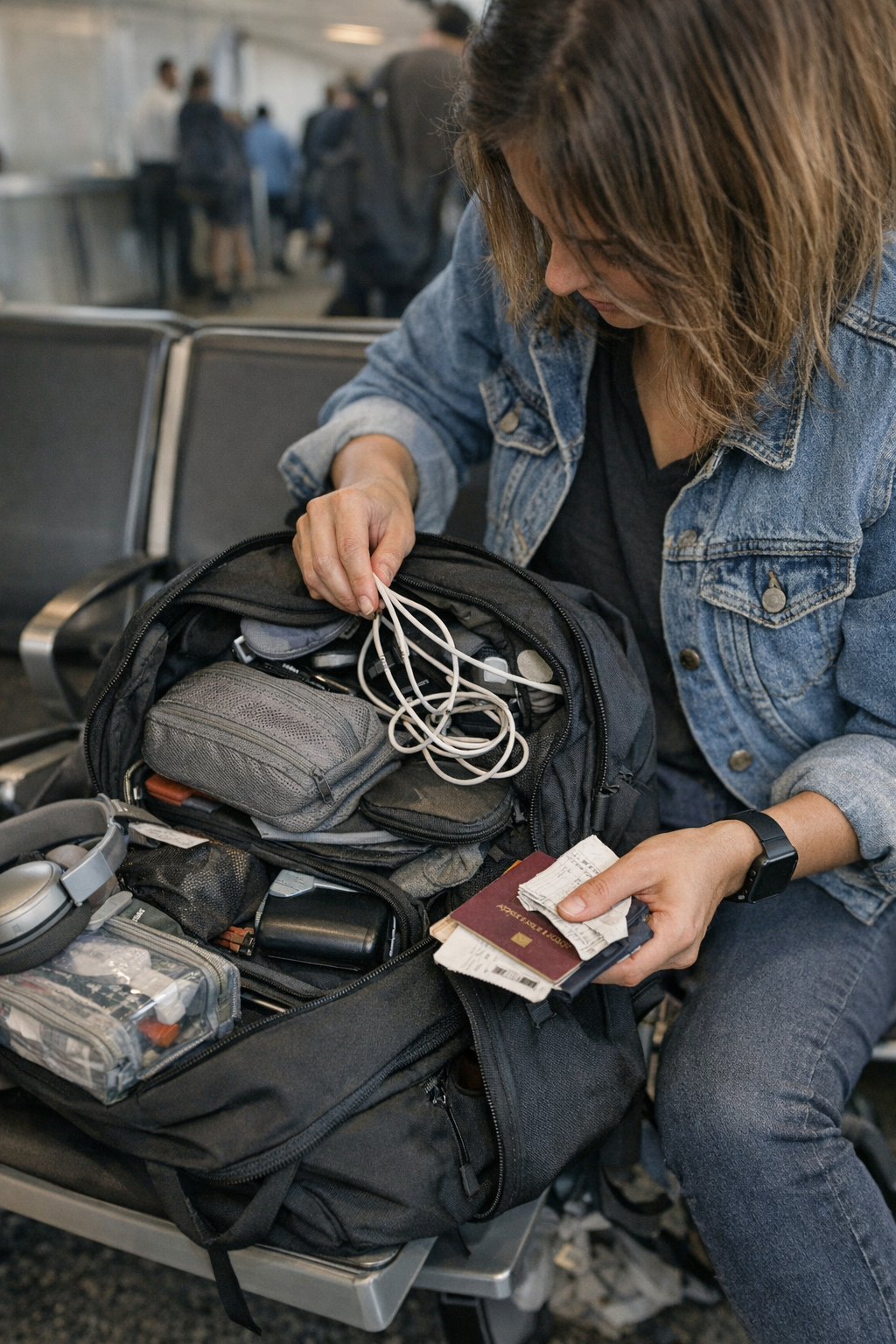
A carry-on bag that looks perfectly organized at home can turn frustratingly slow the moment you hit your first airport checkpoint. Compartments line up, every cable and document has its place—but once you start moving through security, boarding, and in-flight routines, the promise of “neat” quickly wears thin. What seemed streamlined on your hotel bed becomes a hunt for buried passports or tangled chargers by the third reach-in at the gate.
When “Order” Collapses Under Repeated Access
Few travelers realize how quickly a tidy carry-on starts working against you. The system makes sense until you have to retrieve your passport twice in ten minutes or dig through a swelling outer pocket packed with both travel snacks and loose cords. Pouches that nested neatly at first now catch on zipper teeth, refusing to land back in the same spot. Each time you need something, you touch three other things—and every return feels less certain. “Organized chaos” is no metaphor when you’re stuck unzipping layers just to check a boarding pass at the gate.
Most friction builds quietly. There’s no dramatic bag explosion, just a steady increase in fumbled items and misplaced papers every time you reach in. Every two-second search for a sanitizer or cable adds up, magnified by lines, tray transfers, and last-minute boarding calls. By your third gate change, the effort to keep things sorted becomes heavier than the bag itself.
Hidden Costs: Micro-Delays and Unexpected Effort
Travel fatigue rarely comes just from walking or carrying weight—it’s the strain of repeated digging, constant repacking, and access blocked by your own design. Real stress hits in moments like pulling your laptop for security, only to find it wedged under an organizer you haven’t touched since packing. Or hunting for a phone that’s migrated beneath a magazine after a quick retrieval. Overhead-bin lifts turn risky when a bottle starts sliding out because the layout has shifted after every tray checkpoint. Each of these moments turns your bag’s structure from “done” to “undone”—not by mess, but by unpredictable access.
How Compartment Systems Backfire in Live Use
Rows of zippered organizers, stacked pouches, and tech sleeves promise order on paper—but the minute you use them repeatedly, the cost is revealed. The logic of dividing cords, documents, and chargers into separate containers breaks down when reaching your passport means disturbing half your layout. After the second gate check, you’re guessing: Is the ticket in the front pocket or buried between pouches? Cords that started coiled drift into the wrong zone. Now, every security tray is a hurried shuffle, with scattered contents and missed items forcing you to mentally retrace your packing choices mid-line.
Security: Where Setup Decisions Fall Apart
Airport screening strips away the illusion that your system will stay intact. Suddenly, every pouch that promised efficiency demands unstacking, partial emptying, and a risky re-balance. Resealing toiletries or trying to return your phone to its original slot becomes impossible with the next person staring you down at the X-ray belt. The idea of “putting everything back” turns into “good enough, for now,” setting up the next round of confusion at the very next checkpoint.
Boarding, Aisles, and the Blocked-Access Test
The moment you step onto a crowded plane, your bag’s “neat” layout reveals new flaws. Retrieving a laptop from a zippered sleeve becomes an awkward spectacle if it means exposing toiletries, snacks, or hidden cables to everyone behind you. When a bag forces you to open the main compartment in a cramped aisle—risking spills or slowdowns—quick access is gone. The pressure to speed up means papers fall, pouches shift, and now you’re repacking in half-light as the queue moves. What started as disciplined order unravels once fast retrieval is required, not just visual neatness.
When More Compartments Become New Obstacles
More dividers do not mean more efficiency. Every extra pouch or section is another check-point for your memory and another interruption for your flow. Instead of gaining control, you’re juggling micro-tasks: opening layered sections for basics, re-nesting pouches after each scan, or struggling to remember where the snacks landed after your last shuffle. Structure that looked “final” on a hotel desk now multiplies motion and makes quick routines—like passport retrieval or cable grab—awkwardly slow.
The core problem: a segmented bag doesn’t guarantee you’ll move faster—it often adds invisible resistance at every step where you need actual speed.
Reworking for Real: Fewer Barriers, True Quick Access
The biggest relief comes from moving your highest-use essentials—passport, phone, sanitizer, boarding pass, main cable—into a single direct-access sleeve or one main zipper pocket. Eliminating layered retrieval makes action near-automatic: at each checkpoint, everything returns to a known place, with no layers to second-guess. The bag may not win a packing photo contest, but real travel becomes faster and less draining. You don’t just pass security once—you repeat it through each line and reboarding, so the payoff multiplies.
The shift is physically noticeable. After security, restocking is instant—close one zipper and move. Instead of juggling pouches and recalculating order, you keep moving with less pause, and less travel “math” running in your head.
Why Bags Drag More by the End
Your carry-on doesn’t get heavier during a long trip, but the penalty for awkward structure does. Each awkward zip, misplaced pouch, or blocked pocket saps comfort as the day drags on. The setup made to look precise blindsides you by eroding patience mile by mile, not in one dramatic failure but through steady, low-grade obstruction that grows with every repeated use and small disruption.
Choosing Structure That Outlasts Repetition
Packing for aesthetics is easy. Packing for real, repeated access is what saves you at every choke point—from security trays to seat pockets to terminal lines. The test isn’t how tidy your bag looks when zipped, but whether you can grab anything without interrupting your own flow. If every action triggers a ritual of unzipping and balancing, it’s time for a structural adjustment—not another accessory or organizer.
The only setup that works is the one tuned to your real in-transit habits. Start with what you grab most, then shape the rest around that flow—not the other way around. Every checkpoint and seat shift either exposes slow access or rewards a better-placed pocket—your comfort rides on that difference, not just on how “finished” your bag seems at the start.
Shop CarryOnSupply for practical carry-on travel organizers and tools.