
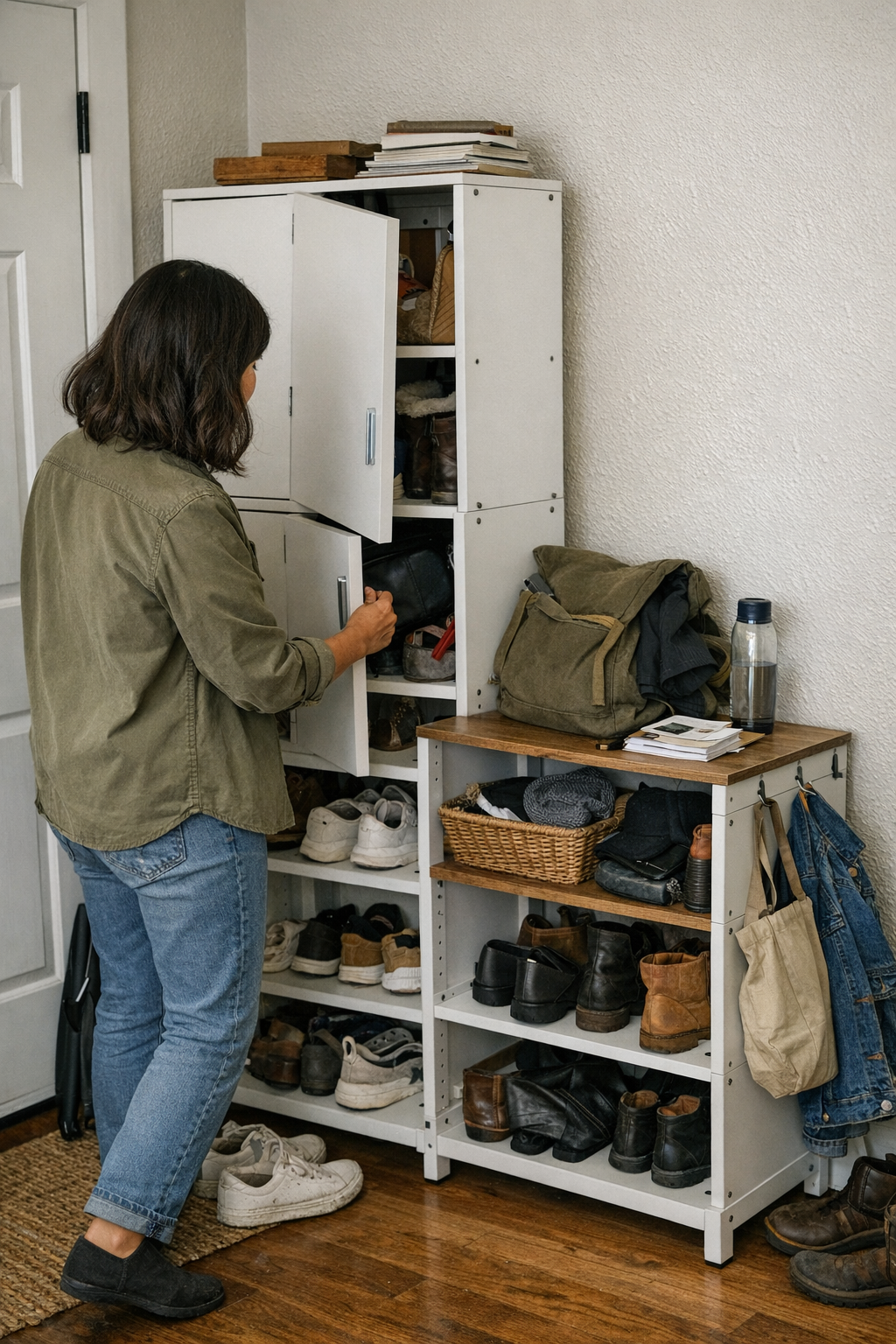
The moment a hinge begins to slip, the whole entryway changes. Suddenly, what was meant to bring order—cabinet, bench, or shoe unit—turns into the kind of problem you can’t ignore: shoes jammed at an angle, cabinet doors needing a shove, and bags balancing on a surface that’s no longer clear. These small failures build up fast in a transition zone, where routines depend on everything working at a glance. The right hardware quietly holds routines together; the wrong detail lets clutter sneak back in every time you step through the door.
When Entry Storage Breaks Your Routine Instead of Helping It
After a wet weekday afternoon, the threshold tells the truth: mud collecting around shoes that won’t quite fit back under a crooked cabinet door, arms full and nowhere to land the shopping because the top surface is already crowded with overflow. Weak hinges don’t flare up instantly, but after a week of normal in-and-out, their effects multiply. Each person’s pass leaves the door hanging a bit lower, the gap opening a little wider, routines tripping on a slow failure you usually don’t spot until it starts costing time. The original storage plan—stash, move, repeat—collapses into friction: pushing against a door that sticks, rerouting around shoes that won’t return, giving up and tossing bags on top when the door’s off and the interior’s blocked. Instead of the cabinet collecting clutter, it’s fueling it, right at the entry.
How Small Hardware Flaws Create Daily Bottlenecks
You don’t notice the drift immediately—but in transition spaces, delay equals spread: The door that used to swing closes now waits for a hard nudge. The top corner sags, shifting the alignment away from your direct hand. Shoes once invisible behind a neat door begin spilling out, kicked forward by each new attempt to force them back. The unit was meant to absorb the daily scramble, but now every access creates a new point of friction: a nick in the door, a backpack wedged half-in. Trying to use a bench for sitting just pushes more overflow onto the adjacent floor. Clutter migrates: one loose hinge turns a single pile into a sprawl, claiming both the surface and the pathway you need clear for re-entry.
This isn’t about how organized you are. Even slim, wall-mounted units look crisp at first but begin to warp under repeated handling if their hinges can’t absorb the real pressure of daily routines. Cabinet lines drift, openings miss the place your foot actually lands, and reach-in access becomes two-handed work. The result: every walk-through needs an extra step, an extra pause—until you start avoiding the cabinet altogether.
Real-Life Scenarios: Where Weak Hinges Break Down the System
It’s the 8:00 AM push—everyone grabs bags and heads out. The entry cabinet, once the solution, now drags at the threshold: doors that don’t shut flush, a shoe row always poking into the path, backpacks teetering on the edge because the gap is off-center. The walkway, built for clean flow, bottlenecks. Each fix—shoving shoes inside, propping the door—works for a day, then resets to chaos. The cabinet was meant to hide the mess, but in practice, its flawed access means mess floods back out, undoing yesterday’s reset. What looks neat for an hour can’t hold up to real, repeated use.
Accumulating Friction: Why Small Access Issues Multiply
Weak hinges don’t just misalign doors—they reroute routines. Every time closing the cabinet becomes a hassle, you leave more outside. Shoes stick out and bring in mud. Bags hang off edges and get left on the floor. The “I’ll fix it later” pile grows, spreading from the top of the unit to a spillover zone at your feet. The intended fix—streamlined entry, gear landing where it belongs—gets replaced by work-arounds: shifting items to make space you no longer really have. Resetting the cabinet, even on a good day, starts to feel like a full chore rather than a quick pass-through.
Slowly, the cabinet becomes less of a threshold buffer and more of a recurring burden. The access you designed for five seconds now costs you half a minute and extra frustration—multiple times a day. Misalignment grows, routines delay, and the cycle restarts after every attempt to reclaim the zone.
Threshold Pressure: When the Walkway Gets Blocked
In tight thresholds—narrow entries, garage landings, backdoor slips—every extra step matters. A cabinet door that catches, or a bench edge that drifts into the walking line, tightens the space until even a small crowd turns into congestion. Most won’t bother to adjust the hardware midweek, so overflow migrates right to the edge: shoes creeping into the hall, bags flaring sideways, shouts to “clear the entry” repeating with every delayed reset. After a while, storage that doesn’t store well is worse than none—it disrupts the core transition path itself.
What Actually Changes with Sturdy Hinges and Reliable Placement
Reinforcing a cabinet’s hinges or upgrading to hardware designed for daily stress isn’t just a technical fix—it’s a reset of how the space works. With solid steel hinges and a cabinet set about 5 centimeters off the wall, the door swings fully open and closes flush every time, freeing access and allowing shoes or bags to return in one move. Overflow stops crowding the top—now a true drop spot, not permanent storage. The difference isn’t visible from across the room, but in use, resets last: clutter stops accumulating, and the walking line stays open, no matter how many cycles the space sees. Routines become automatic rather than interrupted by the cabinet itself.
Tip: Read the Warning Signs Early
If your cabinet door hesitates, needs nudging, or swings back open a day after resetting, don’t wait. That’s the transition-space equivalent of a check engine light: upgrade or reinforce hinges immediately, or you’ll see a simple drift turn into a daily cleanup spiral. The payoff isn’t just neater lines—it’s a transition zone that absorbs pressure and keeps routines intact, even as season and household demands shift.
Quick Checks: Is Your Cabinet Handling Repeated Use?
If you’re not sure where the breakdown is happening, look for these practical signals:
- Doors that resist closing, ask for a shove, or misalign after a week point to hinge fatigue.
- A sagging sightline, even slight, means screws are pulling or hinges are loosening—check them immediately.
- If shoes and bags spread farther across the floor week by week, your “return flow” is blocked by poor access.
Minimal reinforcement sometimes helps for a while, but if you’re resetting or realigning the cabinet more than you’re actually storing things inside, the friction is here to stay. Entry storage built for daily threshold use—solid hinges, robust frames, intentional placement—keeps the flow smooth and makes organization stick longer between resets.
The Difference: A Setup That Resets Itself
In everyday use, hardware and structure decide whether storage is background support or a fresh source of frustration. Reliable hinges and purposeful placement mean you only need one gesture to return shoes or bags—and seldom need to think about the cabinet at all. When your setup absorbs the wear, routines remain stable, and you reclaim time and clarity at the door, instead of fighting daily resets that fail. The whole point of transition-space storage is to keep movement free and resets minimal. If you’re spending more time wrestling the cabinet than passing through, it’s time to rethink what counts as “organized.”