
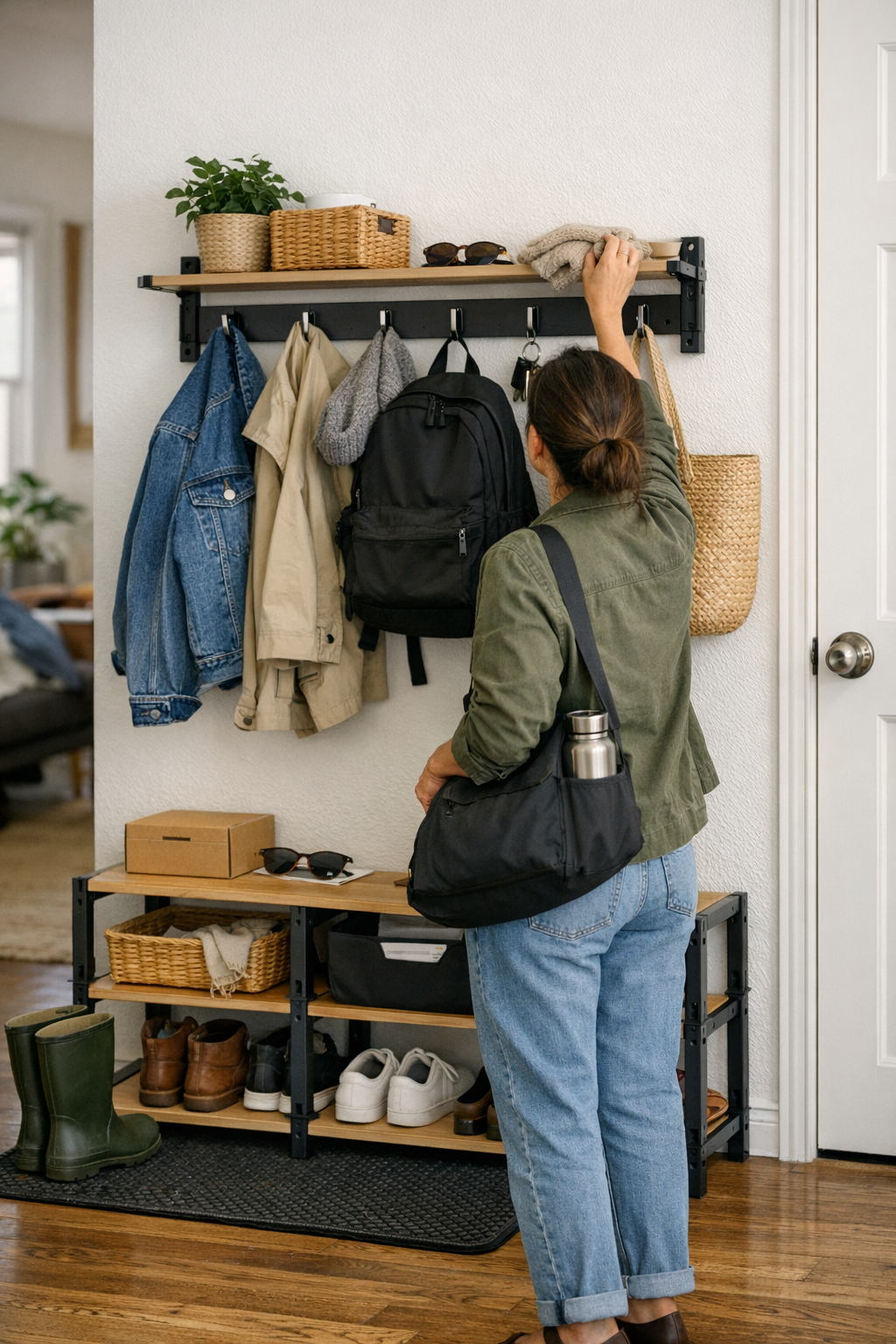
The difference between an entryway that keeps pace and one that collapses under daily pressure shows up faster than you’d think. Within days, setups that seemed organized—coat tree, shoe row, quick bench—begin to snarl. Bags land wherever’s open, shoes scatter far from their original “line,” and the morning’s neat look fades as soon as family routines collide at the threshold. If you care about more than appearance—if you want a drop zone that holds up to the real scramble—how you structure that space decides whether you’re resetting every night or tripping over your own gear by Wednesday.
When Floor Space Becomes an Obstacle
Coat trees look tidy for about 48 hours—but by day three, the limits surface. Shoes at the base spread from a single row outwards, forcing sideways steps just to navigate the space. Backpacks loop over hooks until the top sags, scarves slip off, and the floor beneath turns into a bag-trap. If you have to pass someone at the door, it turns into a bottleneck: sidestepping, scooping up what fell, trying not to grind a wet boot further into the zone. The shrinking walkway rarely feels obvious until the clock’s against you and suddenly, your own drop zone slows you down.
This breakdown is nearly guaranteed in any busy threshold. Mornings might start under control, but by evening: shoes kicked at strange angles, hats quietly migrating, “temporary” bags now camped out for days. Resetting doesn’t restore order—it just shifts the mess. Instead of a usable flow, you get a rotating pileup with less and less walkable space between the piles.
Why Wall Hooks and a Shelf Change the Equation
The major shift is vertical—lifting the whole system off the floor. Wall hooks carve out set landing spots: coats each to their hook, backpacks to their own peg, loose items to a shelf. Now, nothing layers over something else, and nothing drifts beneath your steps. Instead of a pile swallowing new arrivals, each piece has a boundary—if it’s out of place, it shows. Bags can’t hide under damp jackets, shoes don’t block the door, and the process of getting out or coming home actually fits how people move through the space.
In small or high-traffic entryways, this separation controls the spread. Hooks prevent category collapse—coats aren’t fighting for space with bags or hats. Resetting is direct: hang, straighten, maybe wipe the shelf. The time spent untangling a shoe pile drops to seconds. The cost of a weak system isn’t mess; it’s friction—delayed departures, awkward entries, and repeated micro-resets that chew up every transition.
When the System Holds (and When It Slips)
The right gear still depends on the right pattern. Hooks spaced about a hand’s width apart let even oversized coats hang without a tangle. Pack hooks too tightly, and you’re back to awkward overhangs and stuff slipping to the floor. Too wide, and you waste the most precious real estate on the wall. The shelf works only as a strictly limited landing zone—overflow invites a quick return to chaos. For entryways to stay workable, discipline trumps decoration: assign hooks and enforce what goes where, or the vertical system just becomes a new kind of drop pile.
Scenes from Real Daily Use
The After-School Wave
The moment the kids come through the door, the test begins. First backpack dropped, coat added, shoes—still wet—kick off at the border. With a coat tree, just two or three bags tip the whole thing toward collapse: straps slip, the walkway isn’t really open, and you owe yourself a reset before dinner. But with wall hooks properly lined, every kid’s gear lands in its slot, shoes gather under their spots, and you can still get through. The need for a late-night scramble to clear the path? Mostly gone.
The Wet Gear Problem
Coat trees clump damp jackets together, trapping moisture and hiding drips below. Anything on the floor—bags, shoes, hats—ends up soggy or worse. Wall hooks, even at a modest spacing, leave enough room for sleeves to air-dry, and a hard mat underneath shields the floor. The difference is obvious not from how it looks, but in how much less cleanup you do after back-to-back rainy days. There’s still drying out and stowing to do, but you’re not prying up damp piles hours later.
Late Arrivals and the Reset Crunch
When you get home late, the urge to toss things high and collapse is real. If the coat tree is already near its limit, one rushed drop sends the rest slipping to the ground and blocks tomorrow morning’s exit. With wall hooks, every decision happens at eye level, one item to one bracket: the moment anything’s out of place, it interrupts the line. Instead of cleaning up a zone-wide sprawl, reset is a matter of rehanging and nudging a pair of boots—not a nightly production.
Setup Matters: Small Adjustments, Big Difference
The strange part of optimizing an entryway isn’t the hardware; it’s the boundary discipline. Hooks must be close enough to discourage doubling up. If, after a few days, kids or adults start sharing hooks or overfilling the shelf, category drift wraps the space right back to where it started: bags on the ground, shoes beyond their edge lines, and coats layered so thick they slide. Fixes that aren’t anchored or suit only the first week’s gear will drag the whole system down—sometimes literally, if a sagging shelf or loose nail lets half the zone spill at once.
Recognizing the Difference: Looks Versus Working Flow
What looks restful at first—namely, a new coat tree or floor rack—usually misses what the entryway is actually asked to handle. Real use is measured not by neat stacks but by how smoothly people pass through, how quickly the area resets, and whether you can see irregularities at a glance. Wall hooks and a narrow shelf don’t just show less gear—they force a return flow. If something’s off, it sticks out, making the next trip through less likely to bottleneck or collect new clutter at the threshold.
The strongest test isn’t initial order but repeated movement. Systems that ignore motion and allow for hidden overflow might “store” more, but they interrupt the most basic function: coming and going. A hook and shelf setup keeps those movements sharp and the burden of fixing—at the end of a messy day—light enough to do without a second thought.
If Your Entryway Fills Up Fast, Vertical Storage Holds the Line
If every return home means dodging bags, stepping over shoes, and squeezing through the same pinch points, it’s more than a small annoyance—it’s a sign your setup isn’t holding up. Wall-mounted hooks and shelves draw a visible edge: this is where gear goes, this is what’s out of bounds. With boundaries set, resets stay simple, and the floor stays open enough for everyone to pass—whether the week is calm or frenzied. The layout answers not just to appearance, but to repeated, real daily movement; vertical storage quietly holds the line where other solutions break down.
Visit Betweenry for practical transition-space storage designed for real entryways.