
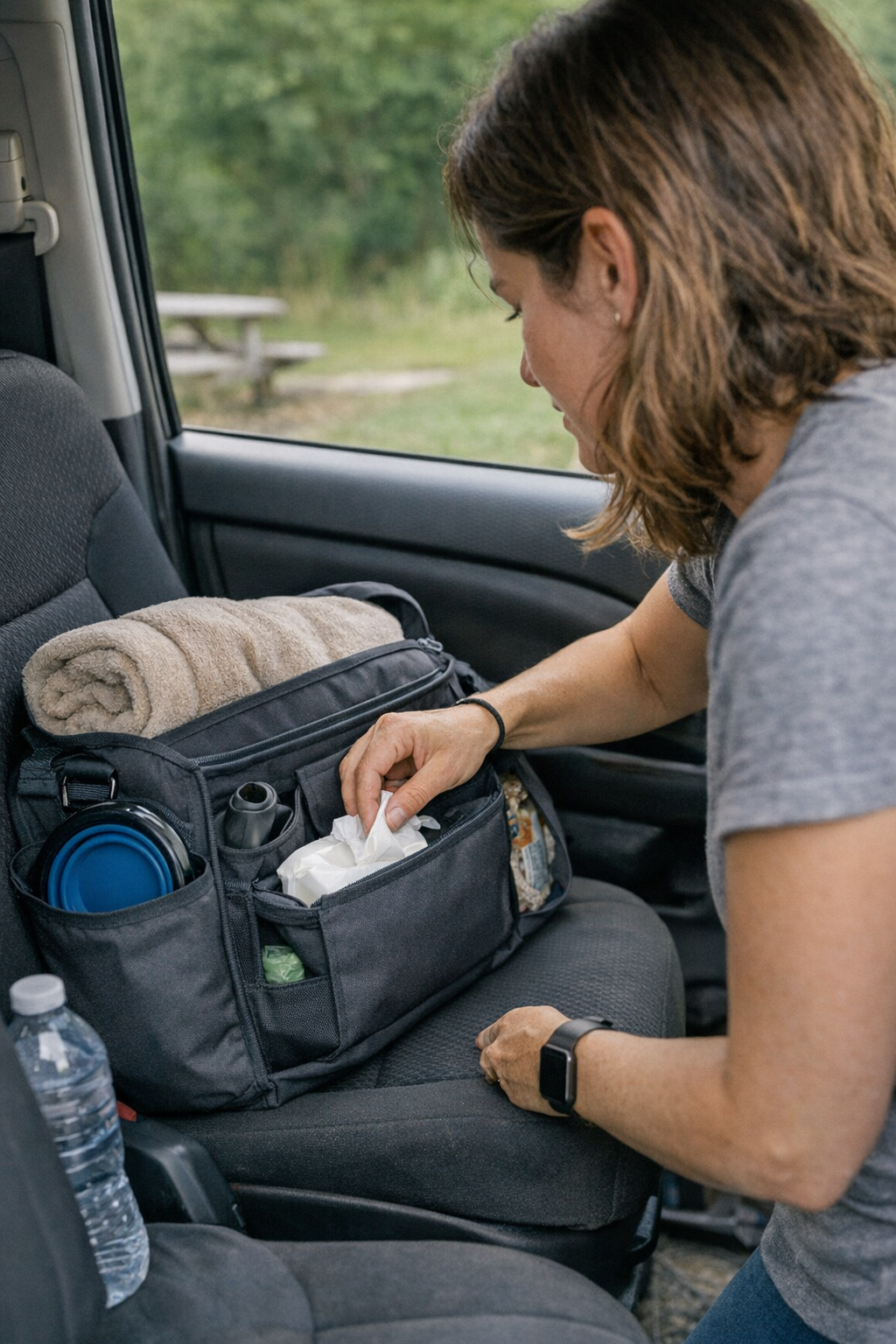
The moment your trip turns from calm to chaos usually isn’t dramatic—it’s that third stop, where your so-called organized pet setup leaves you elbow-deep in your own travel bag, searching for wipes or your pet’s comfort item while your dog pulls against the leash and the door clock ticks on. Everything looked tidy when you left the driveway: leashes coiled, wipes inserted, bowls nested. Half an hour later, the cracks show—what you need has drifted out of reach, bowls spill into pockets, and items that were “packed for anything” now block the one thing you actually need. Travel with pets doesn’t break down because you’re unprepared; it breaks down because most organizers are prepped for display, not for repeated hands-on use in a moving car.
Why Do Pet Travel Setups Break Down So Quickly?
Most pet travel kits fail in the same predictable way—not at first, but once you’re two or three stops in. A neat bag at departure means nothing when motion, restarts, and real-world mess get involved. The leash that looked simple to grab is now tangled with a blanket. That “easy-access” wipe pack? Pinned behind a sloshed water bowl. Try to calm your pet mid-trip and suddenly the comfort item is anywhere but accessible. Each restart magnifies the disorder until every quick pause demands a full reorganization, robbing you of any rhythm. The friction builds with every round-trip to the trunk or scramble at the seat edge—yet, to an outside eye, your setup still looks organized.
Most “minimalist” travel organizers or all-in-one packs aren’t built for motion. They promise less clutter, but tiny, overfilled compartments and undivided spaces simply trap your essentials together, so every attempt to grab-and-go launches a minor rescue mission. Packing to look organized—versus packing to handle pressure—are opposite skills.
The Too-Tidy Trap: Organized, but Awkward
A pet travel bag with single zippers and shallow dividers looks sleek at rest. But the second you’re moving—pet shifting in the back seat, traffic stop after traffic stop—its structure reveals its weakness. Two stops in, your bowls and bottles are wedged under a leash, which has spiraled through the comfort blanket. The wipes you meant to reach one-handed are sandwiched between owner snacks and spare gloves. Each stop, you dig and re-layer, burning patience and letting your pet grow more agitated at the hold-up. Efficient on paper becomes awkward in practice, and the time saved by “clever” storage is eaten up by repeated interruptions.
Here’s the core problem: Real-world travel exposes organizers that only work when untouched. Friction isn’t obvious in a static, zipped bag, but in motion—especially after a few restarts—the wasted seconds, muscle memory of the repeated hunt, and the sigh you hear from the passenger side add up.
Repeated Stops: Where the Weak Points Surface
Picture a standard highway run. Three stops in two hours, your pet is restless, the bag now a minor battlefield. That comfort blanket folded neatly by the door? Wedged under a seat. The spare leash? Looping around a bowl. Wipes, which looked ready, now drift into a chaos pocket or even roll onto the floor. It’s death by a thousand small inefficiencies: fumbling for a single item, the drag of a five-second pause here, a muttered apology there while your pet watches your process fall apart.
It’s the routine that collapses, not just the system. Suddenly, you’re not just grabbing a comfort toy—you’re pulling half your day’s supplies into the parking lot to find it. A travel kit designed for “before and after” moments (packed neatly, zipped closed) won’t keep up with the stop-and-go reality of travel. Even your travel partner notices the delay, feeling the travel flow break under the strain of clashing compartments and unpredictable item migration.
Setup Overlap: When Essentials Keep Getting in Each Other’s Way
You’ll spot a failing setup not by its appearance, but by the way essentials migrate against each other. Bowls and leashes tangle, wipes disappear into the main pit, treats drift toward your own backpack, and comfort items get buried under owner-layered jackets. What felt sleek at the start is now a slow shuffle at every stop. Instead of an answer for each problem, you get a tangle that demands a puzzle-solver’s patience just to find the basics for a bathroom break or hydration stop.
Typical weak points include:
- “All-in-one” main spaces that force every item into collision—making a quick grab for one, a full empty-out for all
- Pockets that don’t truly separate: wipes jammed behind bowls, small gear sinking out of sight after sharp turns
- Pet/owner spillover zones—phone, gloves, and snacks drift into the only wipe compartment, making two routines unravel together
Real Use Says “Separate, and Keep It Accessible”
Setups that make pet travel easier aren’t the ones that boast compactness or symmetry—they’re the ones that let you reach exactly what you need at exactly the right time, without a reshuffle. It means:
- Side-access wipe pockets you can hit with either hand while half the gear stays contained
- Dedicated comfort sections where a blanket or toy never slides under bowls or gear, but always sits at the edge for single-move access
- Total separation of pet and owner items so your bottle or keys never disrupts leash or treat access
Just having a left-handed wipe slot or a no-migration leash section changes the entire travel flow. Spills can be handled in one move. The comfort item comes out with zero dig. After several stops, you notice you aren’t hesitating or mentally rehearsing what’s in which section—you simply reach, handle, move. The structure finally fits the real world of travel, not just the “packed” moment.
How One Tweak Made Real Stops Feel Simpler
The improvement isn’t just incremental—the difference is immediate once you put a separation-first organizer to the test. Shift from a jumble bag to a kit with quick-access saddle pouches, fixed comfort zones, and true leash slots, and you cut not just time, but the frustration that saps every trip’s energy. What was a source of repeated hassle turns into an afterthought.
Here’s how it shows up: Pull off for a break. Without even turning, you reach the right zipper and the wipes are in your hand. The comfort blanket lifts out without disturbing anything else. Bowls stay upright, each in its own spot; leash never blocks your fast exit. Restock and reset take a moment. Suddenly, those tense hold-ups vanish, and your pet watches you—not because your system failed, but because you’re already moving again. That anxious pause at the seat edge? Gone. Even after multiple stops, the kit is still working for you, not the other way around.
If the structure gives you back your rhythm—every trip, every restart—it’s the sign you’ve outgrown ordinary travel gear.
Spotting the Right Structure for Your Routine
Repeated frustration is your cue. Find yourself fishing for one item, elbowing past snacks and gloves, or catching a restless pet’s eye as you delay yet again—it’s not about bad planning, it’s about outdated setup. Organizers meant for “real travel” reduce drama at the seat edge, let you return to movement faster, and protect both your routine and your pet’s calm. The bag that supports you isn’t the one that looks good zipped shut; it’s the one you barely notice because every motion just works.
The ultimate feedback isn’t how tidy your kit looks after packing—it’s how invisible the kit becomes after three stops. If you’re reaching in the same place and finding what you need without a search, you’ve finally found a setup that travels as hard as you do.
For a practical range of pet travel bags, organizers, and kits built for repeated real-world movement—not just for the moment before departure—visit PawGoTravel.