
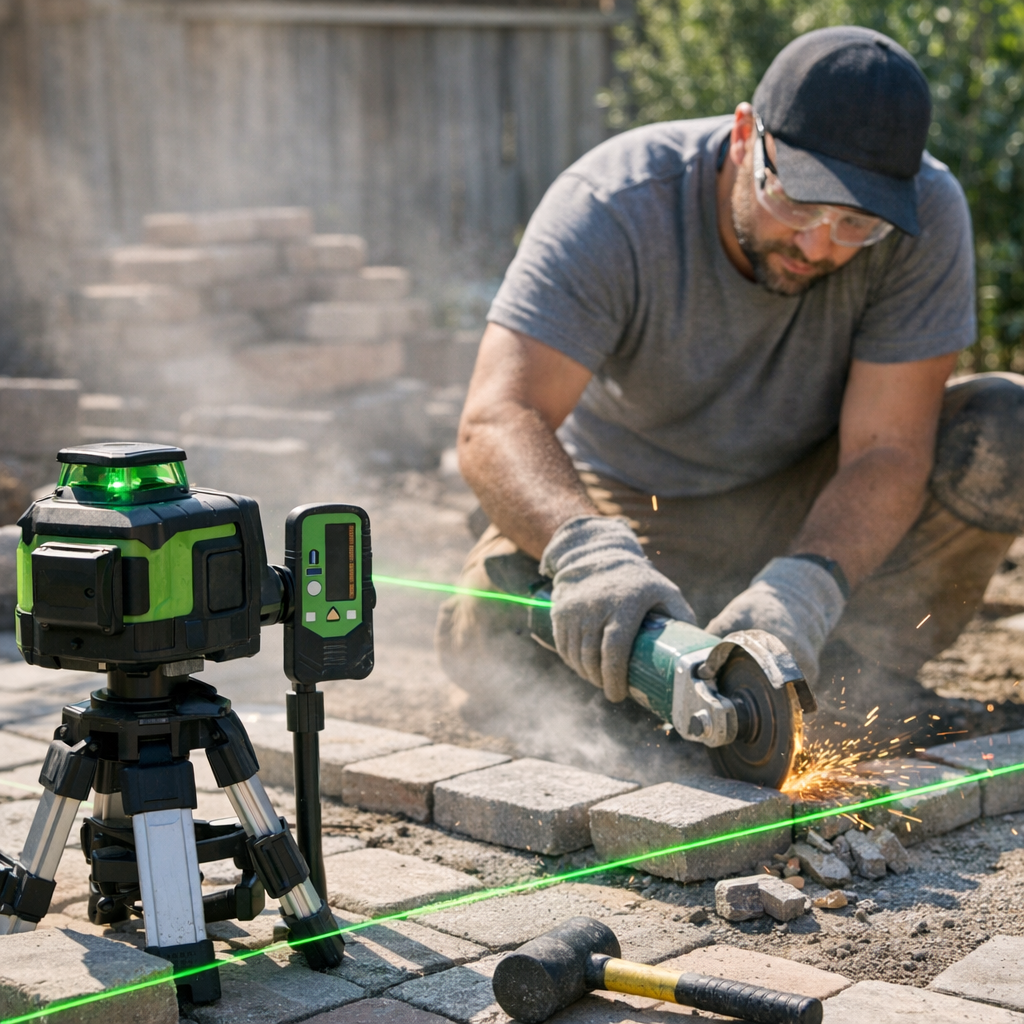
Midway through a cut, the line vanishes. It’s not subtle—you step back, the sun’s at your shoulder, and the laser you relied on has simply faded out. Now you’re no longer guiding the saw, or the drill, or the sander. You’re squinting, guessing, propping up your body just to catch what used to be a clear, bold guide. What was supposed to be a quick, precise setup out on the slab or pavers turns into a slog of double-checks and backtracks. Each tool pass grows more cautious; every movement gets tenser. And somehow, the jobs you planned for one trip across the line end up forcing two, three, or more—just because your alignment faded away the moment you needed it to last.
When Sunlight Erases Your Reference
Laser levels are a given for cutting, fastening, marking, or aligning outdoors. Indoors, nearly any cheap red laser holds up. But take that same tool out onto an exposed patio or driveway, and its line disappears as the sun clears the trees. On pale stone or wet concrete, even turning your head can lose the alignment.
The friction isn’t just “harder to see.” You’re suddenly shielding the laser with a gloved hand, crouching at odd angles, and moving gear around just to make the beam visible. There’s a constant choreography—dropping tools, blocking glare, hoping you can hold everything steady long enough to mark a single true line. As the day rolls along, all those adjustments snowball. Precision unravels; tool trust goes out the window. By noon, your tape measure gets more use than your blade.
How Faded Lines Multiply Mistakes
A single missed alignment rarely ruins a project—it’s the snowball effect that eats the day. Lining up for the fourth brick cut, now the guide’s a guess. Later, installing deck brackets, you find yourself drilling slightly off, making mental notes to “fix it later.” Every pass where the line is faded means the next task inherits that slippage, whether it’s a grinding disk straying off or a sanding block tracing yesterday’s crooked guess.
Gradually, jobs take longer—marks need adjusting, seams don’t close, cuts overlap. By late afternoon, actual progress gets lost in a cycle of fixing what wasn’t right on the first go. When the guide line can’t keep up with the conditions, your whole rhythm turns into repair work and remeasurement, not building.
Hands-On: The Laser That Disappears in Plain Sight
Imagine grinding tile for an outdoor step. You grab the laser, fire it across your workspace, and for the first hour, it’s crisp. Then sunlight hits full force. What used to be a bold line now flickers—one minute clear, the next a suggestion. You waste time ducking and weaving just for that brief angle where the line’s visible. Each time you guess, there’s a wobble in the cut. The result? Uneven joints, extra sanding, and the same tool running twice as long, all because the beam vanished under open sky.
When “Good Enough” Isn’t—Why Laser Choice Matters
On the shelf, all laser levels seem similar—solid blocks, bright packaging, the same line promises. In use, they’re worlds apart.
Field-ready models stand out by output, color, and accessories designed for real outdoor stress. Entry red-beam levels run soft diodes—their lines evaporate in sunlight. A good green-beam upgrade means richer visibility at a glance. Lock in a pulse mode or use a receiver, and the laser becomes readable at surprising distances, even across light stone or asphalt. The difference isn’t just comfort; it’s fewer stuttered stops, less repositioning, and far less guesswork on every pass.
The Fatigue Factor: What Cheap Tools Cost
Use a bargain indoor laser outside, and the hassle compounds: more kneeling, more arm strain from awkward reach-ins, more bent-neck stares waiting for the beam. You start feeling it before you notice; fatigue creeps in as every step turns manual. At end of day, it’s not just thrown-off cuts, it’s the drag of physical wear—time and energy lost wrestling with a tool never designed for the light you’re actually working in.
What Improves with the Right Laser in the Mix?
Upgrading isn’t about “tech for tech’s sake.” It’s the difference between trusting every move with the saw or driver, or checking, correcting, and apologizing for drift all afternoon. A green-beam outdoor laser with a receiver means one bold line, visible at the actual spot you need it: on sun-washed tile, on a hot deck, on pale block. Cut paths turn steady again. Fasteners find their holes. There’s a visible guide from first setup to final fit—no matter what the sky’s doing.
Shielding the beam goes away. You’re no longer trying to remember where the line was—you just see it. Movement smooths out. Your body stops contorting to chase a signal that’s always fading. There’s real, physical relief: less second-guessing, less rework, more time moving forward.
Real-World Gain: Smoother Flow, Fewer Corrections
The biggest shift isn’t perfect speed. It’s the return of quiet control—with the right tool, you finish more jobs on the intended line, not the fallback. You stand up straighter, use fewer bandaids, and the workday feels productive rather than patched together. When you have a reliable line, every tool—from grinders to sanders—performs closer to its real potential on the first pass, not after a round of fixes.
When Your Laser Level Is Quietly Holding You Back
Not sure your old laser is the bottleneck? Look for the red flags: repeated seam gaps, angles that don’t add up, long shadows as you eye the mark from three spots before moving. If you’re holding tools still just to make out a line or squatting for “the right view,” the job’s already harder than it ought to be. The cost shows up in wasted cuts, sore wrists, and—over a week—a lot of lost minutes and material.
Field tip: Test your current laser outside mid-afternoon. If the beam’s nowhere to be found—or fades by the time you walk a few paces away—it’s not up to outdoor reality. Consider a dedicated green-beam model with a good receiver for conditions your projects actually see.
What You Miss When You Don’t Upgrade
Precision on site isn’t just about tools—it’s about tools that suit the actual friction of your day: sunlight, glare, squinting, and lines that vanish with every cloud break. The wrong laser level drains accuracy, saps energy, and demands more bodywork than you’d ever plan for at the start of a shift. A proper upgrade pays for itself not in marketing claims, but in hours recouped and work that finally tracks with your own standards.
The next outdoor job—be it pavers, patio cuts, or bracket installs—comes down to the line you can actually see when you start, and when you finish. Choose the tool that keeps up, and the entire process shifts from patchwork toward real, usable progress—on schedule, and under open sky.
Explore more job-ready laser levels and outdoor tools at Gumboll.