
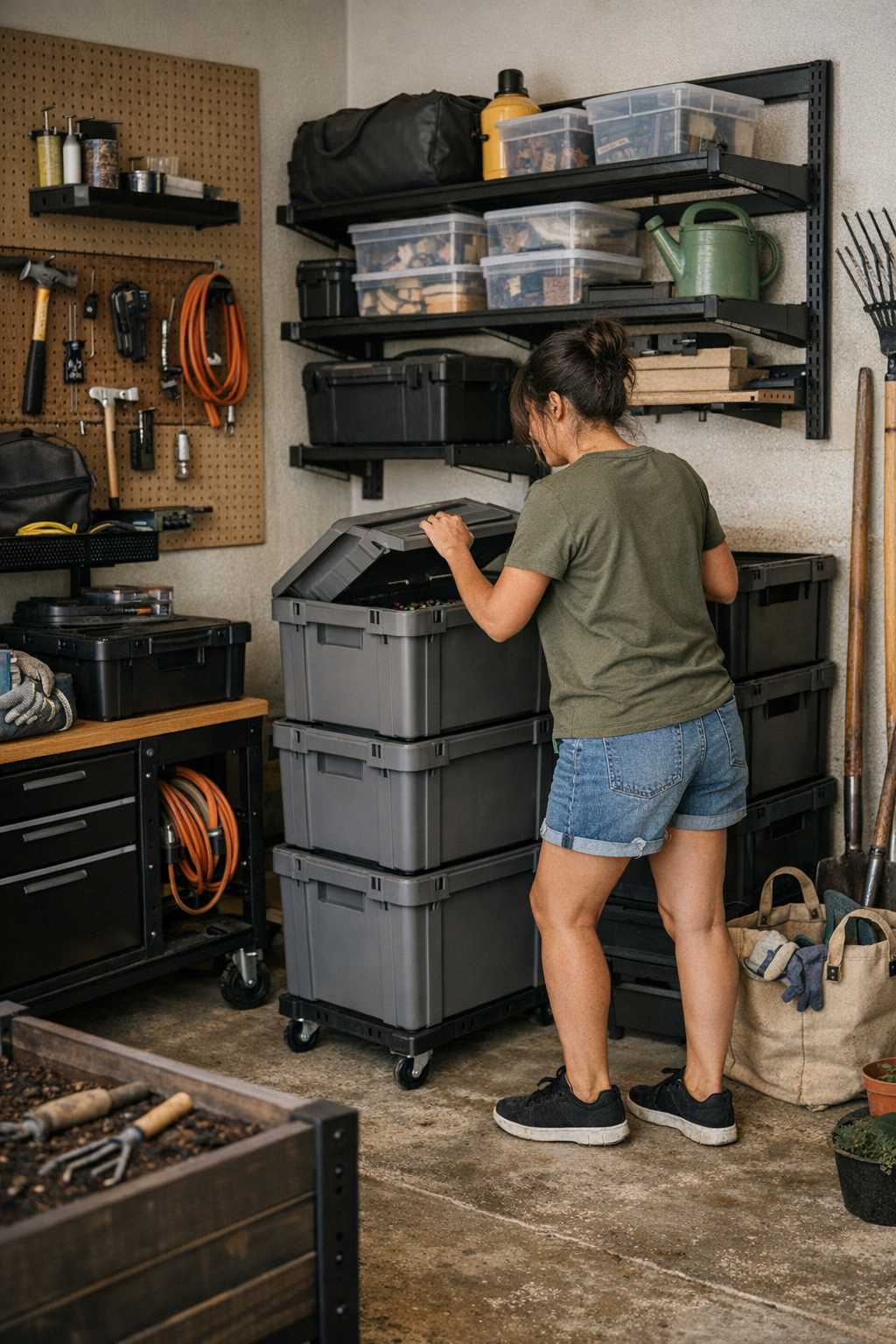
The first day, stackable storage bins feel like a solve-it-all setup. Everything fits flush along the wall, the floor magically reappears, and the idea of “just add another bin” makes your storage system seem endlessly adaptable. But fast-forward a month, and the cracks show up in the routines that actually matter: tossing clutter becomes a late-night hassle, and you find yourself stuck—again—lifting and restacking half the tower just to fish out a charger, a trimmer, or a box of screws buried in the middle. The promise of endless flexibility slides into a familiar grind: more stacking, less movement, and a layout that stores plenty but never quite works for real life.
Where Stackables Stall: Pressure Points in the Actual Routine
Stackable bins advertise a clean visual result—neat towers, open floors, every bin snug to the wall. On install day, it looks like you’ve unlocked hidden square footage in the garage, shed, or workshop. But that “wow” moment is short-lived. The real test is when you’re actually moving through the space—arms full, in a rush, just needing to drop something where it belongs and get on with your day.
Three months in, it’s not the order but the friction you notice: dragging a tower out again just to pop the lid, bracing with a knee so you don’t topple over the stack, always a little careful not to scuff paint or jam your fingers. The more you stack, the more hesitant your movements become. Floor stays clear, but only because the effort has multiplied elsewhere—one blocked path traded for another. You still can’t get to what you need without a shuffle dance.
The Return Problem: Permanent Clutter in Disguise
Picture the usual scene: you finish up outside or in the shop, hands dirty or loaded, and on instinct you head for the storage wall. But the bin you need—cable, paint roller, hand mower—lies beneath the others. Lifting the top stack isn’t quick; it’s an interruption, so you compromise and set things “temporarily” in the nearest open spot. The pile that’s supposed to reset the area instead becomes semi-permanent. Soon, you’re edging around bins near pathways, sliding a rolling cart out just to swing past, or reaching one more time around the side of a cabinet because the “perfect fit” blocks your movement, not clutter.
The Illusion of Order—Day-to-Day Upkeep Slows
A wall of perfectly aligned bins can make a disorganized space look tamed. But if every return means fishing for a lid or shifting weight, the speed of the routine grinds down. What starts as visual order quietly blocks momentum. Each reset, instead of taking seconds, becomes its own little project. The space isn’t flowing—it just appears to.
When Storage Bites Back: A Closer Look at Friction
Here’s how it plays out: late spring swap, winter gear out, garden tools in. Where’s that short-handled rake? Middle of the tower, naturally. One by one, you:
- Grab the two upper bins—awkward, never as light as you remember. Both hands needed, extra caution as you shift the stack.
- Pray the remaining bins stay upright as you dig into the middle layer.
- Find yourself creating a drop pile with whatever doesn’t return instantly—tools, gloves, cords—because the whole process is too slow.
- Restack, knowing the order will never be as crisp as that first setup. Glance back, and there’s already the start of a “temporary” overflow zone at your feet.
Run this play enough times, and you’re no longer saving space—you’re spending it differently, in the form of overflow piles and move-it-later piles. Each use fills up your mental corners as much as your physical ones. A system built for flexibility slowly loses its edge, demanding more out of each reset and leaving dead corners stubbornly unhelpful.
Breaking the Stack: A Simple Tweak, Real-World Payoff
Not all stackable setups fail outright. But as towers grow—five, six, even ten bins high—the system shifts from efficiency to obstacle. One of the quickest fixes shifts everything: split one tall stack into two (or three) shorter sets. Immediately, you cut the teardown steps; what you need is only one lift away. Access speeds up, and “temporary” piles fade because you’re not dodging a multi-bin puzzle every time you tidy up. The path through the area gets wider, and overflow drops off as up-front bins get used and reset in seconds, not minutes.
Another trick: exile the rarely-used gear to shelves or cabinets. Reserve direct-access bins for the things you’re always reaching for—extension cords, gloves, gardening tools, charging cables. Once you sort what’s “in play” from what’s just “in storage,” your daily reset becomes almost automatic. That’s the kind of modularity that pays off in practice, not just on install day.
Stackables vs. Shelves: How Each Holds Up Under Routine
Compare bin stacks to mounted shelves or a solid cabinet. In theory, all free up floor and hide clutter. But only shelving keeps pace when cycles pick up. With stacked bins, every added bin slows you down: more shuffling, more heavy lifts, more decisions. With shelves, nothing is blocked. Pull, return, move on—no rearranging required, no dead zone behind a leaning tower. The space stays in sync with your routine, not in the way of it.
- Stackables: Compress things fast, but force a disruption for anything not on the very top.
- Shelves/Cabinets: Everything stays accessible. No reshuffling, no surprise logjams during cleanup.
The contrast is sharpest for “hot” zones. If you use the contents every week, rigid bin stacks become a drag. For stuff you touch once a season, they’re fine—until you start piling up gear that should live at arm’s reach.
Are You Organizing the Room—Or Just Rearranging the Problem?
Great storage isn’t defined by how tidy it looks the day you set it up. It’s about whether your routine stays smooth for months. Watch for these cues:
- Paths blocked by vertical stacks or disconnected clusters of bins.
- Overflow zones quietly growing because returning items feels like a chore.
- Awkward corners where nothing ever feels convenient, no matter how you stack.
- Tools and supplies getting “temporarily” benched because putting them away is never quick.
The real test of modular storage? It disappears into your workflow. If you find yourself constantly nudging bins, shifting carts, or creating semi-permanent piles just to get by, your layout isn’t modular—it’s just crowded. Lower stack heights. Move less-used items off the busy wall. Make sure your best storage spots serve what you actually need, not what just fits in a diagram.
Organization That Makes It Through the Week
The clean, vertical look is tempting. But a layout that resets fast always beats one that demands an elaborate teardown just to keep pace. Stackables aren’t doomed—but they need to be tuned to your real routine: capped heights, separation between active and archival storage, and walk paths that don’t rebuild clutter right where you’re supposed to move. That’s the difference between a room that stays organized week after week and one that reverts to slow, friction-heavy chaos the minute things get busy.
StackNest creates storage that’s meant for repeat use: shelves, carts, cabinets, and garden organizers that reset fast, flex with your daily flow, and don’t demand a second thought every time you cross the room. The result? A setup that looks right on day one—and keeps working long after. Explore the practical options: