
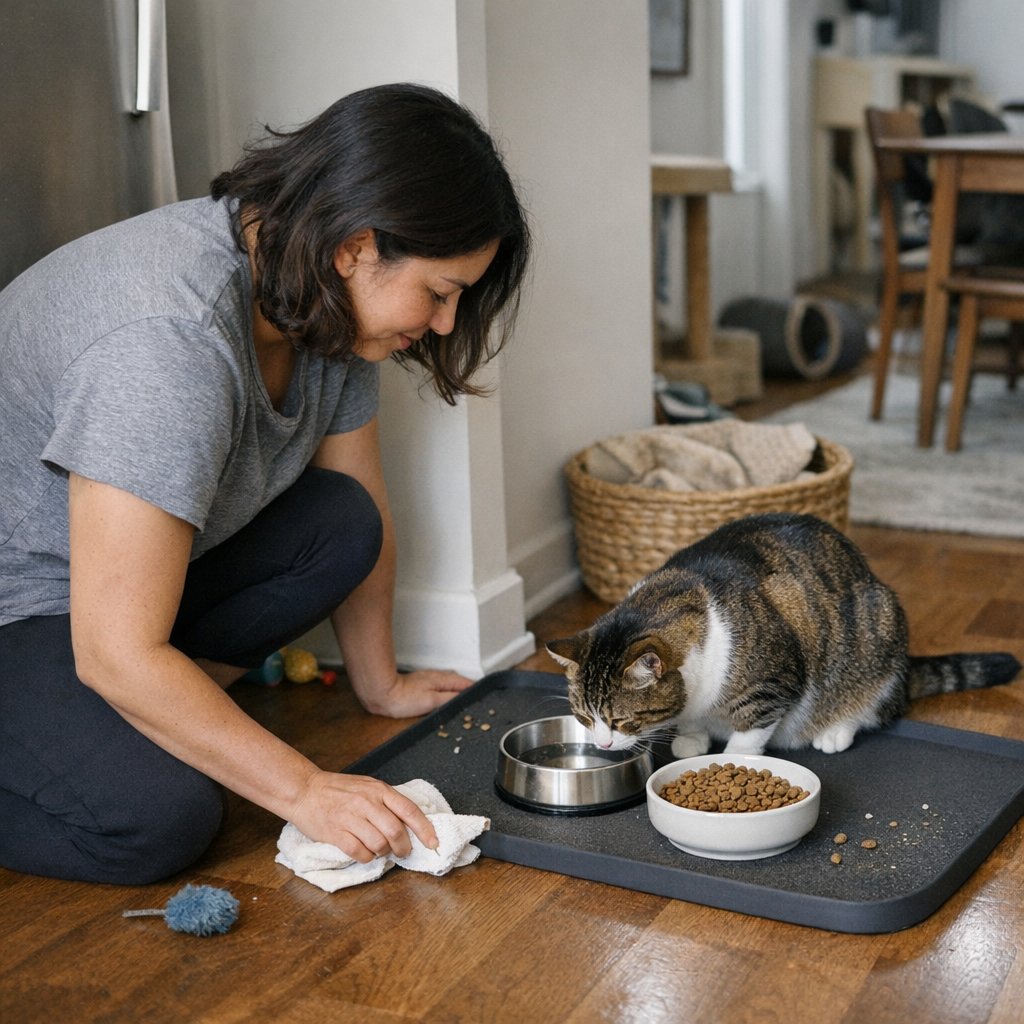
The real test for any indoor cat setup isn’t how clean it looks the first morning—it’s how much it interrupts you by the third or fourth routine reset. Feeding corners that seem perfectly settled at breakfast are soon chipped away by scattered kibble behind the bowl, water droplets trailing underfoot, or toy bits collecting under the table. By midweek, you’re bending down to wipe the same dried gravy you scrubbed yesterday, bumping the water bowl back into place again, and pulling the mat from where it’s bunched against the wall—realizing that “maintained” often just means fixing the same trouble spots on repeat. This is the hidden friction at the center of every indoor-cat home—where even tidy-looking setups quietly create more work than they promise to prevent.
What Looks Settled Isn’t Always Easy to Live With
Most indoor cat areas start on paper with order: a feeding mat, side tray, soft bedding, everything in its place. But after a few cycles, the surface calm shows cracks. The mat fits until a paw scoots a bowl off-center; crumbs start piling at the far edge; water seeps past the border line with each refill. Reshuffling becomes routine—mat back, crumbs swept, bowl shifted, but the fixes never stick.
Improvisation—swapping towels, grabbing whatever’s handy—buys time but builds up work in the background. Small tasks add up: toys showing up where you walk, food bits edging into open floor space, and wipes that leave just enough residue to start over again in hours. The area stays quietly needy, demanding another pass, another reset—more for you than for guests who’ll only see the broad outline of order.
Where Routines Collide: The Feeding Zone and Shared Home Paths
The feeding zone is always just a moment away from crossing into your main home path. The quick scoop at breakfast runs into a misplaced toy; water webs connect bowl to hallway; crumbs stretch into spaces meant to stay clean. Shared space means the cat’s routines and your routines keep bumping into each other—literally—forcing daily collisions between pet area and human traffic lane.
Every refill or fast tilt of the bowl is a small hazard. With busy hands or heads, you’re one distracted motion away from a spill that spreads underfoot or a bowl that skids into open space. Walkways gather what the feeding mat can’t catch. By midweek, the patterns are set: fur stuck where you wiped yesterday, mats drifting into open walking space, small detours around food scatter that never quite stays contained.
Small Messes That Stack Up
- Wiping the same dried spot nightly, only for it to crust back up every afternoon
- Fishing toy mice from behind appliances you never wanted to move
- Dragging the water bowl back again, leaving a wet trail twice a day
- Finding gritty litter dust in new places even after multiple sweeps
The pressure builds through these small, unseen chores. It’s not the one dramatic mess—it’s the cumulative pull of small resets, each one just inconvenient enough to interrupt the day. If a setup feels settled at first but keeps demanding your time, it’s revealing its weak point: the difference between order that sticks and order that just postpones the next hassle.
Containment That Actually Contains: Beyond the “Tidy Mat” Illusion
Most feeding mats look like an easy fix, but the gap between looking contained and staying contained is where real-world failure shows. Mats too narrow push kibble outside the boundary. Lightweight liners slide with every nudged bowl. Smooth surfaces route water wherever they please. Hidden bins might shrink the mess visually but put the cleanup just far enough out of reach to make every reset slower and more awkward.
Spotting False Finishes
- Frequent hands-on work: centering mats, reattaching bowls, wiping new seepage—not just once a day, but after every bump or refill
- Repeated escapes—food drifts into walkways, litter flakes escape the tray, toys migrate everywhere except the intended zone
- Cleanup that divides into too many small jobs, each slowing the entire reset, nudging you to stretch “maintenance” across the whole day
An arrangement works only if, after a week, mess stays noticeably contained and correction time doesn’t double. Order at a glance is easy. What matters is whether the setup absorbs mess or reassigns it to new trouble spots.
When Reset Friction Adds Up
No indoor cat setup is better than the speed with which you can reset it after daily use. When each refresh means kneeling to full-wipe the mat, steering furniture, or re-anchoring a runaway bowl, the friction isn’t solved—it’s just broken into more steps. Slowdowns add up:
- Trying to refill water only to find a toy wedged in place
- Mat edges curled under by last night’s spill or a stray paw
- Food tracked just beyond the “contained” zone—pushing you from a quick sweep into a full-on mop
If every reset feels like you’re “almost finished” but never done, or if each improvement leads to another micro-interruption, that’s the structure fighting you—not helping. Over time, the cost isn’t just time lost but a setup you can trust less and less to stay put when you’re busy with something else.
What a Worked-In Adjustment Actually Feels Like
The difference shows once you move beyond band-aid fixes. One practical change: swapping out sliding mats for a weighted, low-profile, raised-edge mat that actually holds its ground, slightly offset from the highest traffic lane instead of dead center. This caught more mess before it could spread, stayed aligned without constant nudging, and made finding lost toys and crumbs much less frequent.
That upgrade compressed four or five daily cleanups into one genuine reset. Less bending, fewer splashes outside the zone, less searching for what’s gone missing. The test isn’t how neat it looks in photos—it’s whether the area resets fast and mostly disappears from your mind through the week. Good structure respects actual cat movement, not just where you hope they’ll eat or stay. That means fewer rewinds, less self-defeating reshuffling, and more predictable routines for both sides of the feeding setup.
Real-World Test: Does the Setup Hold After a Week?
- Kibble, spills, and toys remain inside a reachable, honest boundary
- Mats stay anchored—so the pet area and walkways don’t blend
- Daily checks become brief, usually just one or two resets instead of constant mini cleanups
- Weak points—recurring pileups or lost items—are obvious and easy to adjust on the fly
Surface order fades fast if the baseline isn’t reliable after a few cycles. Don’t let the feeling of “freshly arranged” cover up a creeping shift of effort and mess somewhere else in the room.
Experimenting for a Friction-Free Zone
No single mat, tray, or bowl position works for every combination of cat and space. Some cats skirt rough edges, some avoid bowls crowded by a mat—real signals show up only in repeated use. Tweak spacing and test edge height; try moving mats slightly out of the walkway. Best-case setups are the ones both you and your cat actually use without struggle—and that you can reset with just one hand while crossing the room.
- Does your cat avoid or track water onto main floors after each drink?
- Is the mat still where you want it after dinner, or has it wandered?
- Are wipes, sweeps, and storage tools actually within reach in the moment you need them?
- Does the area disrupt your day less—or just look less messy for someone else?
When Structure Makes the Room Easier, Not Just Neater
A reliable cat setup doesn’t just cut visible mess—it reduces the need for you to think about it at all. If you’re not pausing to fix, swipe, or rearrange after every meal or refill, that’s the real win. The best indoor cat zones slip from your mind, refusing to add more micro-tasks to your week and letting shared home space stay functional for everyone else, too.
STORE LINK:
http://www.stillwhisker.myshopify.com