
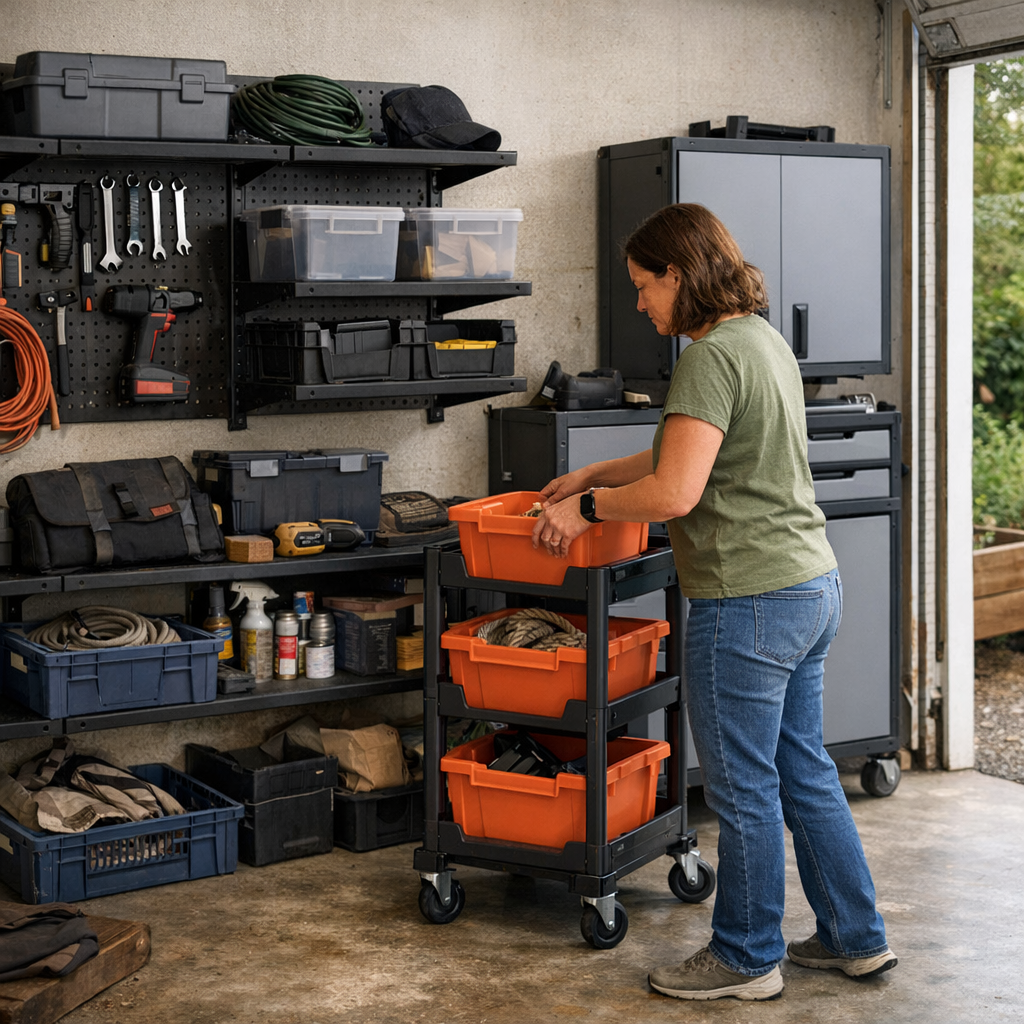
Every new workshop storage setup starts the same way: lined-up bins, fresh wall racks, open floors, and a wave of optimism. Look closer a few weeks later—after two hectic weekends or one unfinished project—and the shine quickly fades. Doors no longer open wide. A rolling cart blocks the aisle, while one high-traffic “return zone” fills up with pile after pile. Forget the clean grid for a moment: does movement feel easier, or are you constantly squeezing, side-stepping, and reworking your path? This is where most systems break down, and where the gap between “looks organized” and “actually works” shows up fast.
Efficient on Paper, Clumsy in Practice
Most modular systems seem brilliant at first: customizable racks, slot-in bins, neatly labeled towers. But after a few real cycles—move a toolbox, drag in lumber, return three things at once—the pain points multiply. Pathways narrow with each add-on. That one dead corner always seems to collect junk. Zones that looked smart on a diagram end up causing routines to double back. The evidence isn’t subtle—it’s the daily shuffles, the awkward detours, the feeling that every restock or cleanup is a minor puzzle.
If you’re reorganizing your route just to live with the storage, it isn’t working. Real efficiency isn’t about how many bins you own. It’s about moving, returning, and resetting with near zero friction—even when the space is busy, messy, or both.
Why the “Boring” Setup Refuses to Fail
What keeps working, month after month, isn’t the most customized setup—it’s the one that disappears into your habits. Bare wall shelves. Long, open racks. The old “boring” solutions no one ever brags about. Why do these last? Because nothing asks you to sidestep obstacles, two-hand a container, or decode the right cubby while you’re carrying gear. Instead of offering options, these setups offer consistency: every return is obvious, every path stays open, and nothing blocks your way to a wall or doorway for the sake of looking modular.
One open shelf along a wall might look plain. But after a dozen rushed cleanups, it’s the spot you trust to always be unblocked, always ready, perfectly suited for both lazy drop-offs and hurried returns—no Tetris required.
When Over-Organization Stops Helping
The tighter you try to design every inch, the more you risk crowding yourself out. Nestled zones, sliding compartments, and mobile pods all promise more capacity—but in reality, they often turn core areas into obstacle courses. Each “temporary” drop-off hardens into an overflow pile. Each step for order adds an extra motion tomorrow. Clutter grows not where you’re messy, but where your system expects too much planning while you just want to put things down and move on.
The pile in the corner? That’s just your setup telling you where returning things feels like work. If the “fastest” path is blocked, your energy for maintenance will drain—until only the least-efficient habits survive.
Scenes from a Cluttered Saturday
End of a typical Saturday: you’ve wrapped up, tools in hand, extension cord slung over your arm, gloves tossed in a bag. Doorway’s half-blocked by the rolling cart you shifted earlier to fetch a drill—now it’s back in the wrong place. The wall panel with storage bins is visually perfect, but the front row bins fill up first, so the deeper ones stay virtually untouched. Every trip to put something away has a catch: shift a cart, dodge a half-open cabinet, or pile gear “just for now” where you know it’ll stay all week.
These aren’t accidents or lapses—they’re the routine friction that accumulates when storage looks engineered but ignores how you actually move. The result: slow resets, doubled-up handling, and the creeping sense that organization has become a second job.
Simple, Open Setups: Real Relief, Fewer Steps
The magic of stripping back to basics is felt immediately. Remove the cart. Replace a wall of bins with a straight, sturdy shelf. Suddenly, nothing stands between you and a clean reset. No re-sorting or maneuvering around awkward angles; just drop the tool and move on. The “I’ll deal with it later” pile shrinks—because it’s as easy to return something right away as it is to put it off. Pathways stay open, and so does your willingness to use them.
The effect isn’t just less clutter. The real win is mental: zero overthinking, zero need to memorize which compartment fits what. Returning is as brainless as pulling something out—and you stop burning time wrestling with your own system.
When the System Fights Your Routine
The most honest measure of your setup? Where do you keep “resetting” things that never quite stay fixed? Is the path between your workbench and the wall always a squeeze? Does the rolling rack camp in a high-traffic spot, just so you can close the back door? Does at least one cubby become a dumping ground for anything you don’t have the energy to properly return?
If these patterns keep popping up, the message is clear: your storage is designed for organization’s sake, not actual use. If every reset takes two steps when it could be one, or if clearing up feels like untangling a mess you just finished sorting, the setup isn’t earning its keep.
Clear Path, Lasting Utility
The most resilient storage isn’t the flashiest—it’s whatever leaves your main walls and pathways available so you don’t have to think. The system doesn’t demand precision. There are no “just for now” piles left to deal with because the quickest, laziest return path is also the right one. Instead of managing overflow, you avoid it altogether.
Over time, these plain arrangements require less and less attention. No need for another storage “refresh.” Just a space that always works, because it’s tuned to movement—not aesthetics or maximum compartment count.
Practical Moves for Smoother Returns
Forget how empty it looks—test how it flows at the busiest moments. Position open shelves where you find yourself stopping at the end of a job, not just where there’s spare wall. Notice the tight spots and rearrange before adding containers. If a cart or divider forces a sidestep or makes a pile inevitable, try removing it—and see how cleanup changes.
If you’re hesitating or rerouting—even once per session— it’s a sign to revise, not add. In storage, simplicity isn’t modesty. It’s speed, clarity, and fewer problems to solve after a long day.
The best system isn’t the most intricate on day one. It’s the one that never interrupts you, never adds a new obstacle, and always leaves you with enough space to work—no matter how many projects you start (or finish) each month. The clear path is the real mark of a setup that’s built for repeated, real use.