
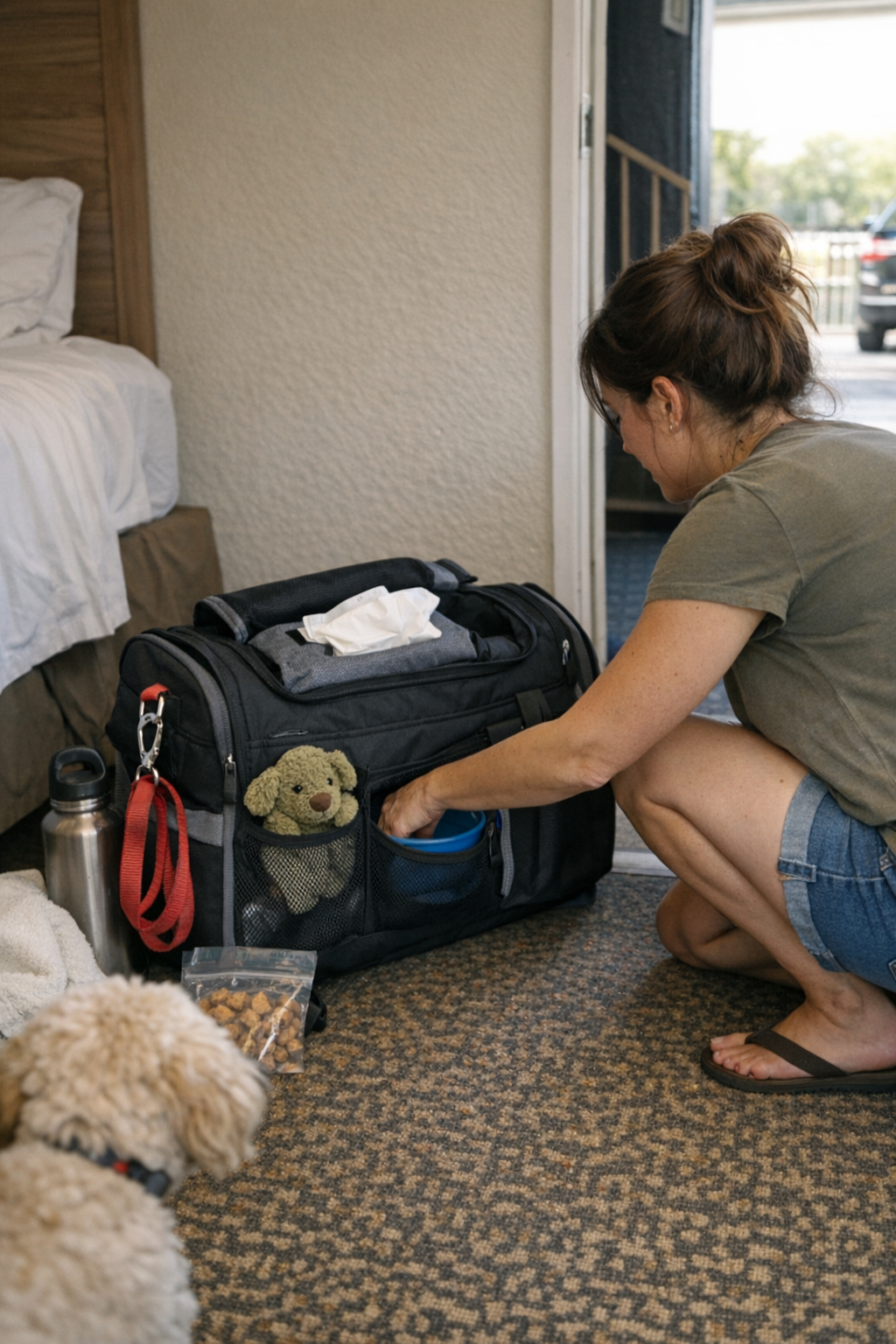
The difference between a “packed” pet travel bag and a bag you can actually use mid-journey becomes painfully clear the first time your routine unravels at a stop. It’s one thing to close a bag and feel prepared. It’s another to reach for a leash, wipes, or water bowl—and realize they’re all layered or buried, never quick to grab when your hands and eyes are already full, your pet is restless, and the clock is running. This is where most setups break: not by missing items, but by forcing you into clumsy digging, stressful pauses, and repeated mini-disasters at every pause to walk, calm, clean, or move your pet.
When “Organized” Still Means Frustrating Stops
Picture yourself outside a busy motel, after hours on the road—bag on one arm, leash in the other, pet tugging impatiently. You carefully packed at home, but now, the leash has slipped under a bag of treats and a towel. Wipes are buried beneath a blanket. You block the entry, one knee nudges your bag open, but there’s still a scramble to unearth whatever’s needed next. Crowds move around you, and your sense of “everything in its place” dissolves in seconds. The irritation isn’t about missing gear—it’s the endless, awkward interruptions that undercut any feeling of being truly ready.
Recognizing the Real Repeated-Use Weak Point
This is a cycle, not a fluke. The real friction in pet travel isn’t the one-off crisis—it’s the mounting cost of small failures: wipes forgotten at the bottom after restocking at a rest stop; comfort toys sliding under food bowls after a bumpy drive; cleanup bags tangled with your phone charger. What seemed “set” before leaving home now fights you every time you need to move quickly. The first two pauses might feel annoying but manageable. By the third or fourth stop, you start dreading each new exit. The system isn’t failing all at once, but the workflow clearly keeps breaking in the same spots.
The Moment It All Unravels
An “organized” bag that hides essentials turns a quick pitstop into a stress loop. Every time you dig for a leash, the treat bag spills, wipes slide under a jacket, and you’re suddenly improvising in narrow doorways with a pet who’s had enough. Even a system that looks neat at rest can become its own obstacle—forcing you to disrupt the flow, lose time, and build frustration with repeat interruptions.
How Setup Structure Shapes the Whole Trip
A pet travel bag succeeds or fails on repeated, one-handed access to essentials—their visibility, separation, and fixed locations matter more than looks. Leash clipped to the outside. Wipes in a front pouch. Water bowl free of nesting. Comfort toy always top or side-facing. These adjustments sound small, but the impact across multiple stops is big: instead of reshuffling everything, you grab what’s needed in one motion, settle your pet immediately, and face each new leg without a reset ritual. Done right, your bag becomes an extension of your routine, not a source of friction.
Real-World Flow: From Pause to Restart
Two types of setups reveal their true colors at every stop:
- Buried-access: Every pause, you’re prying open the main compartment, double-checking pockets, pushing aside food containers and blankets just to seize the core item—meanwhile, your pet gets worked up and space tightens as others try to get by. You tell yourself you’ll rearrange at the next stop, but the cycle repeats.
- External-access: At a rest area, the leash unclips from a side ring. Wipes slide out a dedicated slot—no need to unzip or rummage. The bowl is ready, not entwined with towels. Your pet calms down sooner, and you’re already moving back to the car before anyone’s impatient glance reaches you. Essentials naturally return to their anchored place, so nothing gets lost or crammed deeper with each use.
This isn’t just about saving seconds—it’s about turning an unpredictable, stressful travel rhythm into something manageable and repeatable, with less mess, fewer delays, and a pet who moves at your pace, not against it.
The Downside of Perfectly Packed… but Poorly Designed Bags
Perfect packing can defeat itself if structure fails real-world use. Many travel bags offer “organization” only on paper: every item has a home, but comfort toys share space with food bowls, wipes nest under containers, and leashes coil with wet towels. The bag looks ready, yet nothing key is at hand. Most trips then turn into a pattern—one hidden pocket, one section too many, and you’re awkwardly blocking a doorway, arm-deep in your pack, while your pet’s patience and your own both run thin. What’s worse, these slowdowns stack up, amplifying tension across the whole journey.
Small Delays, Growing Mess
One hard-to-reach wipe leads to muddy paws indoors. A “lost” comfort toy means a pet gets jumpy, ramping up mess and slowing every restart. That minor flaw in reachability keeps inflating stress and increases workload at the next stop. The more the setup blocks smooth access, the messier both the travel and the recovery get—not just for you, but in every space you and your pet pass through.
A Repeatable Structure That Pays Off in Motion
The right fix isn’t only about buying new gear—it’s rethinking how gear loads and resets. Setups that work in motion share a few critical traits:
- High-use items (leash, wipes, travel bowl, calming toy) move to the most immediate-access locations—side ring, front pouch, mesh pocket—never buried or nested.
- Those spots never change, so you develop “muscle memory” for grabbing and resetting between stops.
- Fast-exit items stay out of internal compartments, so nothing gets tangled or wedged under other contents after a drive.
- At every pause, a comfort item is ready—not just for arrival’s sake, but the moment you reach a door, allowing for rapid pet settling and smoother transitions.
Set this up, and every stop feels less like a disruption. Bag and routine both reset easily, stress doesn’t accumulate, and even post-movement clutter stays contained. Pets match the calm, sensing less owner frustration. The whole setup stops working against you—and starts making the trip easier instead of harder.
Handle Reality, Not Just Appearances
Perfection isn’t the aim—recoverability is. The best-ordered layout will get undone by traffic, pet energy, or one rushed moment. But a strong structure is about how quickly you bounce back, not whether the bag absolutely holds its shape. Essentials should never demand a pause-and-dig—especially when your pet bolts, a line forms, or your hands are full. Bad structure draws your attention again and again to the same small friction—in every trip, at every stop—until it finally gets fixed.
Beyond “Organized”: Making Every Stop Easier
If every restart feels like a reset—dig, fumble, reshuffle, repeat—it’s time to diagnose the structure, not the packing list. Lock in the anchor spots for high-use items so you can grab what’s needed even after a trunk shake, traffic rush, or five hurried stops. When the real-world rhythm works—less scramble, faster grab, pet calmer sooner—you don’t improvise every time you open a door. You just move.
Find practical pet travel solutions at PawGoTravel.