
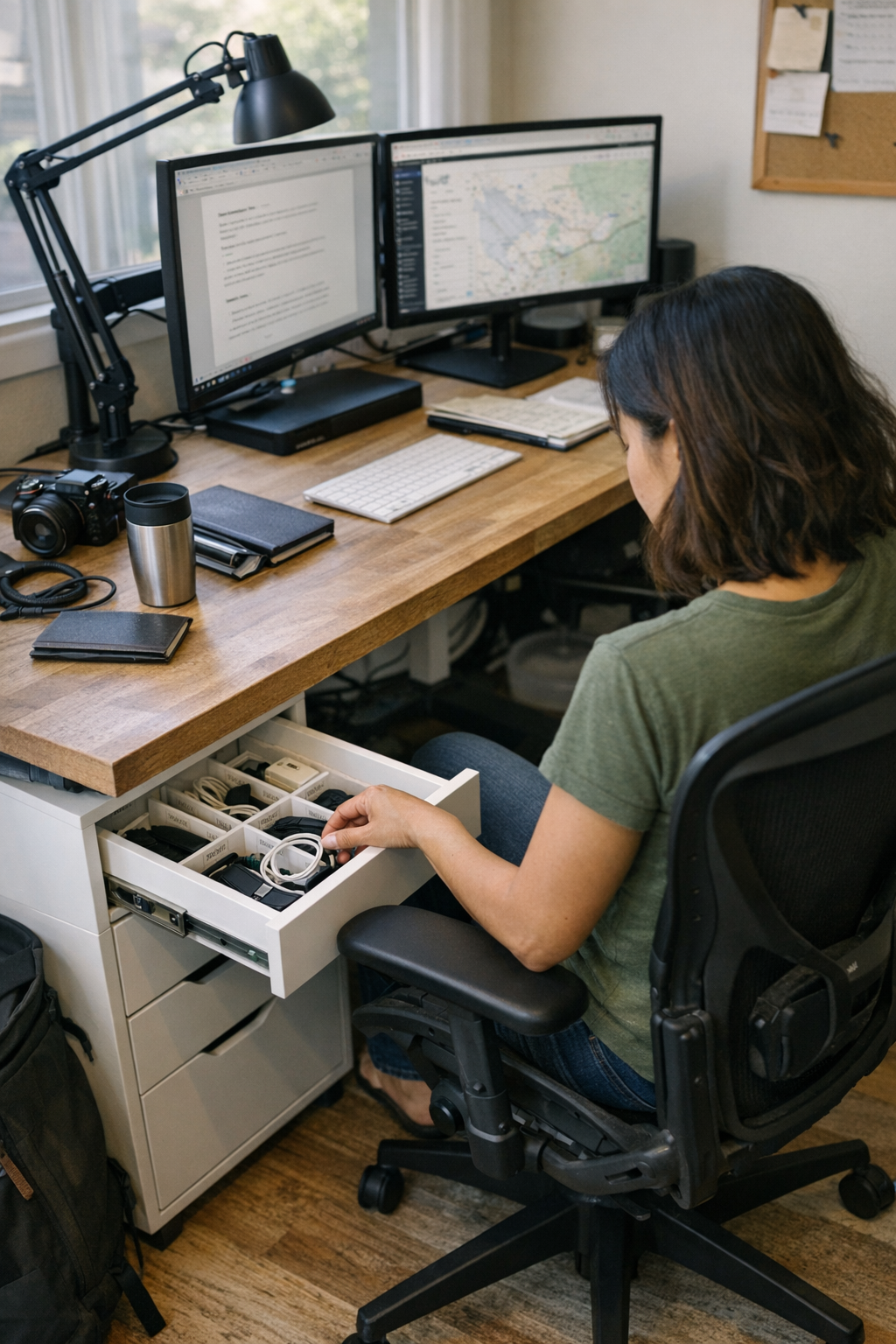
An organized desk promises quick starts and smooth routines. Every pen has a tray, every cable vanishes under the surface, and those drawers close on what feels like a finished solution—you sit down believing the reset is permanent. But as soon as the day shifts—when a charger moves from bag to desktop during a rushed call, or you fumble for a sticky note while your screen lights up with back-to-back urgent tasks—the cracks show. A clean desk hides friction until it counts. You pause, scan one storage tray, then another, maybe rifle the same drawer twice while your flow slips. That half-second stutter isn’t dramatic until it’s stacked: small interruptions spread across a week, quietly erasing the advantage of every morning reset. The more your setup relies on silent memory and unlabeled order, the more that invisible drag creeps in whenever real work collides with routine breaks.
The Clean Desk That Stumbles When Work Moves Fast
Clutter doesn’t have to be visible to slow you down. Drawer organizers and neat storage boxes create the look of productivity, but glossy order only holds until routines flex or timing gets tight. The unlabeled workstation isn’t a mess—it’s a moving target. The same cable that slipped easily into its tray yesterday turns up under a notebook or beside a wireless mouse after one long afternoon of calls. Loose headphones blend with chargers; pens migrate just far enough to force a double-check. Each swap or tool hunt is just awkward enough to break your stride, especially when your natural reach path is blocked by under-desk storage or an extra unit that seemed smart until it started intercepting your knees.
Fast cycles expose the soft spots. By Thursday, “Is the backup drive in the left drawer or right?” becomes routine, and a once-clear system now means you’re touching three places instead of one. Those little grabs amount to resets you didn’t plan for—the paper organizer looks sharp but fails to anchor your most-used tools when the workflow doesn’t pause for sorting.
When Drawer Labels Make All the Difference
Labeled drawers don’t announce themselves in a still photo, but in motion, they’re the difference between flowing through the day and hesitating mid-task. Reach for the SD card—your hand goes straight there. Open a drawer for two types of cables—one scan is enough. By contrast, even the tidiest unlabeled system invites drift: you guess, second-guess, move to the next bin, or toss something back where it “sort of fits.” During busy stretches, those micro-mistakes start to shape your perception of the whole setup—suddenly a perfect system has invisible friction lines everywhere you need speed.
Picture a week with high-rotation drawers: by Wednesday, pen refills have swapped with adapters, USB keys mixed with receipts, and each retrieval has shifted from routine to chance. The visual order on Monday doesn’t defeat the lived chaos by Friday, especially after every meeting leaves a charger somewhere new.
Stress-Test Moments: When Flow Breaks Down
Desk organization works when the routine is calm. But most setups fail their test during spikes: double-device days, urgent deadline sprints, or when you’re shifting between keyboard and notebook while fielding messages. It’s in those moments—the cable tray partially blocked by a laptop stand, or a deep drawer that never quite lines up with where your left hand reaches—that well-intentioned systems slow you down. You hunt for the USB dongle and emerge with yesterday’s receipts, or yank a drawer only to find it packed with things that belong elsewhere but never made it back. Labels, meanwhile, quietly rescue these situations: they cut reset time, anchor items, and save you from the seconds lost to guesswork, even as the work surface looks as minimal as ever.
Delay can come from the unexpected: a quick device swap, a not-quite-centered monitor arm forcing your body to bend, the way a task light skips the exact spot you’re writing your notes. When the whole setup relies on memory, every real-world curveball becomes a drag on your momentum.
Making Organization Work for Real-World Routines
It’s a mistake to cover every inch with labels—real improvement comes from targeting. Most desks only need the top “traffic” drawers marked: the ones you open every session, where fast multitasking or blended contents create constant turnover. Labeling just these hotspots is enough to change retrieval from hesitation to habit. High-use, mixed-content drawers get bold, readable cues; low-rotation and single-item drawers stay clean and label-free, preserving calm where it’s earned and urgency where it’s needed most.
This way, the workspace avoids the clutter of over-labeling and the stalls of memory-only systems. You skip sticker fatigue and endless name edits—just quick visual guidance, anchored to the physical workflow that repeats most, especially on high-pressure days. The aim isn’t decoration; it’s keeping the desk functional and frustration-proof even when routines collapse or priorities stack up unexpectedly.
The Small Stuff That Changes Everything
Sometimes a label is the whole difference between a smooth handoff and a stalled reset. “Cables—Power” keeps you from upending a drawer when an urgent plug-in comes; “Adapters” makes the grab-and-go motion truly single-step, regardless of how many swaps a chaotic week brings. These aren’t just niceties: they’re friction-busters that grow in value every time you sit down again. Tiny cues accumulate into a desk that stays ready, even as your tools and priorities rotate unpredictably.
Quick FAQ: Labeling Drawers Without Overdoing It
Which drawers should get labels?
Target drawers you open repeatedly during the day or that hold blended groups of tools. If you notice yourself scanning for something twice, the system needs a label.
Does labeling ruin a streamlined desk look?
Not if you’re selective. Focusing only on high-turnover drawers keeps your primary workspace minimal while giving clarity where reach and reset speed matter. Most drawer fronts—and the surface itself—remain untouched.
Can a label-free drawer ever work well?
Yes—for dedicated, single-item, or infrequently used drawers. But frequent-use, mixed-item drawers don’t stay stable without visible anchors. If you’re reaching and pausing, a simple label restores flow.
Workstation Flow: Labels Support Real Use, Not Just Appearance
Scrubbing every label off your setup might look great for a moment—until hidden friction returns and productivity stalls. Routines shift, memory slips, new cables and devices shuffle in. Targeted labeling—clear markers for drawer “hotspots” and nothing extra—bridges the gap between aesthetic order and functional speed. This is the small, concrete tweak that helps a real workstation keep up: clarity where pressure lands, open simplicity elsewhere. Organization finally supports the way you really work, not just how your desk looks after a clean-up sweep.