
It hits in the middle of a job: you’re halfway through slicing laminate trim, sawdust in the air, when the multitool stutters, coughs, and leaves a ragged line across the workpiece. There’s a flicker of irritation every operator recognizes—not another pile-up from a dying battery. The blade is sharp, your movement steady, but the cut feels gutless. Tool precision slips, work slows, and suddenly a routine pass drags into another repair. In most jobsite toolboxes, it’s the battery—not the tool head—that quietly decides whether today’s work runs smooth or sideways.
When Batteries Turn Fast Jobs Into Friction
Pull two packs from the same set and they seem equal: both light up “ready,” both slot into a charger, both look new. Yet, as the day unfolds—tools bouncing from bench to truss, three or four hands in the mix—the real difference snaps into focus. One multitool melts through drywall and leaves crisp edges behind. The next starts strong, then loses its bite, vibration turning jittery. Cuts that should slide straight stall mid-panel, and sanding passes start skipping—precision slips as battery strength quietly fades away.
The cost shows up everywhere. Teams swap spent batteries chasing just enough juice for one more screw or plunge cut. The pace gets choppy as focus breaks to check indicator lights or rummage for a pack that isn’t running on fumes. Each stutter adds seconds to every task, and suddenly the far end of that MDF panel looks a lot further away.
The Quiet Drop-Off: How Underperforming Batteries Sabotage Workflow
Green indicators lie. A pack that claims “full” before the shift can choke as soon as it bites into cement board or thick plywood. Under pressure—cutting fasteners, sinking blades, running sanding pads through paint—the cracks show. Reliable batteries hold voltage and keep the work rolling. Weak ones sag early: oscillations lose force, the tool body gets hotter, the vibrations turn harsh and unpredictable.
It often starts subtly—an extra second stuck in a knot, deeper saw marks on a cut meant to be clean, the sanding head leaving behind stubborn ridges. Not disastrous—at first. But the longer you ignore it, the more precise work turns into chasing flaws. One weak battery gums things up for the next operator. You end up finishing by hand, timelines stretching, finish quality dipping. The frustration isn’t theoretical—it’s in the physical drag across every repetitive cut, every awkward stop to swap packs, every time a crew member mutters about “that dead battery again.”
On the Ground: Battery Failure in Real Jobsite Flow
Picture a renovation morning. Three people rotate tools: one cutting panel reveals, another grinding out grout, the third sanding back edges for paint. By lunch, the rotation is smooth—batteries fresh, work passes steady. But late afternoon tells a different story. Midway through a dense fiber cement cut, the oscillating tool whines and stops cold. Its battery, which flashed green earlier, now quits 60% through the cut. Suddenly, everyone’s hunting for backup packs—some only half-charged from rushed top-offs between coffees. Each failed swap doubles downtime. By day’s end, thirty minutes are gone to troubleshooting, with a growing pile of messy cut ends to tidy up by hand.
This isn’t rare on a big job or even in a home woodshop where tools move person to person. One overlooked battery turns into a chain of stalling, repeat swapping, lost minutes, and a noticeable drop in finish. The ripple effect is real—one slip turns a smooth build into stop-and-go frustration for the whole crew.
From Luck to Process: Building Battery Checks Into the Routine
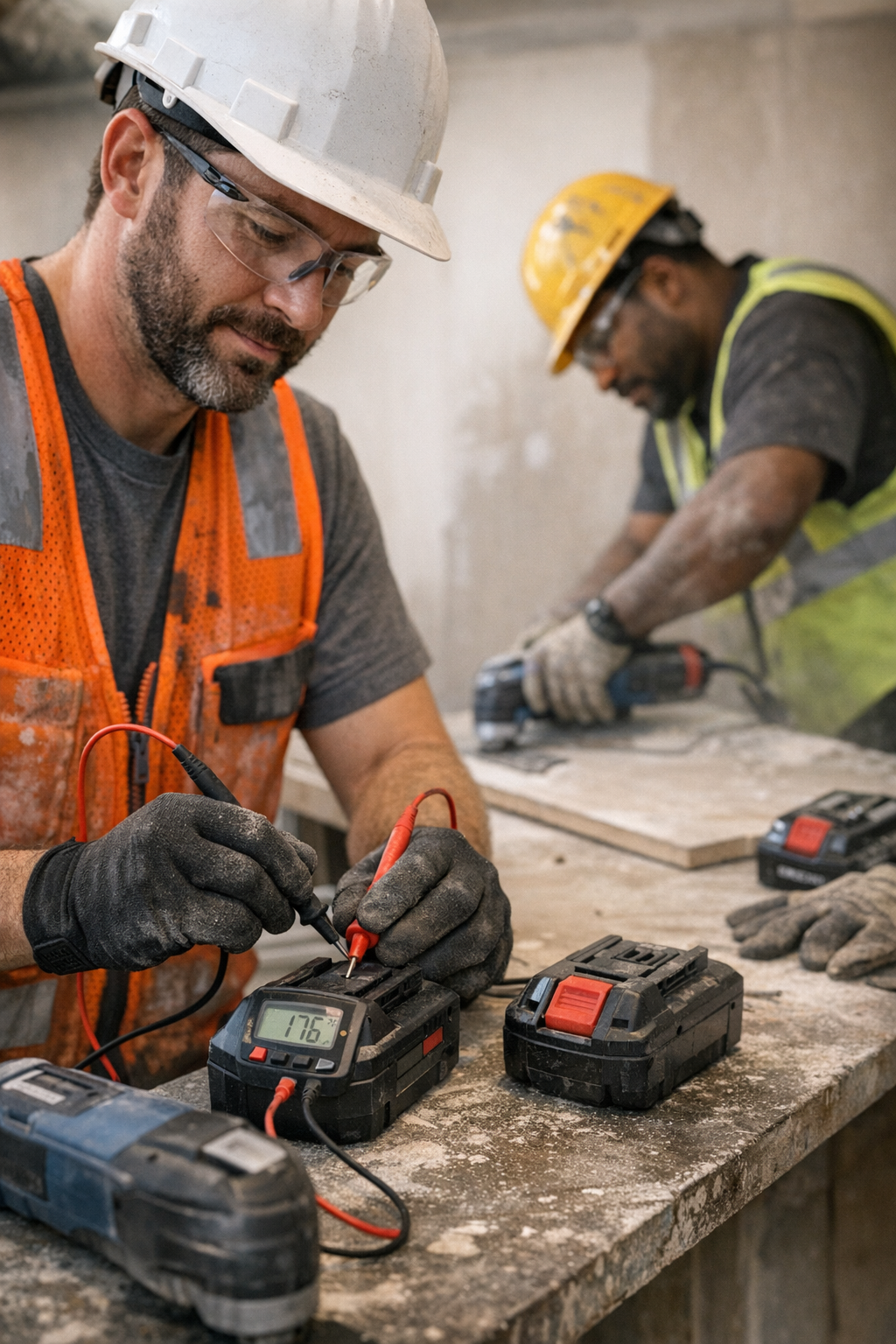
This headache gets fixed not by working harder, but by working smarter—cutting out the gamble. Don’t just trust the “full” light. Build a quick, deliberate battery test into every shift. Before tools change hands or anyone starts cutting, clamp the multitool, attach a fresh blade or sanding pad, and run it under load for five minutes. Then grab a voltage meter—see what the pack’s really delivering under stress, not on the shelf.
Batteries showing less than 18V under real load? Pull them from rotation. These are the troublemakers: they’ll fade fast, stall during detail work, overheat, and turn your precise multitool into a guessing game. Flag them for reconditioning or recycling. Don’t let “maybe it’s fine” float into tomorrow’s schedule.
Simple Work Habits That Eliminate Guesswork
- Watch how the tool feels and sounds, not just what the indicator says. If you sense the tool getting choppy or losing speed mid-task—change the pack before the cut is ruined.
- Rotate your strongest batteries to the hardest work. Save older packs for sanding, screws, or lighter cuts. Use fresh packs for long, demanding sections where stalls cost the most time.
- Mark the month and year on each battery when it joins the fleet. You’ll spot underperformers quickly before they start making more trouble than they’re worth.
Just a few habit changes make a visible difference. Sudden stalls drop off, sanding becomes smooth and controlled, long blades stop binding mid-beam, and no one is left asking who swapped in “the dead one” before a critical panel cut.
Why It’s Worth It: The Payoff of Smarter Battery Care
The change isn’t subtle—it’s all over the workflow. By end of week, you’ll notice fewer slowdowns, snappier tool response, and cuts that stay clean all the way across. Less time disappears into swapping packs, fiddling with chargers, or smoothing out gouged edges with hand tools. When batteries are managed deliberately—not by wishful thinking—crews regain confidence: switch pulls always bring full power, momentum builds through projects, and the jobsite feels reliably in sync again.
Bottom line: Battery health isn’t busywork. It’s the backbone that keeps precision, pace, and finish quality consistent, especially when the day runs long and delays pile up. Lose track of creeping battery failure, and a single “it’ll be fine” pack can jam up everyone’s progress for hours.
If you run more than one multitool—at home, in a workshop, or across a team—don’t leave battery performance to chance. Fold in consistent, real-world checks. It’s how the best jobsites keep cuts straight, sanders even, and teams moving at full speed.