
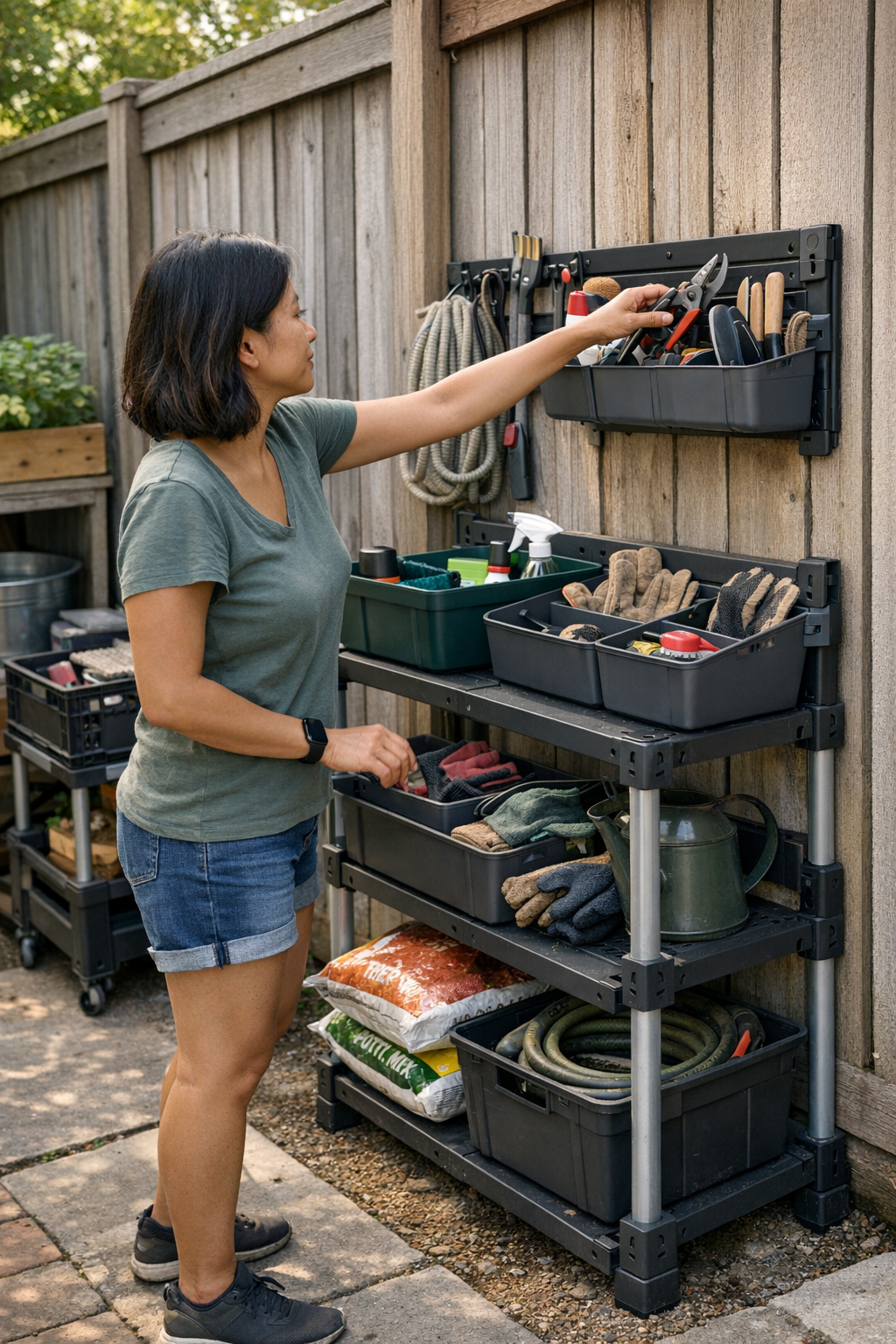
Most outdoor storage setups fail one step at a time: every time you drop muddy gloves by the garage door “just for now,” or wedge a trowel onto the shelf that’s already half-blocked by last week’s potting tray. It’s not the big installation day that proves a system’s worth—it’s the slow grind of daily use. That’s when a storage setup goes from “looks organized” to “actually works”—or doesn’t. If you’ve ever circled the same cluttered spot by your gate, or hesitated before peeling back a lid because you know there’s a wall of random tools inside, you know how quickly order unravels. What’s supposed to save time—the bins, the racks, the clever corner organizers—turns into a silent drag on the whole routine. The area meant to keep things moving just keeps getting in the way.
The Subtle Creep: How Small Frictions Pile Up Fast
It starts the first Monday after you sort everything. In that narrow zone along the fence or beside the garage, the setup looks perfect: every rake and glove in its slot, fertilizer stacked to one side, hoses untangled, and the walkway clear. But by midweek, normal movement draws out the cracks. You come out to water in the morning; next thing you’re trimming a shrub, then setting down soggy gloves on top of the fertilizer bag because the proper basket is out of reach. The rack you meant to keep clear now has an “invisible tripwire” of a hand fork resting at ankle height. Each reset gets slower: put one thing away, move two others “just for now.” The neat grid starts to fray, and the open path bottlenecks until you’re sidestepping piles you barely remember making.
When Storage Becomes Its Own Obstacle
Going for more bins and deeper shelves promises capacity but creates headaches: “black hole” storage where small essentials sink and drift. What feels efficient—one hefty tote for everything—quickly backfires. The shears you tossed in two days ago are now buried under hose ends, year-old gloves, random plastic pots, and a coil of string. You open the lid, sigh, and dig, then drop what doesn’t fit at the very edge. The result? The bin isn’t empty, but it’s not useful—just an excuse for messes to linger. And the bulkier the container, the more “just for now” items sprawl onto the ground beside it, right where you need to walk.
Open wall racks don’t get a free pass either. They’re meant for quick access but end up as shelf-catchers for project leftovers: bits of twine, a half-used spray can, yellowed seed packets. Tools rest sideways because the appropriate bin’s overloaded, so the “grab-and-go” shelf quietly jams with overflow. Suddenly, the wall is full and your hand routine is slower, not faster. The problem isn’t what fits, but what’s always in the way.
Problem Zones You Don’t Have to Imagine
- Entrances jam up: A mini-mountain of gloves, snips, and garden shoes collects just inside the gate or garage threshold.
- The “catch-all” shelf: Bulky odds and ends migrate to the same spot, blocking faster access to daily gear.
- Constant shuffling: To put one shovel away, you scoot aside two other tools and a slouching bag of compost.
- Dead corners stay dead: Floor spaces behind bins fill with rain boots or tangled hose segments nobody wants to sort.
The Real Cost: Slowdowns, Blocked Paths, and Resets That Never End
The promise of a quick cleanup morphs into a ten-minute hunt for the “good” pruners. You’re leaning around a batch of leftover tomato cages, pausing to pick up gloves you nearly stepped on, and working in a corridor that’s somehow half its original width. Even if the area never turns into a junk pile, you notice you’re always behind—a few tools away from a true reset. The failure isn’t always dramatic, but you feel it: more clutter in your line of sight, more time lost on what should be a one-move return.
Why “Return Flow” Decides If Order Actually Stays
Success in outdoor zones doesn’t hinge on how much a setup can hold—it’s how frictionless it is to put things back. When every return means rolling a bin out, prying up a lid, or wading through three misplaced tools, you cut corners. Hand tools stop making it into the bin. Gloves land wherever is closest. The boundary between “stored” and “left out” weakens until even the labeled zones get blurry, fast. The more steps each return demands, the less it actually happens.
The Real Shift: One Setup That Changed the Routine
The fastest improvement came the moment a deep shared bin was swapped out for a shallow, divided wall basket—mounted right at arm height on the way out to the yard. Now returning tools is a forward swing, not a squat-and-dig. Everything has a visible slot: secateurs, multi-tools, gloves, hose fittings. Nothing’s hidden. After a week, it was obvious: the floor stayed open, rushed resets took seconds, and not a single item started migrating toward the walkway. The old routine—“where do I shove this?”—was replaced by one quick motion. There’s still the occasional stubborn item, but zero new piles at ground level and no reshuffling just to clear a path.
It didn’t turn chaos into magic—the odd straggler still appears—but it changed the tone. Instead of resenting the system, you notice yourself using the space without second thought. The busywork melts away, and resets stick longer—even on high-use days.
More Storage? No—Better Storage for Real Movement
It’s a constant trap: thinking that bigger bins or taller racks fix messes. In side yards, garage edges, and between-the-gate utility strips, more space only enables bigger piles and longer hunts. What quietly fixes things is the right division and easy landings—setups that force single-move returns and don’t let overflow build up undetected.
Shallow baskets and sectioned holders beat bottomless boxes every time. You see what’s most used. You’re not digging past last season’s forgotten projects. The walkways stay clear, and the usual corners stop becoming tool limbos or dump zones. It’s an upgrade you feel in every return—not because the setup’s flawless, but because nothing big gets in the way.
The Signs That It’s Actually Working
- Returns are frictionless: One motion, no digging or restacking.
- Your go-to gear is never hidden: Gloves, snips, and hose heads are in plain sight and easy reach.
- Hallways stay passable: Floor space and entry spots don’t shrink week to week.
- No “temporary” pile-up zone: Even when you’re rushing, the default spot isn’t the ground.
Small Shifts That Make Outdoor Reset Obvious
Want instant improvement? Make the return path easier than the path out. Hang divided baskets instead of burying essentials in deep bins. Set them at arm height, not ankle. Use wall sections for daily-use tools, not dead storage or “someday” gear. Keep rarely-touched items tucked away, so the stuff you actually need isn’t blocked or shuffled. Every shortcut you bake into the setup keeps the area moving, not bottlenecked by its own organization.
Looking organized means nothing if resets are a chore. The payoff arrives when the setup becomes invisible—you move, use, and return gear without noticing the system at all. The awkward pauses, workarounds, and creeping piles stop being part of the routine. That’s when you know it’s working—for you, not just for show.
For more practical ideas on what actually works for real outdoor setups, visit TidyYard.