
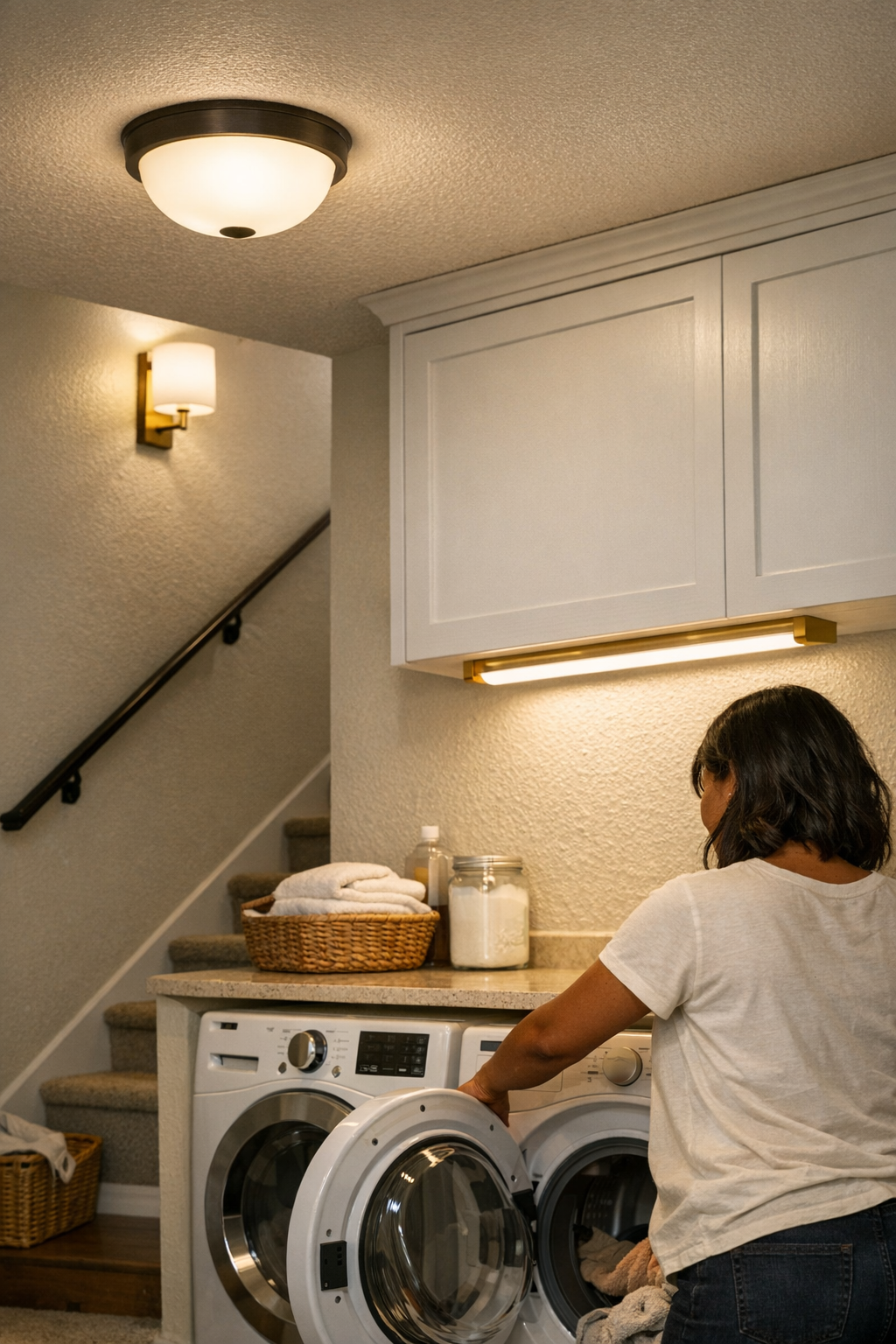
Where lighting quietly betrays you: The stairwell looks fine at noon, and the laundry nook seems bright enough when you move in. Two days later, the difference shows itself—a sharp shadow on the stair turn makes your foot hesitate. Socks and cleaning supplies vanish behind appliances, and what passed for “well-lit” now trips you up or stalls the routine. Without warning, simple habits become a daily obstacle course, thanks to shadows and glare that the basic fixture didn’t warn you about.
Where “Bright Enough” Fails in Real Spaces
Ceiling lights promise total coverage, but routines prove otherwise. Grab laundry on a late night: the back edge behind the dryer is still a black hole, making you kneel and grope for missing socks. Take stairs before sunrise: a centered flush mount slices neat shadows across every step just where your foot lands, forcing you to slow and check each tread. The room glows overhead, but the pathway itself remains uncertain—your instincts hesitate where light never quite reaches.
It’s not brightness—it’s about how light lands and where it falls short. Most “all-purpose” lighting passes on first inspection but breaks down the instant movement matters. Places like stairways, hallways, and laundry corners punish lazy lighting, exposing every missing beam at turning points, hidden shelves, and uncertain landings. When you use a room for more than standing still, the flaws stack up fast.
Common Pitfalls: How Typical Fixtures Let You Down
Ceiling Lights—Good on Paper, Risky in Practice
Flush and semi-flush ceiling fixtures seem to check the box. In stairwells, though, they create a lopsided spread. Center a light overhead and the lower half of the stairs gets murky—especially when the fixture sits above your line of sight. You spot the next step a half second late or shuffle for the rail because your eyes can’t trust the shadowy outline at the turn.
Wall Sconces—Stylish, but Isolated Illumination
Sconces favor symmetry, not safety. If they’re spaced for looks instead of reach, pockets of shadow blink into existence behind cabinets or along the wall beside the laundry. You end up swinging a basket side-to-side to catch any last shirt, or pausing mid-step to squint at the floor’s edge—places that invite mistakes when you’re distracted or tired.
“High Output” Still Leaves Blind Spots
A brighter bulb ups the lumens but not the coverage. Glare bouncing off tile or glass can blind you just as much as darkness does, especially when you’re searching for a stair edge or pulling supplies from a recessed shelf. Even with high output, the corners left untouched stay stubbornly dim as you circle and double-check the space.
The Real-World Friction Points: Overlooked but Constant
The first sign of weak lighting isn’t eye strain—it’s how your routine slows down: Now, hunting for socks at the back of the laundry or hesitating at the stair’s mid-flight becomes normal. Movement gets interrupted, footsteps pause for a beat, and the flow you took for granted has turned into a series of minor checks and recalibrations. The “good enough” setup unravels every time you cross a dark patch or miss the zone that needs to be clearly seen.
- Stair mid-flights and turns feel risky after dark, with shadows pooling where steps change direction.
- Small essentials vanish behind a utility cabinet, despite the ceiling light claiming total room coverage.
- Hallway corners become places to shuffle, not stride—one side of your movement path falling away in dimness.
- Early morning or post-dusk routines reveal weak spots—always the task zones, edges, or surfaces that matter most.
The truth: What looks “lit” isn’t truly usable. Safety and confidence only show up when every angle, turn, and reach point lands in reliable, overlapping coverage—not just center stage or wherever the blueprint says a fixture should go.
Targeted Fixes: Where Structure Beats Sheer Output
The breakthrough isn’t about flooding the area with more wattage. It’s about strategic source placement: a second damp-rated flush mount at the stair landing, a dedicated fixture over the laundry’s cabinet run. Instead of chasing lost socks into the shadows or guessing at steps, these tweaks close the gaps. Shadow edges retreat, movement flows naturally, and every inch finally matches the routines that expose the setup’s weak points.
What Changed After the Setup Shift?
The pacing shifted, and the stops vanished. Gathering laundry stopped being a crouch-and-search routine. Every stair, even one-handed or half-awake, revealed itself clearly—no need to hug the wall or guess in the gloom. The light began to serve the routine, following the action instead of just decorating the ceiling.
Practical Tips for Daily Lighting Relief
- Layer ceiling and wall lights for real coverage—ceiling mounts give general fill, but wall or directional fixtures erase shadowed edges exposed by footsteps, baskets, or cleaning tasks.
- Let activity—not drawings—dictate placement. Put fixtures at stair turns, above reach zones, and in the corners where hands, eyes, or small items go missing.
- Use damp-rated fixtures without hesitation in spaces prone to humidity or moisture. A standard fixture in a laundry or utility space isn’t just a short-term fix—it’s a future dark spot once humidity takes its toll.
Questions People Ask Once Friction Sets In
Should I use a ceiling light or wall light for better stair or laundry visibility?
Both—never one alone for problematic zones. Ceiling fixtures fill the air, but wall lights chase away recurring step and edge shadows. The combination is what finally stops the guessing.
Is it more important to choose a bright fixture, or to think about placement?
Placement, every time. Over-bright, poorly placed lights cause glare or leave dead spots. A moderate, smartly located fixture lets you see and move with certainty. Real-world use exposes errors in placement—not just weak wattage.
What if I use a standard fixture in a utility or laundry area?
Humidity and routine are relentless. Non-rated fixtures lose ground to steam and moisture, failing early and leaving your most-used surfaces in shadow. The cost is more than a bad bulb—it’s years of dropped items, second-guessing steps, or slips in dark, damp corners.
From “Good Enough” to Truly Usable Lighting
The difference is obvious during the small, repeated moments: safe at the stair’s turn instead of tentative; no more squinting behind the washer; never losing your step mid-hallway. What looks “lit” is often just the absence of darkness, while functional lighting is about every daily move feeling smooth, unhesitating, and safe.
The real question isn’t “Is it bright?” but “Does every step and reach feel clear?” In hard-use indoor zones, lasting improvement requires coverage that fits the actual routine—flush or semi-flush for area fill, wall or task lights for shadow-prone spots, and always a moisture-safe fixture where needed. Zones with recurring strain should dictate your setup, not just plans on paper. Lighting built for movement and daily retrieval keeps those trouble spots from stacking up over time.
See lighting that’s mapped to real movement and true coverage at LightHelper.