
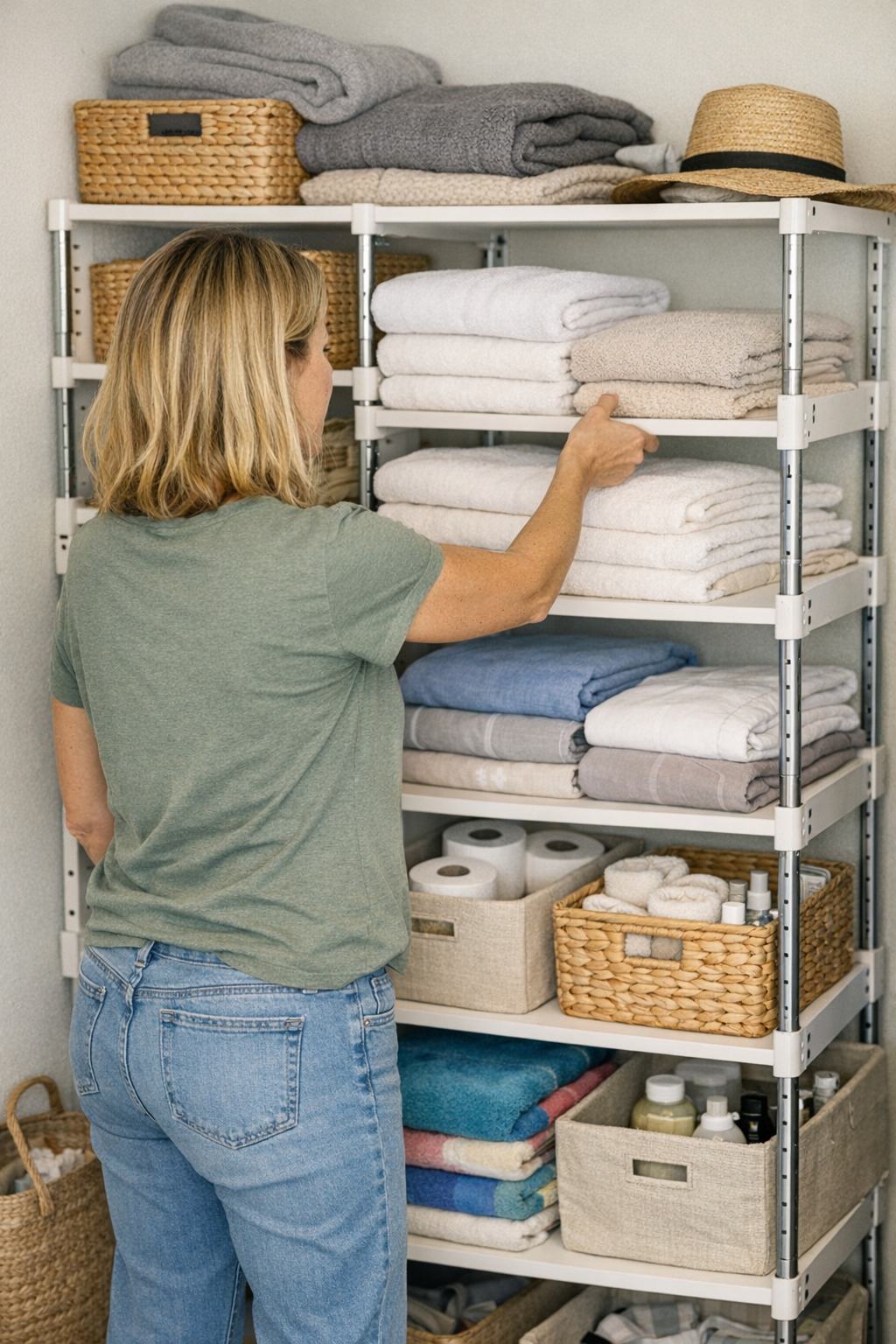
There’s a difference between a closet that looks tamed for a day and one that keeps pace through the week’s real chaos. You notice it around Thursday, when stacks that started crisp collapse into leaning towers, bins blur with stray socks and scarves, and the morning scramble means poking behind lopsided piles for the “good” towel—again. The root of it? Fixed shelves that insist your stuff, your routines, and your categories stay frozen, even as everyday life frays the order.
The Slow Slide Back to Mess
Open any hallway linen closet or kitchen pantry and the signs show fast: piles edging higher than you ever planned, bins carrying a week’s worth of last-minute dumps, and categories once tidy drifting together by midweek. On fixed shelves, the neatness you started with always has an expiration date. The first time you dig for the right shirt or the back can, you trigger a small cascade, leaving the shelf a little messier each time. Resets stretch longer, and “organized” shifts from feeling possible to feeling like a lost cause.
When Your Routine Collides with Fixed Shelving
Think through any morning in a stacked closet. You reach for a towel, but grabbing one means steadying a pile about to tip. Towels rest on one mountain, sheets balloon in another, and hand towels wedge somewhere in the shadows at the back. By Wednesday, those careful stacks blur—slopes between categories, singles folded on top of the wrong set, and every “quick grab” threatens an avalanche. It’s not that you’re messy; the shelf forces your routines to fit a shape that doesn’t suit how you use the space.
Every retrieval becomes a micro-obstacle. The deeper you reach, the more likely you’ll set off a silent reshuffling session—especially when you’re in a hurry.
How Modular Shelving Actually Changes the Game
Modular shelving breaks that noisy compromise. Shelves adjust to your stuff, not the other way around. Bring a shelf down to stop towels from stacking too tall. Set a new level for that pile of jeans that always wobbles, or carve a lower row for sheet sets so you can finally put them away without battle folding them to fit. Instead of one forced configuration, you get clear lanes: every category has its own space, shaped for what you put there.
The real upgrade? Stability with less effort: you grab a towel without disturbing the rest. Separate shelf levels mean stacks don’t lean, bins don’t mix, and you’re not stuck refolding half a closet just to reclaim order. When a season’s needs shift—from sweaters to swimwear, or school lunch snacks to baking flour—just realign the shelf. It takes minutes, not an afternoon overhaul.
Access Without the “Jenga” Moves
On fixed shelves, grabbing something halfway down means a one-handed balance act. You brace the tower, dig for your target, then spend an extra minute rebuilding what you disturbed. Modular shelving turns that chaos into a single-motion reach: set stack heights and section widths so nothing has to give, and pulling out an item is as simple as sliding it free—no collapse, no side shuffles. Just as important: putting things back is straightforward. No more cramming towels onto a teetering heap or guessing which bin is safe to nudge open.
What Looks Neat Can Still Work Against You
Baskets lined on a deep shelf, or bins packed tightly, show well for a photo or a calm Sunday reset. But daily use exposes the flaws—overflow items crammed wherever there’s space, lids left off bins too hard to reach, and “just for now” placements that gradually unhinge any system. Fixed shelves ask you to stack higher or push occasional-use items farther out of sight, so your “quick grab” becomes a frustrating, slow puzzle more often than you’d admit.
Modular shelving answers with shorter stacks and tighter borders: no spreading piles, no mixed-up baskets, just clear separations that last. It’s not about containing clutter so much as preventing its constant return—when every item actually fits its space, there’s simply less room for mess to spread.
Scenes from a Real Closet Reset
I spent too long rebuilding the same towel stacks on a shelf so deep and tall that nothing ever stayed tidy for more than a few days. Moving to modular shelves, I set a limit—nine inches high, nothing more. Suddenly, each towel came out and went back in without a topple. The edges stayed neat, towers didn’t sag, and I stopped budgeting Saturday mornings for re-folding and re-sorting. The most telling part isn’t that a shelf looks tidy for a photo. It’s that—after a week of hasty mornings and late-night drop-offs—you can restore that order in little more than a minute, not with the exhausting resets that fixed shelving demands.
Modular shelving turns an endless battle for order into an occasional, near-effortless touch-up.
Spot the Subtle Signs of Storage Friction
If you find yourself pausing before pulling out a plate, rebalancing a pile of jeans to reach one t-shirt, or shimming bins in a closet every few days, you’re managing friction—not organization. Watch out for bins filled with a mixture of categories, stacks that tip after two uses, or the familiar two-hand pull. These are the red flags that your storage isn’t working for you—it’s quietly doubling your effort in ways you notice most on rushed or tired days.
Actual Adjustability or Just Marketing?
Not every “modular” shelf truly adapts to your needs. Some systems promise flexibility but only let you move shelves an inch or two—barely enough to matter when piles still outgrow their spots. Before committing, check that you can set shelf heights exactly where you need them. Genuine modularity means being able to convert a closet, pantry, or mudroom section in minutes, not facing the same overcrowded shelves every season.
The Difference That Lasts Beyond One Clean Day
The real reward isn’t a space that’s only photo-ready after a four-hour reset. It’s a closet, pantry, or laundry shelf that stays usable—where you know what’s where, categories don’t slip, and a five-minute pickup on Friday actually restores the whole system. When stacks aren’t forced too tall and every item has an obvious landing zone, the slow spread of clutter—and the dread of “organizing day”—finally fades. It isn’t perfection, but it’s daily, lasting clarity.
Find shelving, closet systems, and practical storage tools that fit daily life at ClosetWorks.