
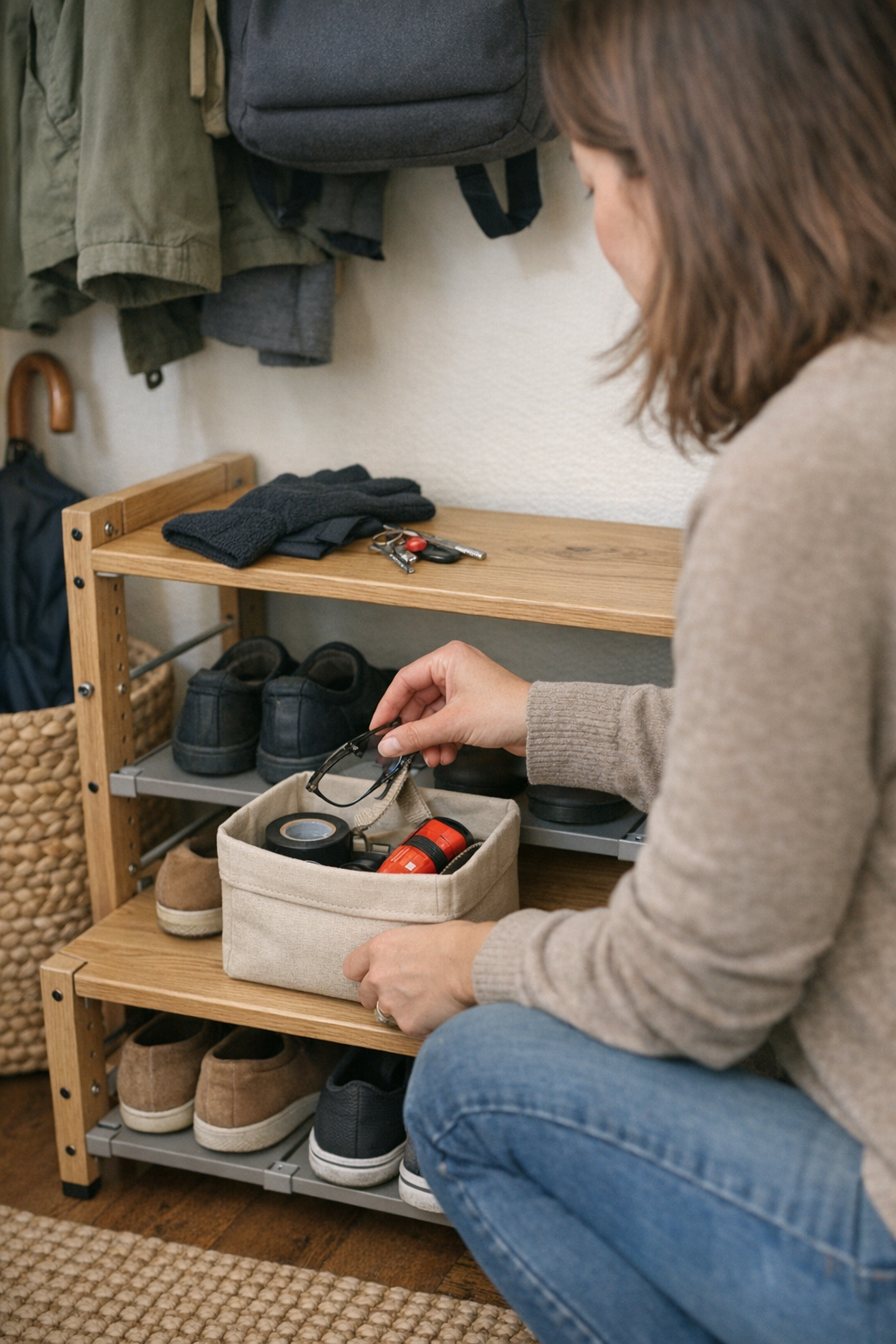
The first sign isn’t clutter—it’s a blocked path. That “repair later” box you squeezed into the entryway was supposed to keep mess at bay. But too often, it turns a clean threshold into a slow-motion obstacle course. It never happens on day one. Give it a week of wet arrivals: a snapped shoelace, a leaky bike light, gloves with torn seams. These repairs-in-waiting quickly multiply, crowding out shoes, edging bags to the wall, and forcing the “clean zone” to shrink. Suddenly, the daily flow stalls at the threshold. A repair bin meant to help is now squeezing the entry routine, not just storing tomorrow’s problems.
Why Oversized Repair Boxes Break the Flow
At a glance, a big repair bin by the door feels like good prevention—just toss any broken item in and reclaim the surface. But extra capacity rewrites the rules: instead of solving problems, it collects them. The bin suggests every snag is someone else’s future job. What belonged in a quick-reset zone becomes a semi-permanent backlog—umbrella missing a spring, jacket with the ripped cuff, mug with a cracked handle—none fixed, all lingering underfoot.
This doesn’t just create visual clutter. The oversize box tempts everyone to ditch “one more thing,” shifting responsibility to the pile. You notice it in the hesitation—no one sorting, everyone bypassing. Instead of urgent fixes, the box becomes a holding pen for abandoned repairs, half-resolved jobs mixing with your gear. Within days, the space meant for a quick handoff slows to a crowded detour.
Seeing the Slow Creep: Real-Life Entryway Scenarios
The “just drop it” habit: Someone comes in, drops their bag, and the box is full or almost toppling. Instead of a clean transition, there’s a shuffle—maybe a glove slips out, or a bag lands in a splatter of “to-be-fixed” scraps. Quick drops get interrupted by a balancing act.
The shoe row story: Shoes lose their zone as the repair box colonizes part of the bench or floor, so the row of boots and sneakers spreads into the walking path. Mornings become a dance, dodging both repairs and gear, dragging the reset time longer after every busy day.
The bench-edge clutter trap: The corner you use to tie shoes now has a spillover repair basket poking into your seat. Every time you want to sit or set something down, there’s a micro-shuffle—moving the box, steadying it, dodging another precariously perched item. Miss the edge, and a flashlight tumbles onto your foot.
Blocked entry resets: The moment you try to return a coat or drop your lunchbox, the oversized repair container is in the way. What should take five seconds turns into tiptoeing and nudging the box aside—if you don’t, you risk toppling it or mixing up repaired and unrepaired items until the reset slows from habit to hassle.
A Smaller Container Creates Just Enough Useful Pressure
The fix isn’t getting rid of repairs altogether—it’s shrinking the space they can invade. A box sized for only three or four small fixes—what a household can reasonably address inside a week—forces backlog into the open and caps the spread. Now, pressure moves from storage to action. Every new addition to the box is an obvious cue: delays can’t hide. Overflow means immediate triage—fix something now, or move it out. The entryway regains flow, not just aesthetic order.
In practice, the right size container prevents the invisible creep. You can handle a busy repair week, but a smaller limit keeps everyone from using the box as a permanent exile for broken items. The container signals when it’s time to act or clear space—no more finger-pointing or letting repairs “live” in the main flow.
What Happens When the Box Shrinks
The transition is tangible. Where once forgotten umbrella tips and broken toys settled in strata, a right-sized bin now holds only what you’ll address soon. The visible pile never gets deep enough to hide things. On busy days, you scan what’s in, grab what needs a fast fix, and keep movement snappy—thirty seconds, not another mini-cleanout. If overflow creeps in, it’s a signal, not a failure: time to move old repairs to a utility cabinet, out of the high-traffic flow.
If the box fills, don’t try to force it—shift sluggish repairs to a slower zone (like a storage cabinet or garage shelf). High-traffic entryways thrive on rules. Repairs that can wait for weeks simply don’t belong in the path you walk through daily.
Not Just Neat—Actually Functional, Day In and Day Out
A photogenic entry is easy—an efficient one is elusive. Most repair bins look fine for a day but reveal their true limits in daily churn. A right-sized repair box puts pressure where it belongs—on keeping the entry clear and functional, not just tidy. Shoes don’t get squeezed out by tools, keys don’t vanish under gadgets, the bench doesn’t morph into overflow. The smallest reduction—a slimmer box, a vertical container swapped for a deep one—makes walkways feel wider and returns the bench to its intended use.
Daily Behaviors That Signal It’s Working
- Resets are brief and automatic—not another project on the list.
- Repair items stay visible and move quickly, never getting buried for weeks.
- Shoe and bag space holds steady—new repair jobs can’t shrink the zone.
- The household learns the loop: if the bin is full, it’s a cue to act or relocate, not to add “just one more.”
- Footpaths unclog, and pass-throughs happen smoothly, even on rushed days.
The setup isn’t flawless—everyday use keeps things fluid—but the entryway stops falling into the same old pattern of backlog and blockages. Instead of each surface attracting another stray, they reset for next use almost on their own.
When It Looks Organized Versus When It Feels Usable
A box can look under control while quietly sabotaging the flow. The real test comes a week later: does it nudge you to finish jobs, or does it anchor an ever-growing backlog? Something that holds “just enough” repairs for one week forces friction early before small problems turn into daily interruptions. Functional entry setups aren’t the ones that store the most—they’re the ones that prevent drift, crowd-out, and hesitation when crossing the threshold.
Choose the repair zone that stays nearly invisible because it keeps moving—never the one that comfortably grows old with things no one’s fixing.
Practical Tip: Build In a Weekly Reset Routine
The best transition spaces run on habits, not just containers. Set a fixed time—end of the week, right after school, Sunday evening. Glance at the repair bin: if it’s more than half-full, clear anything you won’t fix in days to deeper storage. Old tasks get priority or get moved out. Over weeks, every inch of the entryway starts supporting momentum instead of slowdowns, making each arrival a non-event, not a miniature reset challenge.
If your entry system keeps the threshold open, stops new blockages, and lets you reset the space in seconds, the repair box is doing its real job—not stealing the entryway, but returning it to daily use.