
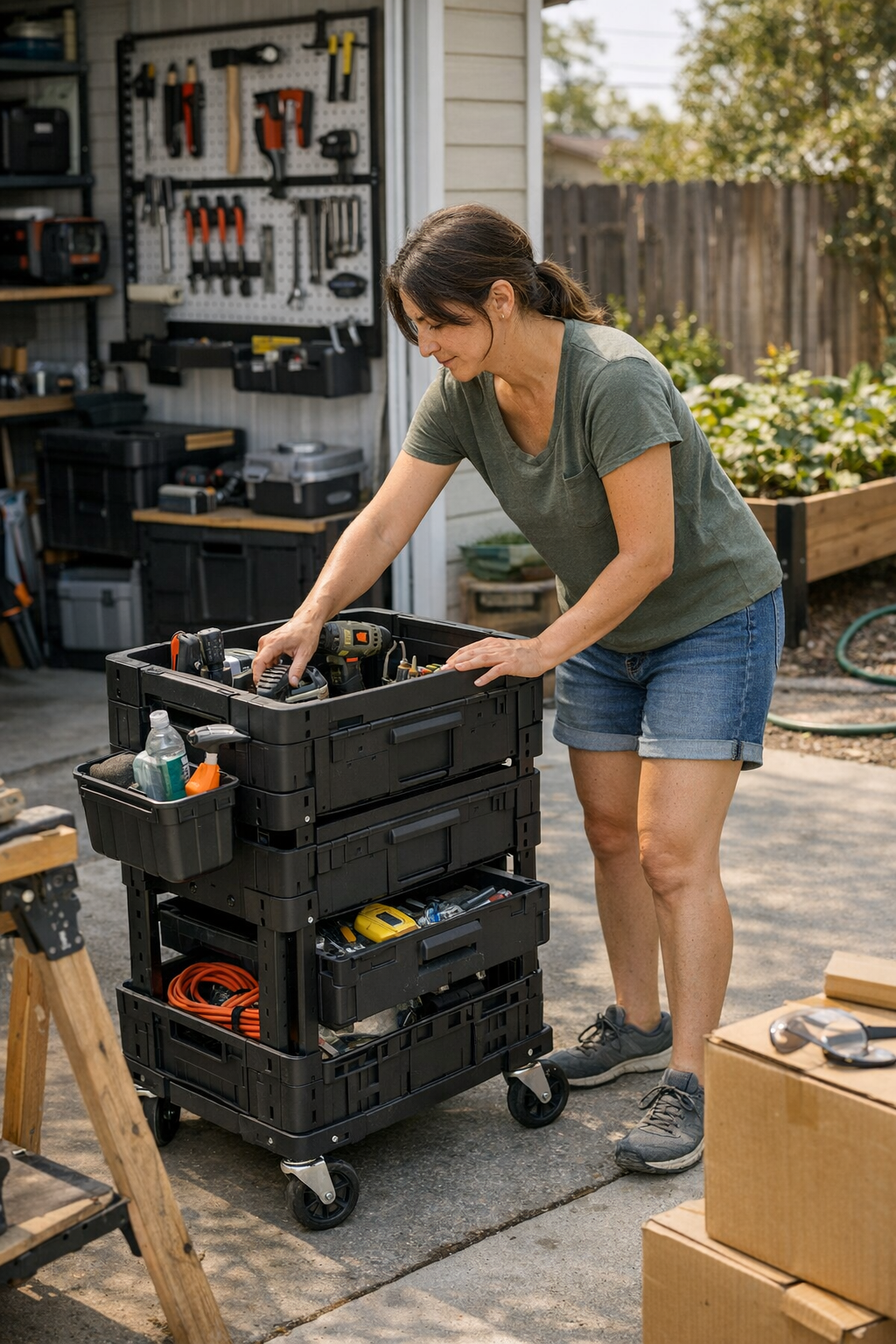
Every garage or workshop looks organized—until you actually try to use it. The problem isn’t always clutter or neglect. It’s standing there, staring at a perfect grid of labeled drawers and wall racks, only to trip over the same blocked path, squeeze past a cabinet that always seems in the way, or shuffle tools in and out every time your project spills beyond that one perfect wall. What’s supposed to be an upgrade—the “everything in its place” system—becomes a stop-and-start obstacle. You find yourself dodging fixed shelves, retracing steps for forgotten tools, or improvising makeshift piles in open corners just to keep moving.
Stationary Setups: Where Organization Stops and Frustration Starts
Most setups start the same: fill the main wall with shelving, pegboards, or a bank of deep drawers. For a little while, everything looks under control. But start a real project—installing shelves outside, swapping tires in the driveway, just cleaning up yard tools—and the stationary system quickly betrays its limits:
- Making three separate trips because the next socket or screwdriver is back on the wall, past the bikes, around the lawnmower.
- Edging your way past a low bench only to find both sides blocked by deep cabinets—no good angle, nowhere for your knees.
- Stacking the “overflow” tools into floor corners, because the wall rack is full but there’s never enough truly usable space.
- Shoving open a cabinet door for the hundredth time, just to squeeze out the same wrench you always need, and fighting the door as you pivot through a narrow walkway.
It’s not chaos, but it’s not flow, either. With every trip, work gets incrementally slower. Corners fill with odds and ends. You know where everything lives, but getting to it—actually putting it to work—becomes a tactical scramble more than a routine.
Mobility Breaks the Pattern
This is where mobile storage—rolling carts, compact chests, or modular cabinets—quietly shifts everything. The benefit isn’t just squeezing in “more storage.” It’s the ability to bring what you need to where the real work is happening, not the other way around.
On a Saturday tune-up, instead of filling your arms with everything you think you’ll need (and inevitably missing something), you load key tools into a cart and roll them to the driveway. The setup moves with you—against the workbench, outside near the project, or down the line as you shift between tools. Every transition that used to mean starting over or stepping awkwardly around barriers now becomes a single, consistent flow.
Real World Scenarios: How Static Storage Trips You Up
Think back to assembling outdoor furniture last summer. The storage cabinet looked tidy, but the moment you needed a clamp or swapped out a bit, your hands were already full and your path was blocked by the same old stack of bins. Every unplanned step back to the wall cost you time and broke your rhythm. The corners became holding zones for whatever didn’t fit. At the end, it felt like you spent as much time resetting your workspace as working.
Now, picture a cart loaded with just your essentials parked beside the job. No more juggling bits and running laps; no more fishing behind storage that looked great but never actually cleared your path. The cart slides with you, pivots where you need it, and parks out of the way when you’re done. You see the change in the rhythm: less time resetting, more time actually building, repairing, doing.
Daily Friction: Where Static Setups Cost Time
The same story plays out in daily routines. It isn’t just big projects—small repairs or quick tune-ups stumble over the old traps. Running to the yard with a single tool, then doubling back because the rest are anchored inside. Piling gloves, fasteners, or cleaners on the nearest flat surface because the shelves are full but never quite flexible enough. Your attention fragments, and little jobs sprawl out longer than they have to.
With a mobile cart, a third of your daily-use gear follows you. Suddenly:
- The blocked passage clears as you spin the cart, not your entire body, around fixed shelves.
- No more reaching blindly behind the same cabinet for a tape measure you use daily.
- The overflow stops accumulating in the same corner, because your storage flexes with project demands.
- End-of-day resets shrink to seconds; just wheel the cart aside, instead of sorting scattered piles by hand.
- Lock the wheels once—your gear stays put even on uneven ground, and you stay focused.
It’s not a showroom transformation, but it’s a real relief. The difference isn’t dramatic at a glance—but over a week or a month, the space actually fits your routine, not the other way around.
More Than Looks: Spaces That Work, Not Just Impress
You know the difference the first time you don’t hesitate before starting a new task. Static wall systems impress with perfect rows, but if every little change in your workflow means more reshuffling, their rigid “order” just slows you down. Mobile systems don’t always win beauty pageants, but they keep pace with the unpredictable mess of real projects:
- You set up faster—and clean up with a single push, not a dozen little cleanups.
- Blocked zones and dead corners stay empty, not filled with the same old cast-offs.
- Walking space and work surfaces stay clear—ready, not cluttered with what you “might” need next.
- Wall racks finally become supporting players, not dead weight; the cart does the heavy lifting where it counts.
No setup is flawless, but the old grind—reshuffling, dodging, backtracking—fades. The place feels like it’s finally working for you, not the other way around.
Small Changes, Noticeable Results
You don’t need a full overhaul. Shifting even a handful of your top-used tools—pliers, driver, tape, gloves—onto a mobile cart can unstick your flow instantly. A cart with locking wheels, or one that tucks under the bench without blocking aisles, turns the space from “arranged” to genuinely usable. These aren’t prestige upgrades; they’re practical, lived-in changes that stop the little frictions from stacking up day after day.
If dust keeps building on one wall rack or the path past a cabinet never feels clear, pay attention—that’s your setup speaking. When your routine moves, your storage should follow. Make your organization work the way you do, not just the way it looks in an empty room.