
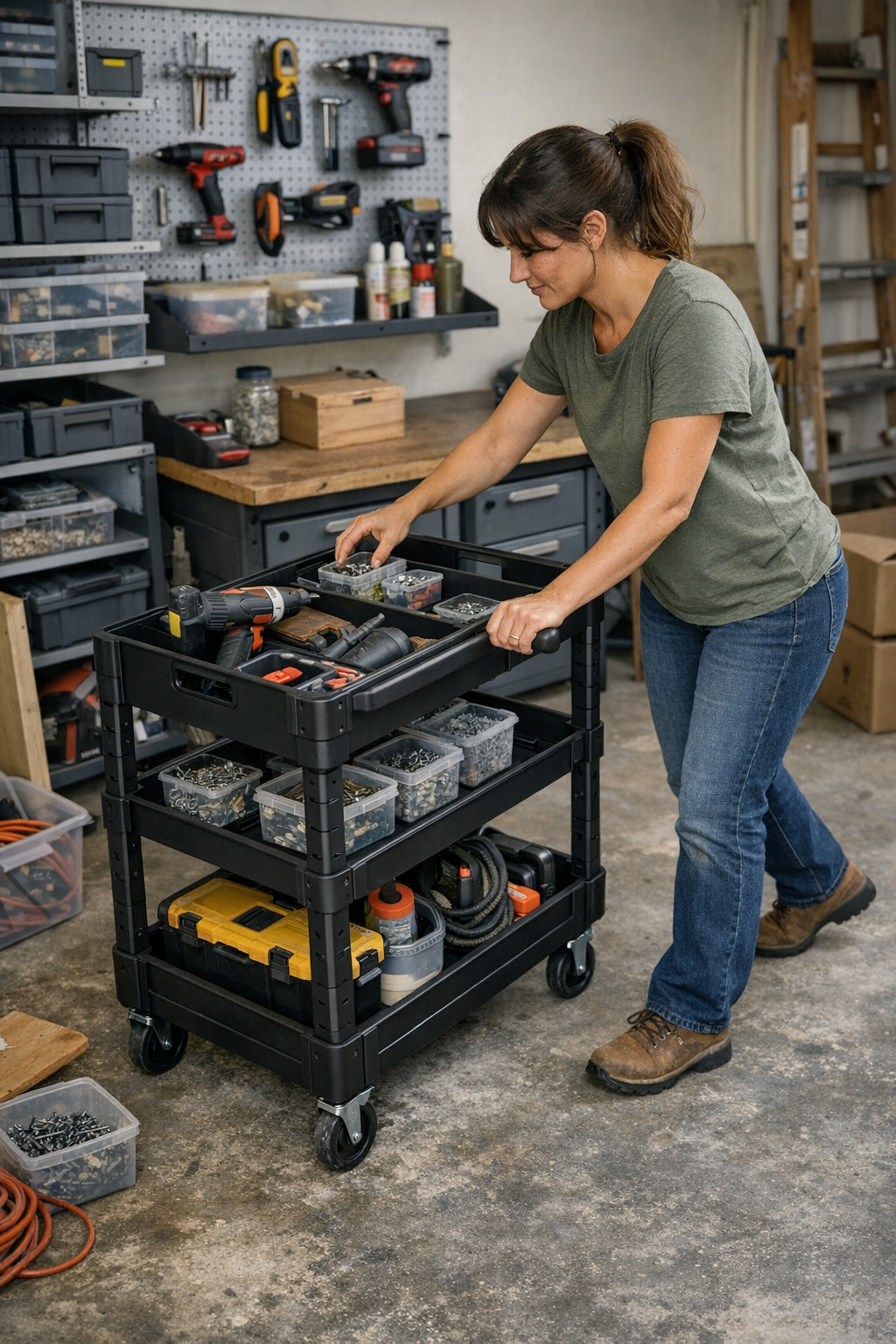
The promise of a spotless workspace always looks good—until the friction begins. If you’ve set up a garage, workshop, or utility room with those satisfying wall shelves, crisp cabinets, or neatly stacked modular bins, you know the routine. Day one is all clear counters and smooth labels—the space radiates readiness and order. But let a normal afternoon unfold, and the cracks reveal themselves fast. The clutter that “shouldn’t” return starts creeping back, but not as chaos—this time, it’s awkward footsteps, blocked corners, and a subtle drain on your workflow every time you try to get something done.
From Showcase to Slowdown: When “Organized” Trips You Up
The trouble isn’t clutter—it’s how “organized” means working twice as hard just to keep the pace. On the first real project, you find yourself darting between cabinets for a drill bit, dodging the mower squeezed in for winter, then reaching around that shelf that always juts onto your path. Grab a handful of fasteners, make two trips since one never holds everything, then circle back to return what you forgot. Every extra step redraws those supposed “clean lines.” Spaces that look dialed in on day one suddenly make every movement feel boxed-in—and the overflow starts accumulating in the same tired zones every time.
Fixed setups sell the dream of order. But after a few rounds of actual use, their real legacy is blocked walkways, double-duty movement, and corners that quietly choke up with overflow. That clear area next to the cabinet mutates into a dumping ground; the floor fills up as bins get shifted out “just for now.” Resetting after a job? Suddenly it’s a scavenger hunt, not a process—slowing you down before the next project even begins.
The Hidden Cost of Fixed Storage: Reset After Reset
Setup day isn’t real life—the true test is how long it takes to reset after each job. Too often, that means juggling bins to reach what matters, or abandoning tools near the door because shelving is buried behind “temporary” piles. The wall might be fully kitted out, every shelf labeled, but actually getting to what you need—and putting it away—requires constant reshuffling. You move a box to open a cabinet, nudge a bin to pull out a sander, then detour around a cart left parked in your work lane.
Footprints get awkward and detours multiply. It’s not one big mess—it’s dozens of micro-obstacles: a half-blocked aisle, a tool left balancing on the freezer, a quick reach around a cabinet edge that you repeat for the hundredth time. What felt “efficient” at first slowly turns every 10-minute chore into an unintentional marathon—especially if two people are working at opposite ends or you suddenly have to haul larger equipment through those tight walkways.
How a Mobile Cart Shifts Everything—Without Adding Clutter
You don’t need more storage. You need storage that moves with the job. Roll your core tools, fasteners, and small parts onto a heavy-duty cart—and the friction that drains your setup simply stops accumulating. Instead of zigzagging across the room for each piece, you work straight through: the cart follows you, not the other way around. Wall space could look the same, but now there are no dead corners or blocked pathways, because the essentials move with you, and nothing gets parked in the way for long.
Clutter zones start to evaporate. No more overflow quietly sprawling behind toolboxes, under benches, or beside the washer. With a mobile hub, bits and tools return to you—not to a random flat spot across the room destined for forgotten piles. Flat surfaces that were once magnets for “just for now” gear finally stay clear, because your reset can actually keep up with your workflow.
Real Setup Scene: Getting It Done—Or Getting Stuck
Picture a bracket installation near the garage side door. With tools locked away in fixed cabinets, you shuffle across the room for a screwdriver, realize you’re missing anchors, kneel for hardware, then stand up only to remember the drill’s back by the door. Now, one box is underfoot, your balance is off, and the job that should take 15 minutes mushrooms into a series of stop-and-go corrections. A mobile cart changes the scene: you roll up, everything stays beside you, each tool returns to the same spot, and your path never tightens. The job finishes with less back-and-forth and almost no unnecessary detour.
Mobility Isn’t About More Stuff—it’s About Easier Returns
The cart doesn’t just haul extras—it unravels that relentless loop between using and resetting your space. When the job’s done, everything used is already on the cart, ready for return. Start-to-finish, there’s less scatter, no forgotten piles on random shelves, and your reset is nearly automatic. The visual calm and the open movement aren’t just an illusion—they’re a real improvement you can feel at the end of the day.
What Static Storage Still Does Well (And Where It Fails Without Backup)
Wall cabinets still earn their keep—just not for daily flow. Stash overflow, off-season gear, and backup supplies where they’re out of the way. But if you lean on these zones for every project, cracks show fast. The system might “look finished” right after setup, yet within weeks, new piles sprout in awkward spots the layout never anticipated. Clarity starts eroding not because you lost discipline—but because static storage can’t flex with your actual work rhythm.
Notice yourself—or anyone else—repeating the same detours: shifting a cart just to pry open a door, weaving around gear you parked “one time,” or reaching past the same cabinet edge for the third trip in a row. These repeated movements aren’t mistakes—they’re your setup signaling it’s working against you, squeezing the room tighter even when there’s technically “a place for everything.”
Flexible Fixes: Tweaks for a Smarter, Smoother Setup
You don’t need to ditch your shelves or rip out what works. In most setups, background storage stays—wall cabinets for backup, shelving for seasonal tools. The real shift is making your daily-use gear mobile: a cart, caddy, or rolling chest that clears the main area after every session. Even a single high-quality cart changes the flow of the whole workshop or garage, letting you put hands on what you need, right where you’re working, without crowding the floor or wall zones for good.
Four Tweaks That Help Right Away
- Make overflow obvious: Any bench, floor corner, or shelf that always collects extra gear? Give that stuff a mobile home, not a permanent landing pad.
- Use your cart’s top tray for in-progress parts: Fasteners, bits, or hardware stay visible and contained—not spread across every project zone or slipping underfoot.
- Watch your walkways: If you have to move your cart (or a bin) just to open a cabinet door or squeeze by, reconsider where things live between uses. The return route should stay as clear as your starting lane.
- Group tools by action, not by wall: If you always grab the same drill, measuring tape, and level, keep them together on the cart—don’t split them between fixed shelves, only to cross the room every session.
Choose Flow, Not Just “Order”—And Make Your Setup Work For You
The best area isn’t the one that looks arranged right after a deep clean. It’s the setup that lets you work straight through, reset in moments, and keeps corners from turning into overflow traps—even when projects pile up or routines repeat. Once you’ve swapped the headache of endless return trips for the ease of open movement, the case for a mobile zone writes itself.
For real-life setups that hold up—the kind that don’t box you in or slow you down—mobility is the missing piece. The difference isn’t abstract: it’s felt every time you avoid that repeat detour, recover precious floor space, or end a day without hunting for lost tools. Try letting your essential gear flow with your work, and see how much more usable your space becomes.
Visit StackNest for practical storage solutions that fit the way you really work.