
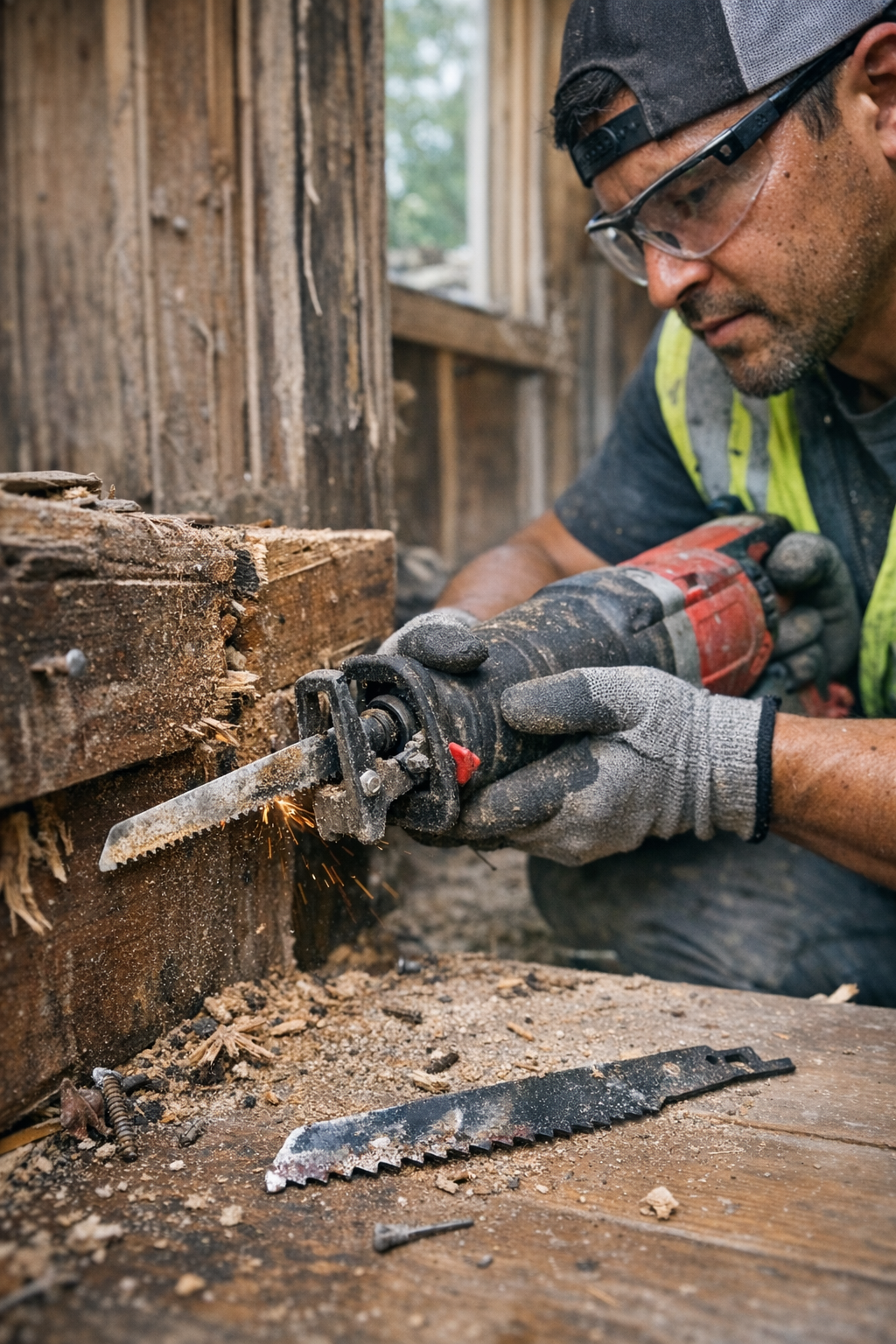
The moment your saw lurches and the cut goes sluggish, you feel it—the blade isn’t up to the job. On paper, every reciprocating saw blade promises “professional results,” but only real-world cuts separate smooth progress from relentless struggle. At the bench or waist-deep in demo scrap, nothing exposes blade weakness faster than a few feet of buried nails, damp wood, or dense studs. That’s where tool performance stops being theory and starts costing you—time, effort, and finish quality.
Blade Trouble Usually Hits Mid-Project—Not on Day One
The first plunges often fool you: fresh teeth, quick pass, everything easy. But when you’re two dozen cuts in, heat builds, dust packs into the gullets, and the job shifts. Suddenly, a blade that powered through framing boards now shudders at every nail; control slips, and you feel your shoulders tensing, trying to muscle through. Cuts veer, edges rag out, and that simple trim-out stretches into bonus cleanup. If you’ve ever had a vibrating saw leave your arms buzzing for hours, you know the difference isn’t subtle—it’s the friction you fight with every pass.
It’s not catastrophic failure that kills productivity—it’s the slow, creeping grind. A little more vibration, just enough burning pitch, twenty more minutes chasing ugly edges with sandpaper. Ignore the warning signs and you’ll feel progress grind down with each cut: more strain, less control, and a cutline you end up fixing instead of moving on.
Why Some Blades Quit Long Before Others
Not all saw blades fade the same way, and the reason rarely comes down to what’s printed on the label. It’s the nagging factors under real load:
- Material matters: Bimetal blades tough it out; brittle carbon steel flexes, then fails.
- The workload: Are you cutting old nails and wet studs, or clean pine?
- Your approach: Do you force every stroke, or let the saw do the work?
- Keep it clean: Ignoring dust quickly glues sawdust onto teeth—hello, friction and heat.
Grab the wrong blade for the job, skip cleaning, or mismatch TPI to the material, and you get trouble early: grabs in the cut, wandering lines, and teeth that dull before the blade snaps. Sometimes the blade flexes sideways after three studs, or gunk bakes on the edge, ruining any hope of a clean finish. That’s time lost—not to catastrophic breakage, but to burned out edges and hours of sanding and rework.
How a Dull Blade Draws Out Every Task
Picture midway through basement framing—shavings on your boots, saw humming. A solid bimetal blade lets you steer, keeps vibration steady, and the passes smooth. A bargain blade? Three studs in, it starts pulling off line, rearing up at buried nails, and the cut grows a jagged tail. Sawdust turns to paste, teeth overheat, and every next cut takes longer. You feel the control slipping every inch.
The Real-World Difference: Side-by-Side on the Jobsite
This isn’t just warranty talk—it’s straight off the job. On a porch tear-down laced with half-hammered screws, I drove an 8/14 TPI bimetal blade through boards and hardware for an hour—line stayed dead straight, cuts clean, only a whisper of scorch on the exit. Swapped for a big-box carbon steel blade out of thrift: instantly the cuts wandered, noise amped up, and by the seventh post, it was bent, teeth caked, and fighting every entry. It doubled my time, left splinters everywhere, and forced a cleanup that nearly beat the demo itself. A cheap blade isn’t a deal when it drags down every pass and turns one job into two.
Tweaks That Actually Save The Day
No magic bullet—just small shifts that pay off. On that same porch, two habits changed the whole tempo:
- Pace the stroke: Instead of raw force, pull out after every half-foot to shake dust loose—keeps heat down, saves edge life.
- The right blade for the material: With nail-hardened timber? Stick to that bimetal 8/14 TPI and the saw stays controllable and smooth. That blade finished 48 plunge cuts before showing real fatigue—well past what the cheapo survived before it started tearing fibers and trashing finish quality.
Real Friction From Routine Jobs
It’s not just on showpiece decks—blade life bites you everywhere. Trying to square off old floor joists under the house, hacking stubborn roof braces, or slicing deck rails in a deep freeze: if you hit more vibration, have to lean hard, or the blade binds mid-cut, it’s usually not your saw failing. The wrong blade, dirty blade, or worn-down teeth force you to fight every step.
- Can’t tell why progress has slowed? Pause and check for sawdust caking or the edge running hot.
- More vibration than last cut? Odds are good you’re running dull—or mis-matched for the material.
- Saw feels “grabby” or fights you? Pull the blade clear, tap off debris, and reset your technique—let the tool’s action, not your biceps, do the work.
Your Quick Field Reference: Saw Blade Life
How do you know a blade is finished—before it snaps?
If you feel new vibration, smell burnt pitch, or notice the saw pulling off line, pay attention. Sticky gunk building on the blade often warns you before you see rounded teeth.
Does it help to clean the blade mid-job?
A hundred percent. Let pitch and dust build, and you’ll trash the edge in minutes. Habitually pulling up and clearing grit during the cut means cooler runs and blades that last twice as long.
Is there really a “one-size-fits-all” blade?
Not in the real world. For mixed demo—hidden nails, surprise screws—stick with a variable TPI bimetal for the longest run. But shift to dense hardwoods or all-metal tasks, and specialty blades pay for themselves in both time and fewer ruined passes.
Real Performance Comes Down to Blade Choice
The right blade isn’t just about speed—it’s control, smoothness, and less beatdown on your hands. In the middle of a dust-choked workspace, that means cuts that run true, less sanding, fewer unplanned breaks, and actual forward progress. Small mistakes in blade selection cost you sweat and time; the cheapest option often becomes the most expensive over a day’s worth of work. Forget the claims on the box—feel the difference as your workday stacks up, and pay attention to what you’re left holding: a finished project, or a pile of wood that needs fixing.
Shop Gumboll for blades and accessories tested where real work happens.