
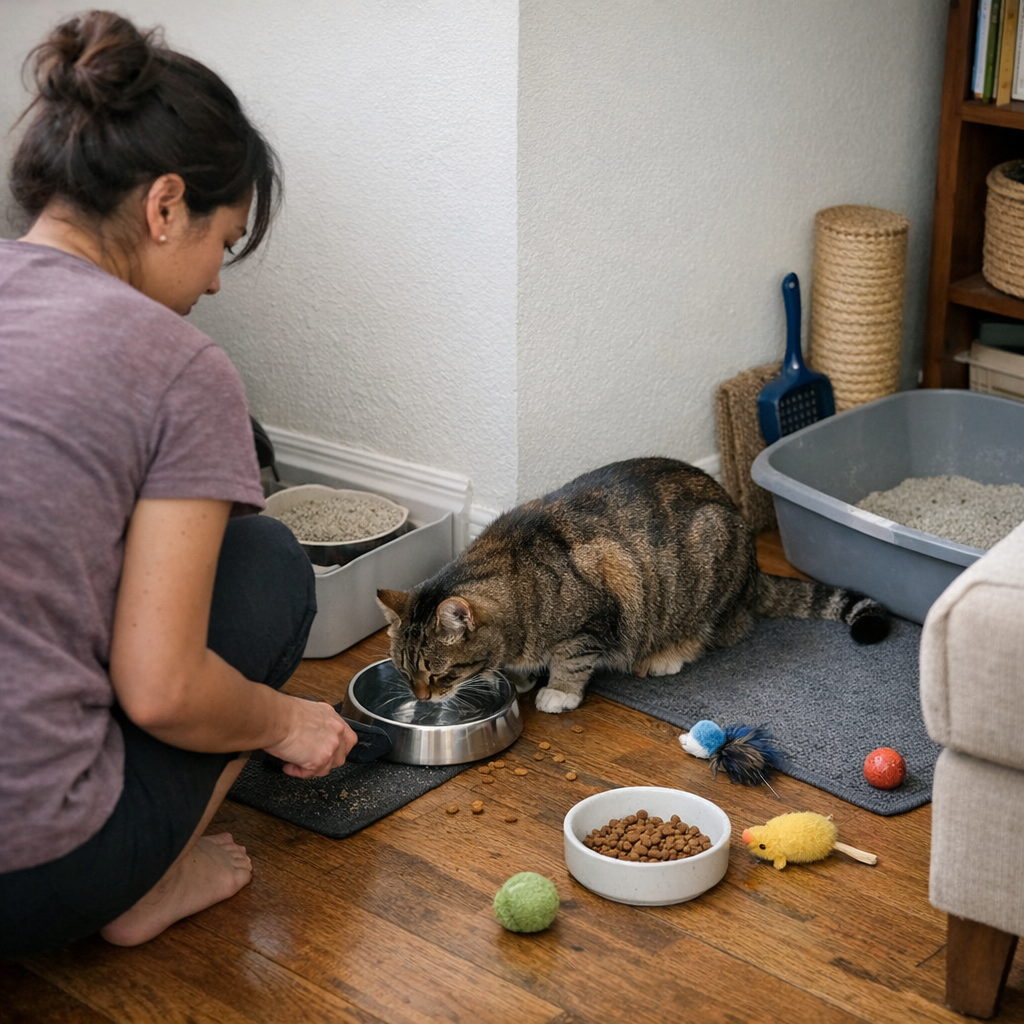
The reality of an “all-in-one” indoor cat starter kit hits after the first couple days: the neat tray, cluster of bowls, and tidy block of toys that promised order turn into a reshuffling project you didn’t sign up for. By midweek, your food bowl is drifting into water territory, stray kibble outlines the mat edge, and that streamlined look morphs into an obstacle course as you refill, wipe, and navigate around scattered cat supplies. What felt settled quickly becomes friction: a food bowl out of place, water drops you missed earlier, and toys finding traffic lanes instead of staying in their basket. It’s not “cat chaos”—it’s the cost of too much crammed into one spot. The starter-kit shine fades fast, and the friction lands right at your feet.
When the New-Kit Shine Fades: First Signs of Friction
The earliest warning isn’t dramatic; it’s accidental contact between items that should cooperate but instead get in the way. The food bowl slides into splash range of the water dish. Kibble grains stick to the mat and cling under the water rim after every meal. Within five days, toys invade the path to the litter box as if the kit’s design never imagined daily movement. You notice the same sponge-ball blocking your path at night and a tangle of catnip mice lurking under the scoop just when you need quick access.
The kit’s visual order doesn’t hold. Every refill, every mat wipe, you find yourself nudging aside one thing just to handle another. It accumulates fast—interrupted task flow, the sense of the setup quietly working against your routine, and a layer of nuisance you can’t ignore during most resets or cleanups.
Daily Routines Expose Where Starter Kits Fall Short
Starter kits feel efficient—until the routines start looping. At first, everything “in one place” seems practical: feeding, water, litter, scratching, play. But your living space isn’t a store display photo. Packed zones create failures that only regular use reveals: kibble drifts into water with two meals, mats shuffle loose by lunch, and toys bypass the “tidy corner” to reappear in high-traffic spots.
Overlapping Spaces—A Recipe for Repeated Micro-Cleanups
The first spill in the water area isn’t an anomaly—the spacing forced the mess. The convenience of combined setups turns out to be false:
- Food and water blend zones: Crumbs migrate, water splashes, and what you thought would mean fewer cleanups just means each bowl’s mess joins the other’s chore.
- Litter mat loses control: Packed against feeding space, tracked litter finds routes straight to your main walkway. Now you’re vacuuming not just near the box but anywhere the mat “overflows.”
- Toys break containment fast: Even with a storage basket, balls roll out toward doorways and plushies stack up in corners, constantly underfoot or in the way of a quick litter scoop.
Every fix—another sweep, a bowl moved an inch, an attempted reset—proves that dense setups can’t keep up with real movement. You’re stuck patching instead of solving.
The Cycle of Reset, Clean, and Repeat-Adjustment
Routine maintenance becomes a slow round of minor struggles. By the end of week one, you’re not just tidying—you’re pre-emptively troubleshooting a cluster of items that don’t cooperate. This isn’t a messy-cat problem; it’s the direct result of physical overlap and functional clash.
Every Reset Reveals the Real Weak Points
Morning refill rush? Reach for the food bowl, nudge the water, spill a few drops—same crumbs clinging to the mat as before. The wipe-down never feels complete. Each reset uncovers another small mess you missed or created by jostling the crowded arrangement. Cats loop the same routes: grains track, toys sneak under furniture, nothing stays where it should.
The “compact” kit quietly eats your time:
- Bending down for a refill turns into a treasure hunt—move a squishy toy out from behind, then finally reach the bowl.
- That “accessible” scoop clip gets in the way every time you try to swap a litter liner.
- Your paper towels are nearby—until a quick spill reveals they’re actually blocked by a mat or cluster of bowls.
Visual Unity vs. Usability: When Looks Work Against You
Grouping everything for a clean look—a shared tray for both bowls, a mat nudging against the litter box, toys posed around the scratcher—might impress on day one. But the denser the zone, the more you end up tripping over your own organization. Fitting the kit into a two-by-three-foot patch doesn’t mean actual routines become simpler.
Cleanup and resets devolve into a careful chain reaction: move a bowl to wipe, reset the mat, hope the toys don’t roll out again. Often, as soon as it looks “fixed,” the next round of feeding or play scatters items all over again, sometimes within hours.
Repeated Interruptions and the Hidden Cost of “Tidy Enough”
There’s a persistent gap between “kit looks clean” and “kit feels effortless.” Starter kits are best at hiding the difference—until daily routines drag subtle annoyances back out, especially if you share space or need to move quickly.
When A Setup Looks Under Control, But Still Doesn’t Feel Right
The irritation isn’t a big catastrophe—it’s the drag of repetitive annoyances:
- Sidestepping toys you know you just picked up this morning, scattered out again by evening.
- Tracking stray litter to the hallway, proof your “contained” mat let grains slip past the integration point.
- Lifting and re-placing the water bowl every time you wipe, never feeling like its position is stable for long.
- Trying to speed through a refill, slowed down by other items blocking direct reach.
It’s not just mess, but the daily cost of interrupted movement and small delays—always one more nudge, one more obstacle, one more “quick clean” that never quite makes the system feel under control. A kit built for show turns into a setup that wants constant attention.
How Real Adjustments Make a Difference: Spacing for Function, Not Just Form
What actually works is spacing out your setup based on tasks, not the original kit grid. You don’t need an entirely new collection—just a reset based on what keeps colliding or slowing you down.
Real-World Shifts That Actually Reduce Daily Friction
- Water bowl: one mat-width separate from food: Shift the dish to a quiet edge of the room, further from feeding crumbs and splash. Suddenly, you deal with water mess and food mess as separate jobs, not an endless two-in-one wipe.
- Litter: runner isolated from feeding area: Place the box and mat three steps away, and most tracked litter stops at the runner’s edge. Now litter doesn’t scatter through multiple rooms, and you have a defined cleanup zone.
- Toys: clearly away from feeding/water traffic: Keep play storage at a distance; cats will find the toys, and your routine path is no longer an obstacle course. Resetting is straightforward, not a repeated gathering mission with every pass-through.
The impact is immediate: refill and cleaning sequences become linear and predictable. No extra detours to move stray items; no repeated frustration over the same mat or water splash. The setup might look less showroom-ready, but you gain time and lose the irritation of overlap that a “kit” can’t actually solve.
Lessons from Imperfect Improvement: It’s About Day-to-Day Recovery
Few indoor cat homes last a week with the starter-kit “all-in-one” look intact. The difference after a few real adjustments isn’t perfection—it’s smoother routines: each feeding, cleaning, and reset can happen without tripping over leftover scatter or blocked access. The best setups aren’t about minimal footprint; they’re about making it quick to recover from the day’s mess.
Real setups trade a tidy look for easier living: Maybe it doesn’t photograph as a “perfect cat station,” but it lets you refill, wipe, and reset in clean steps—making repeat work almost disappear. Instead of circling the same flaws, you find the routine gets quieter and the friction shrinks, even if your space looks a little less staged. That’s the mark of a setup that fits actual indoor-cat life, not just the ad copy.
For everyday indoor cat life, the best setup looks like one you continually tweak—not because you failed, but
because you expect to make small changes as real routines bring out what works