
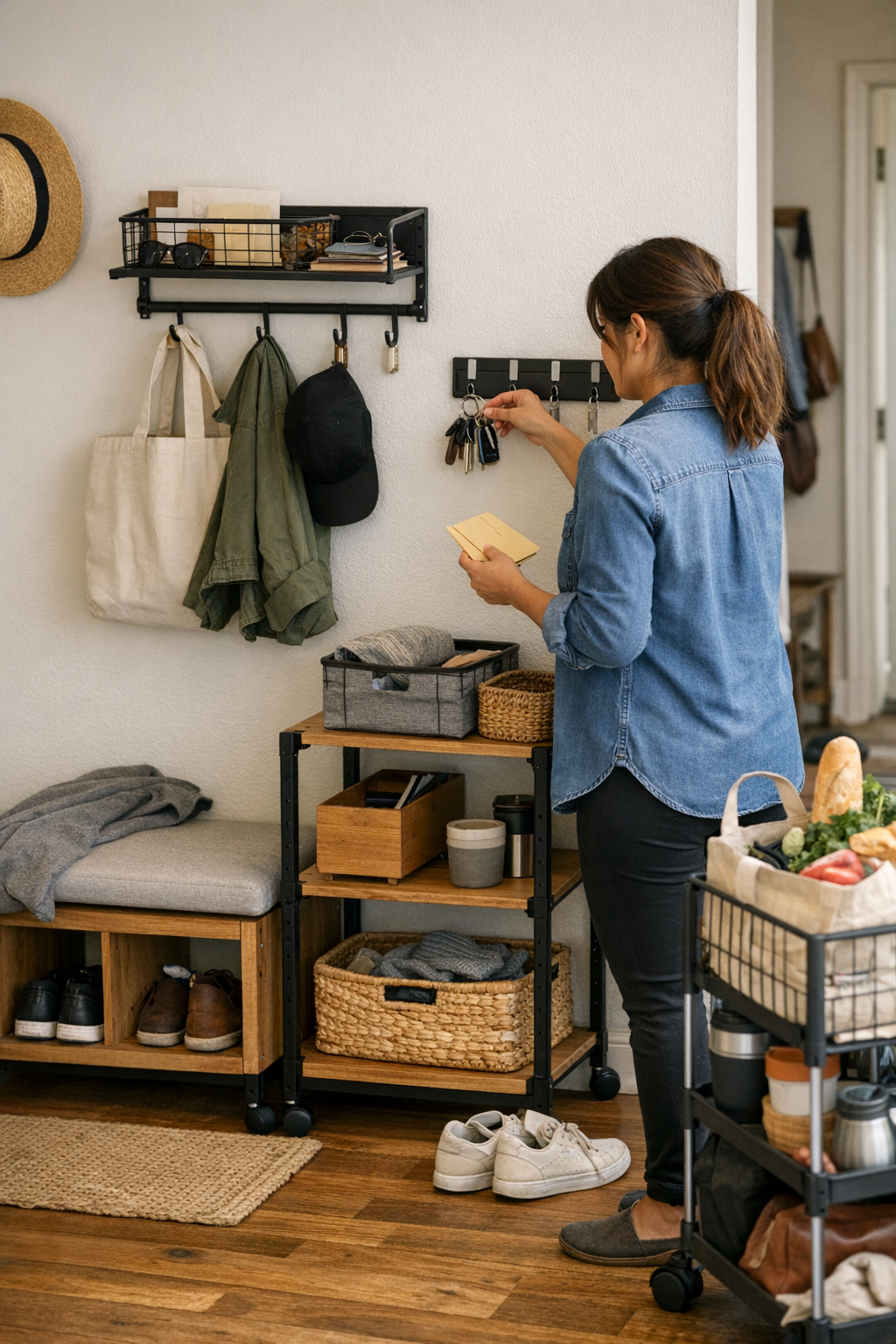
Mobile storage starts off as a quick fix—and quickly becomes a slow obstacle when your entryway routine piles up. Sliding a wheeled cart into place for shoes, bags, and jackets promises flexibility and easy resets. But within days, that “convenient” cart jams the path, edges into walking space, and attracts overflow. Shoes spill from shelves, backpacks dangle, and yesterday’s mail settles in for a longer stay. Instead of a clear threshold, you get a high-traffic detour: maneuvering around wheels, nudging piles aside, inching past a bottleneck that only grows with every “just for now” drop-off. The real friction isn’t the mess—it’s the sticky, daily slowdown right where you need speed and clarity most.
That First Week: Where Flexibility Turns Into Friction
Day one with a new cart feels like you’ve cracked the entryway code. Shoes land on a shelf. Backpacks rest on top, keys tossed where you can find them again. It’s not just organized—it’s mobile, ready to shift for vacuuming, groceries, or a quick rearrange.
But daily use unravels control faster than expected. Shoes barely stacked in the morning begin crowding the path by evening. A “temporary” bag lingers, crowding out space for mail and essentials. The cart drifts as it’s nudged out of the way for cleaning—and never quite returns. As the week ticks by, every new arrival finds less room, reshuffles more, and pushes the cart itself into high-traffic territory. What started as open access soon blocks the route, until you find yourself squeezing past and searching for what’s missing underneath the overflow.
Why Carts Drift and Clutter Spreads
Wheels invite you to adapt—but rarely to reset. The cart’s mobility, meant for flexibility, encourages you to shift things “just for a minute,” often without clearing them properly. Shoes, dropped as pairs, quietly spread sideways until they’re in the walkway. Keys and sunglasses land wherever there’s space. That early shelf order blurs as categories overlap and the cart’s boundaries dissolve.
Pushing the cart aside clears floor space for a delivery or quick sweep, but never truly resets the entry. Instead, you get drifting piles and a container that keeps changing position, never grounded enough to anchor the routine. By midweek, the cart is half staging area, half clutter magnet—blocking the entry, absorbing everything, and requiring a mini-decision every time you pass through.
Contrast with a Fixed Home Base: More Routine, Less Reshuffling
Replace the cart with a fixed zone—bench with cubbies, wall rack, vertical tray—and you get instant routine. Each item has a natural landing spot. Shoes off? Straight into a cubby. Bag? Onto a designated hook. Mail and keys? Clear, predictable drop-point, not a free-for-all. With a bench or rack, the path stays open: no wheels nudged sideways, no shifting piles, no rolling unit blocking your next step.
The change is visible by midweek. A bench’s full cubby signals “time to tidy” before clutter hits the floor. Wall-mounted setups keep footpaths wide, prevent drift, and make it obvious when something’s out of place. Every return or pickup becomes one move, not a negotiation. Instead of arranging each day, you reset again without thinking—not because it looks perfect, but because it works with your real movement, not against it.
Scenes from a Real-World Entryway: Where the Difference Shows
- The Drop-Off Tension: Coming home with arms full, you reach the threshold and realize every hook and shelf is blocked—bags, coats, shoes all tangled around a cart too crowded to help.
- Shoes in Escape Mode: Rainy days double the number of shoes; soon they leak off the cart onto main walkways. The entry narrows. Every pass becomes a shuffle and a search for a dry spot to stand.
- Reset Drag: Friday means peeling layers from a rolling pile—keys under a tote, one boot under two bags. What should take seconds turns into a search-and-sort session.
- The Cubbied Upgrade: Swap in a bench with three cubbies; now every shoe is corralled, each trip means a clean step, and hooks actually signal when to put things away—stopping overflow before it starts.
Why Carts Accumulate Instead of Organize
Open-access wheels attract everyone’s “for now” drop-offs—especially with roommates, kids, or offset schedules. Instead of guiding what goes where, carts simply expand the area of what collects, blurring boundaries on every pass. One person moves it to sweep, another rolls it closer for charging a device, someone else fills it with “out again soon” gear, and nobody resets the whole pile. Multiply by a week, and each errand leaves residue; the rolling cart morphs from solution to speed bump, clutter spreading underfoot and blocking the quick exit you actually need.
That flexibility costs routine: the cart drifts, categories merge, and the only signal to clean up is a bottleneck tight enough to force a clear-out. When the threshold is a moving target, your entryway becomes one big, accumulating tripping hazard—especially in small, high-use homes.
Making Carts Work: The Role of Temporary Overflow
Carts aren’t useless—but their real strength is backup, not everyday baseline. The right use is short and focused:
- Wheeling in a load of groceries after a big trip
- Batching tools or sports gear needed for a one-time event
- Holding “out-the-door” items for a day, not a week
To prevent drift, always pair a mobile cart with anchored storage—a bench, wall rack, or cubby system that absorbs routine daily items. Let the cart handle exceptions only. Notice shoes slipping off, bags hanging by straps, or a cart angled out across your main walking lane? That’s the sign to re-anchor with something fixed before the routine bogs down again.
Anchoring the Threshold: Practical Tips for a More Workable Entryway
1. Assign zones, not surfaces. Use fixed cubbies or vertical racks—return flow happens by location, not just available empty space. The right zone triggers the right reset.
2. Keep carts limited in function. Store carts at the edge, not as the main access point, and limit them to handling bursts—never regular drop-offs.
3. Pay attention to early warning signs. If a cart blocks passage or every “quick tidy” grows into a full reshuffle, your setup is overdue for a stable anchor.
4. Prioritize smoother resets over visual perfection. The best entry isn’t empty; it’s one where the reset is automatic, the path always clear, and “where does this go?” never slows you down.
The Real Test: Does Your Entryway Support Daily Transitions?
Carts can help in a pinch, but as daily storage they turn into rolling archives for everything unsorted—and quietly jam your daily flow. Choose a structured entry base—bench, wall rack, or cubby—if you want clear returns, open movement, and a reset that really sticks. Flexibility has its place, but in the tight, repeated routines of real homes, anchored structure wins. The payoff shows every time you open the door and walk through unblocked, no search and rescue required.