
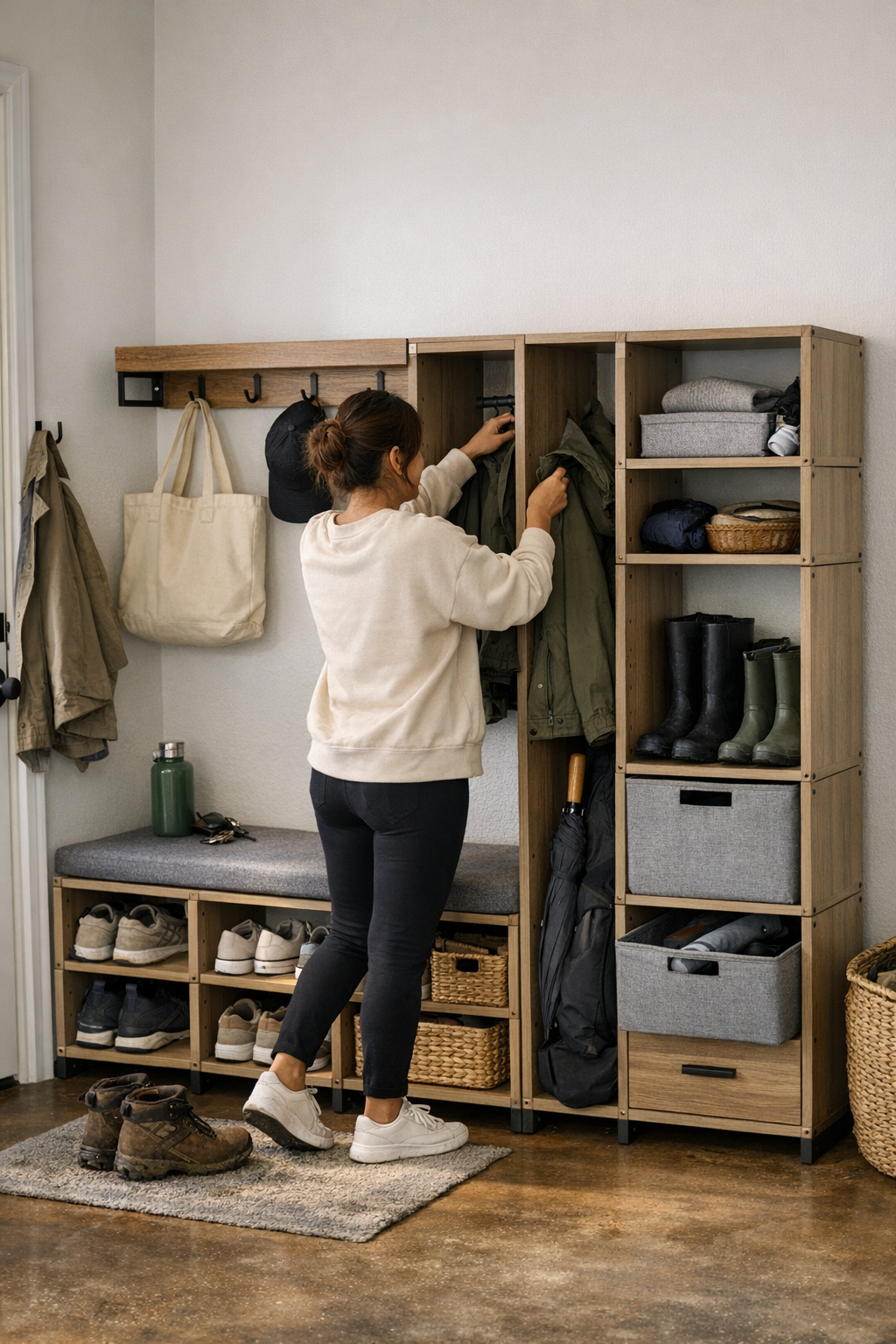
Entryway storage usually fails for one hard reason: it doesn’t match what really hits your doorstep. The drift begins the first time you stagger in with a wet bag, a dirty pair of shoes, or armfuls meant to land “just for now.” Day one, the setup looks sharp—hooks aligned, bench empty, shoes in a row. By week two, the truth appears: you’re sidestepping a line of half-wet boots, hunting for keys buried under bags, or wrestling for space to sit. Every pass-through adds invisible friction, forcing small resets and erasing whatever calm “organization” promised. The cost isn’t just clutter—it’s blocked paths, slower exits, and a daily loop of putting things back before you get out the door.
Where Entryway Storage Breaks Down—And Why You Notice Too Late
Failure in the entryway never arrives as a sudden avalanche. Instead, the system just starts dragging at your routine: shifting shoes to reach your own pair, unstacking bags to clear a seat, tripping over that one “temporary” bin that’s always in the way. Shared entries pile on awkwardness—a bench covered with someone’s gear, hooks that look full even when half are buried by layered jackets, and bags retreating to any available surface the moment routines overlap.
The problem isn’t surface mess. It’s a slowdown that accumulates—extra seconds to untangle shoes, minutes lost moving bags, repeated detours around a “solution” that only fits when nothing changes. Every reset—shoving aside a block of boots, scavenging for lost keys, clearing a bench—confirms the setup’s not keeping pace with reality.
The Trap of Open, Unitemized Storage
The starter-kit fix is universal: wall hooks, a narrow bench, a simple rack. It’s organized at rest, but almost none of it is assigned to real, repeating items. Add rain, groceries, or an extra person: the shoe rack doubles up, soaking soles meet clean sneakers, and every “grab-and-go” zone turns into a game of shoe shuffle. The bench, meant for a quick tie or pause, becomes a soft overflow—bags settle, then multiply. The “open” look masks invisible friction: you’re always tidying, with no memory of how it slipped from streamlined to cluttered.
Even wall-mounted bins—meant to absorb leftovers—get loaded with odds and ends, then forgotten. When there’s no specific rule (“bags here, gear there”), every bin becomes a catchall. Visual chaos is hidden, but daily function breaks down: searching for a single glove, fishing through random piles, or dodging what can’t dry fast enough. By midweek, the open system looks blurred; by Friday, you’re fighting it.
Pressure Points: What Happens When Real Life Hits
The real test hits with shared entries or bad weather. Imagine this sequence:
- You and a housemate step in—heavy coats, dripping bags, boots still wet.
- The bench vanishes beneath a pair of grocery totes.
- Shoes skid off the rack, stacking sideways, then blocking the door swing.
- Keys migrate to the first flat surface—windowsill, radiator, even the shoe rack—building new clutter that nobody owns up to clearing.
- Adding “just one more hook” leads to overlapping coats, tangling sleeves, and vanished wall space.
In these high-pressure moments, small issues reveal the structural gaps. You sacrifice flow: set something down and pick up three, block another person’s path, sidestep rogue shoes and sprawl, or simply abandon order. The problem isn’t always too little space—it’s that the space can’t handle daily, real-time entry churn.
Real-World Correction: The Power of Purpose-Built Zones
What solves this isn’t “more storage”—it’s sharper borders and the right container for each category. A real fix recognizes what always returns and builds around the messiest moments, not the cleanest. Modular cubbies change the physics: replace a low bench with a single row of shoe slots and a tall upright beside it. Shoes land side-by-side, never on tiptoe or in tangles. Tall gear—umbrellas, oversized bags, saturated boots—get their own vertical slot: not crammed, not left leaking onto the mat, never blocking a seat. Routine items boomerang to their spots without pause. The bench edge once used for mail and keys stays clear—defaults become habits, not nightly chores.
- Daily shoes in quick-access cubbies prevent pileups in the main walkway.
- Tall, segmented storage contains everything awkward: rain boots, briefcases, gym bags, or folded umbrellas—no more “where now?” cycle.
- The bench becomes predictable seating, not an accidental shelf.
The outcome isn’t perfection. It’s stability you feel—the five-minute nightly reset shrinks to seconds, the zone recovers without drama, and the daily “drop” loses its sting.
Trouble Signs: When Storage Feels Like More Work Than Help
Every overpromised “organizer” has weak points that show up fast in real use:
- Rows of shoes migrate outward, stalling in passageways, demanding constant swipe-backs to reclaim safe footing.
- Bags on an empty bench vanish for a minute, then return by evening in a repeating cycle—the bench is both seat and overflow, so always halfway full.
- More hooks don’t equal more order: coats double up, guessing whose is whose, with out-of-season layers hiding under the latest arrival.
- Open bins tempt drop-ins, but become a fast blur; closed bins look sharp until you’re digging blind for backup hats or last week’s scarf.
Once the system starts to need as much attention as the mess itself, the storage becomes its own work. Watch for spreading shoe rows, bags settling wherever you rest, or bins whose contents you can’t account for—these are warning lights that the routine is breaking down, not being streamlined.
Make Each Slot Count: Tuning Storage for Real Use
The difference between “organized once” and “organized for daily use” comes down to control at the item level. Every repeating object gets a defined home:
- Daily shoes in front-access cubbies—visible, always ready, never double-parked.
- Bags on their own hooks or vertical slots, never forced to share with coats unless you build it for that overlap.
- Wet, dirty, or oversized gear in a tall, open segment, not on the bench and not at the door’s edge.
Shared surfaces—like benches without rules—inevitably become mess magnets. The bench is for sitting, full stop. Wall hooks and vertical slots break up the spread, but only if each category has its territory. The best entryway layout blocks clutter drift by default, not because you micromanage it.
Open Storage vs. Closed Storage: Picking What Fits the Routine
Open storage always wins on speed—instant see, grab, go. But open systems show disorder fast: the clutter is in plain view, especially once more than one person collides in the space. Closed cabinets, by contrast, hide the mess but breed new ones of their own: the quick dump, the disappearing act, the stack of “found later” things that gum up routines. The middle path is blunt: closed bins for what’s rare or bulky, open access where you need speed, and clearly marked zones for everything you drop daily. Don’t copy catalog images—plan for the mess that happens under pressure, not for how it looks at rest.
From Control to Routine: Keeping Entryways Clear When It Matters
The entryway that doesn’t backfire isn’t the most stylish—it’s the one mapped to the churn of real re-entries and resets. Count what you really bring in. Watch where things always land by accident, not where you wish they did. A working setup accounts for busy departures, slushy boots, late returns, and just-enough moments when one more thing tips the balance. If the gap between “looks fine at rest” and “works in motion” keeps tripping you up, the cost isn’t aesthetics—it’s time, blocked flow, and a daily sense you’re working around the system, not with it. Map a real return path for every shoe, bag, and coat, tune for daily rhythm, and the worst friction falls away: the threshold clears, and the zone flexes with your real life instead of fighting it.
For modular and transition-focused storage solutions built for real entryway pressure (not just clean looks), explore Betweenry.