
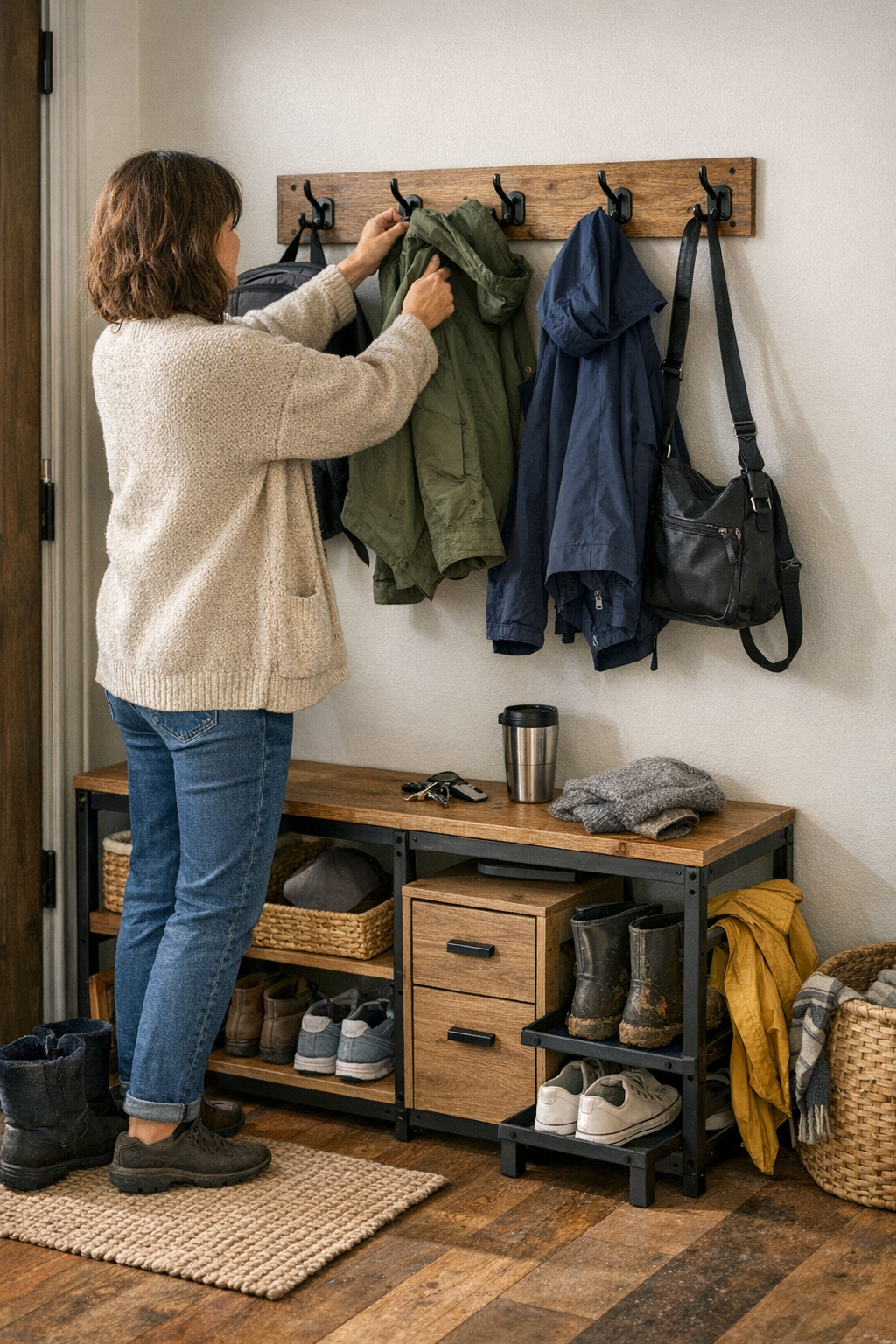
The first clean entryway never lasts. The wall hooks and slim shelves might hold steady for a few mornings, but any real routine exposes their weak points fast. One heavy bag swings from a screw, raincoats pile up after a wet commute, and yesterday’s perfect shoe row starts drifting outward, breaking the clear path you thought you had. Instead of frictionless order, the space slips back toward blocked passages and shoes scattered underfoot. What looked organized on day one now demands constant vigilance: every drop-off, every return, another unpredictable test for the threshold zone.
The Hidden Stress Test of Real Entryways
Wall-mounted hooks show well in photos, but in live use, the entryway is never empty or static. It absorbs the unplanned: dripping gear, a grocery bag heavier than yesterday’s load, someone tossing a backpack onto an already-crowded row. These aren’t rare accidents—they’re routine. As each person squeezes in, the pressure multiplies. A lunch tote slides into the space meant for neatly staged shoes, and one heavy load makes a hook sag. The attractive symmetry sold by drywall-mount storage warps under these daily collisions, erasing the sense of control by midweek.
The pain isn’t just the occasional collapse. The real cost is slow, layered failure: hooks that lean a little more every day, a shelf that starts to tilt just enough to annoy but not enough to fix tonight, a reset that takes longer each time. Re-entry becomes a tactical shuffle—and lightweight fixes (tightening a screw, straightening a mat) never fully catch up with the pressure of repeated, shared use.
When Temporary Becomes Semi-Permanent
There’s a moment—the first time you step over a dropped tote or squeeze past a bench now crowded with overflow—when the flaw clicks into focus. Setups designed for neatness get swamped under normal traffic: one rushed morning, one stack of mail, one too many pairs of boots crowding the welcome mat. The wall system that “fit perfectly” starts drifting: shoes push past the edge, bags dangle unevenly, coat piles become semi-permanent because nobody has a simpler spot to dump them. Each day without resetting piles on extra disorder, until the bench becomes a permanent catch-all and the path tightens further.
Drywall-only anchors fracture first. The moment the pace picks up—kids cutting through on a rainy afternoon, armloads of sports gear arriving late—the repeated weight and hasty drops stress every attachment point. Wall hooks lean farther. Shelves threaten to tip. Resets that once took seconds stretch into a full disruption: hardware repairs, deep reorganizations, or a stealthy hunt for extra mounting points behind the drywall just to keep things functional.
Unplanned Resets and Blocked Passages
- A fallen bag blocks the main path, so what should be a walk-through becomes a dance around an obstacle.
- Shoes overflow beyond their “zone,” squeezing entry traffic and forcing everyone onto the edge of the mat.
- Damp or muddy gear spreads a “do not touch” zone, making a whole corner unusable after a storm or practice run.
Each small breakdown feeds the next. Instead of correcting the clutter, people adapt around it—bags dumped on the bench stay there “just for tonight” but quickly become permanent. Coats overflow from wall hooks to backs of doors. Resetting is no longer a quick fix, but a drag on the day: picking through piles, navigating blocked doors, or having to clear a path before you can even bring in groceries.
Why Studs, Benches, and Floor Supports Change the Game
After cycling through a few failed resets, the value of hybrid setups becomes obvious. Wall hooks anchored into studs (not just drywall) hold up to repeated, real pressure: a full bookbag or bulk winter coat doesn’t threaten to pull them down. A slim bench or grounded cabinet below creates a forgiving “overflow tier”—if hooks fill up or rain hits unexpectedly, shoes and bags land on a stable base instead of crowding the entry walk. There’s breathing room for everyday chaos: boots can sprawl temporarily without toppling the entire organizational plan, and resets are limited to clearing the bench, not rehanging hardware.
With supports where weight actually lands—stud-anchored hooks, strong benches, and cabinets meant for edge overflow—you gain a margin for error. Bags drop, shoes spread, but the infrastructure doesn’t collapse. You spend less time reacting to failure and more time simply passing through, even when the routine is less than tidy.
A Quiet Fix: Find and Anchor the Weak Spots
If hooks are leaning again or a coat rack feels loose after a busy week, it’s a clear sign the mounting can’t match your routine. Tighten any visible fasteners, and—especially where the loads are heaviest—grab a stud finder and anchor at least one or two hooks directly into the supports behind the wall. Spreading out the points of pressure offloads strain from every weak anchor, helping the whole entry system last through more unpredictable weeks.
The Reset Rhythm: Faster, Smoother, Repeatable
The best setups shrink the reset burden. After a normal day, instead of a ten-minute cascade—untangling bags, straightening wall hooks, re-lining up shoes—you face only minor shuffles. Overflow goes onto the bench or low cabinet, not the floor. Wet gear lands in a stable drip zone, not sliding from an overworked hook. Most importantly, the natural flow through the entryway stays open: no blocked door, no dance around scattered boots, no hesitation to move quickly when schedules collide in the threshold space.
Don’t Be Fooled by Day-One Order
There’s a gap between a system that “looks finished” after install and one that survives daily collision. Drywall-only setups may stage the area attractively, but repeated, shared use exposes their limits. Anchoring to studs and backing up regular hooks with grounded storage is what quietly resists the expansion, tipping, and blocked thresholds that every high-traffic entryway sees. Real entryway performance isn’t about first impressions—it’s about absorbing daily pressure, shrinking the clutter creep, and giving you a zone that resets itself faster than it unravels.