
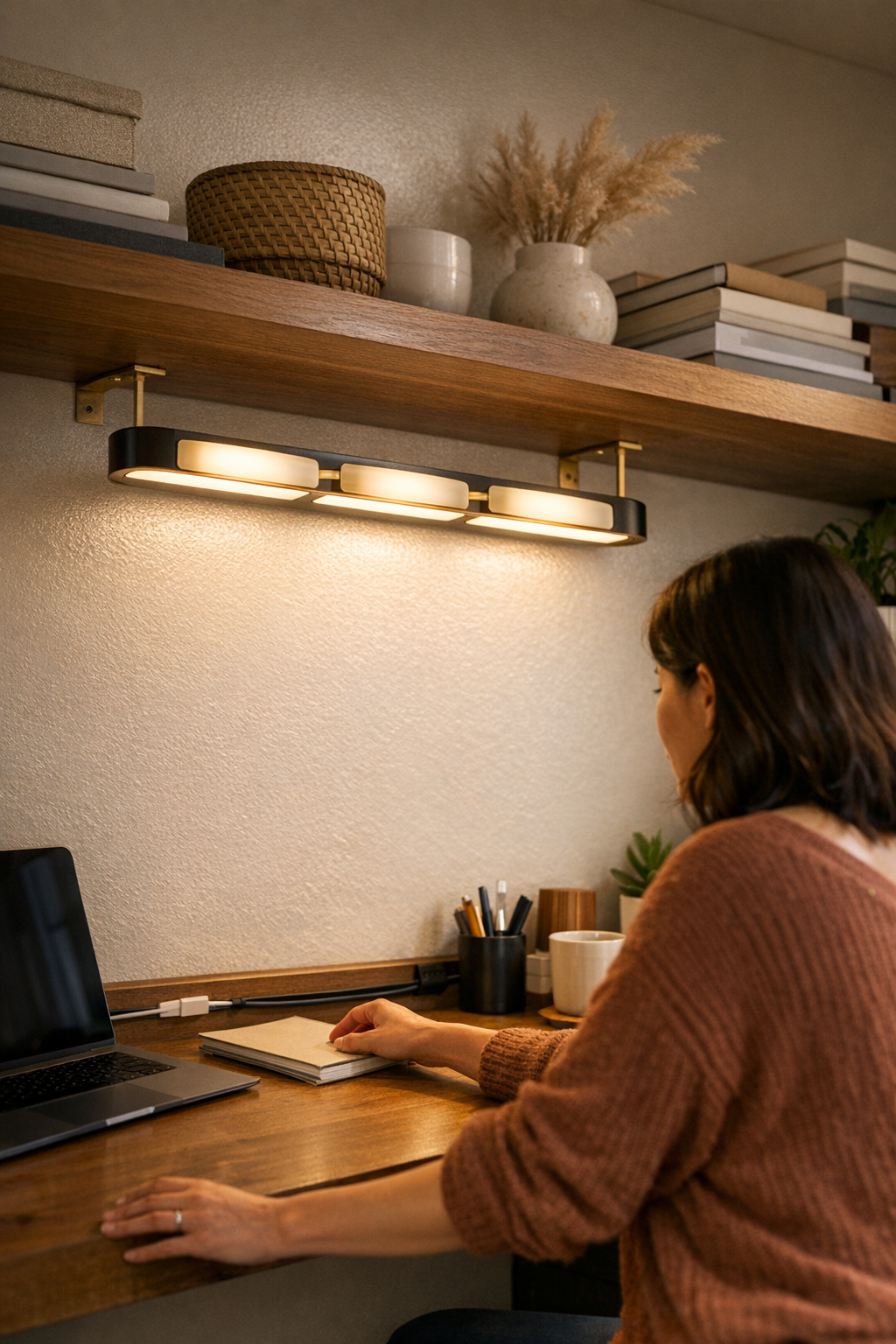
Most lighting setups pass the first-day test: a clean edge, no cables in sight, everything snapping perfectly into place. But within days, friction shows up—literally. Laptop cords shift, a bracket slips, and the under-shelf LED that made your workspace sleek on Monday now droops or throws glare across your desk by Thursday morning. Cables once tucked away creep back into view, tripping wrists or knocking into charging ports mid-task. These aren’t dramatic failures—they’re the repeated annoyances that slowly invade every desk, shelf, and work surface relying on “invisible” supports.
The Hidden Cost of Weak Lighting Supports
Every minimal LED panel or under-cabinet strip promises a finished look and rapid install, especially when adhesive mounts and “no drill” brackets are in the box. It’s what you see on the product page or in showrooms: lines straight, surfaces clear. But the real test starts when you actually use the space—sliding a monitor, rerouting a charger, reshuffling books. Adhesive pads let go a little each day; mounts twist or sag, pushing glare onto screens and shuffling cables right back across surfaces you meant to clear. The weakness rarely fails all at once. It drags out across the week, turning routines into a cycle of last-minute fixes and small, distracting adjustments.
Where the Friction Builds Up: Recognizing Subtle Setup Failures
Lighting support pieces aren’t just wallflowers—they actively shape the work zone. Use adhesive-backed LED strips above the desk and they’ll hold until you move a chair or plug something in: a half-centimeter droop, edge light lost, glare sneaking into your line of sight, a cable pulling sideways with each reach. Under-shelf lights that looked seamless on day one need realignment after every new device is added. And “quick fixes”—a bit more tape, angled brackets, a cable tucked in haste—never last. Instead, the desk drifts into a semi-permanent state of maintenance, never quite finished, always almost convenient but never quite right.
Spot the signals early:
- Sagging or off-level LED strips turning task lighting into uneven, shadowy zones
- Cables making surprise appearances on workspace edges
- Glare that creeps in hours after installation, not just from the fixture but from a shifting mount
- Mount points that let go with every nudge or device shuffle, but never fully detach
The true cost isn’t in the single repair—it’s in the low-level distraction that grinds on, routine after routine.
Real Use Scene: The Desk That Never Feels Truly Clear
Picture a shared desk under floating shelves: on install, stick-on under-shelf LEDs instantly modernize the look. Fast forward two days. Now, phone chargers compete for outlets, drive cables crisscross, a power brick pushes a lighting strip sideways. The once-bright, seamless light leaves a shadow at the desk edge or stabs glare onto the back wall. Each fix—shifting brackets, taping a cable, straightening the strip before lunch—lasts hours, not days. By Friday, the “finished” setup is a tangle of compromises: drooping lights, cables in the way, adhesive barely sticking. Everything’s still technically installed—but now every device move means thinking about supports, not just getting work done.
This isn’t poor installation; it’s proof that everyday desk movement outpaces minimal support hardware.
How Sturdier Supports Quietly Change the Routine
Swap out weak adhesive for fixed metal brackets and tight cable guides and the dynamic shifts immediately. With screwed-in supports, the under-shelf light stays in place—even as chargers tug and monitors slide. Cables run along the back edge, never clawing their way back over your workspace. The brackets show, but function wins: by the week’s end, the lighting still aligns, glare never reappears, and there’s no need to prop, realign, or fix uncooperative pieces before starting work. For desks, shelves, and counters, proper support structure quietly lifts mindless maintenance and leaves behind a routine that finally feels clear and unbroken.
Real stability beats showroom smoothness every time. A bracket you only notice once makes more difference than a hundred adhesive “solutions” that can’t withstand real use.
Spot the Signals: When to Upgrade Your Mounting or Cable Management
Stop waiting for something to fall before fixing it. The strongest upgrade signals are:
- Cable drift: Wires keep creeping across a desk or shelf, no matter how you arrange them. Your guides aren’t holding under real movement.
- Sagging/tilting lights: Any fixture going crooked within days needs rigid, anchored mounting, not a temporary pad.
- Repeated surface interruptions: If you’re constantly moving cables or angling lights just to see or work, your supports are losing the daily-use contest.
Robust brackets and proper cable guides solve what upgraded lights alone can’t: predictable, stable routines that make you forget hardware was ever a problem.
Practical Tips: Setup Choices With Fewer Regrets
Choose Real Brackets Over “Invisible” Solutions
Adhesive strips and near-invisible clips cut corners, not friction. For desks, entryways, or any high-traffic surface, a visible bracket or direct mount quietly wins in actual use. Minor hardware visually fades when the light and cables stay right where you need them, all week long.
Install Cable Guides Early
Getting ahead of cable chaos is the single most effective trick. Install screw-in cable guides or serious clips before surface use begins—they keep wires pinned, prevent cables from spilling over the edge, and eliminate the creeping mess that adhesive patches rarely manage for long.
Take Five Minutes at the End of Week One
Don’t assume a clean start stays that way. At week’s end, check: Is something already drooping? Are cables sneaking into reach or getting tangled? Swap in solid supports or double up cable guides now. Addressing small failures before they become habits is the easiest way to stop endless micro-repairs from taking over your surface.
Setup Appearance vs. Real-World Function
There’s always a gap: what looks resolved under clean lighting versus what feels genuinely frictionless after five days of real work. The true test of a lighting support isn’t invisibility but whether you stop noticing flaws—do cables catch your eyes before the room? Does a fixture sag into your typing zone? Reliable mounting and cable structure simply let you live with the light, not with its maintenance. If you realize after seven days you haven’t straightened a strip or wrangled a cable, you’ve reached a better setup—practical, not just pretty.
Lighting only truly improves a space when repeated-use problems—glare, cable mess, shifting supports—fade out. Smart mounting and good cable control transform ordinary routines so they stay effortless, not just look finished. You’ll notice the difference the next time you move a laptop, reach for a book, or plug in a charger—and nothing needs fixing just to get back to work.
LightSupport – lighting, accessories, and setup solutions that work as smoothly as you need them to