
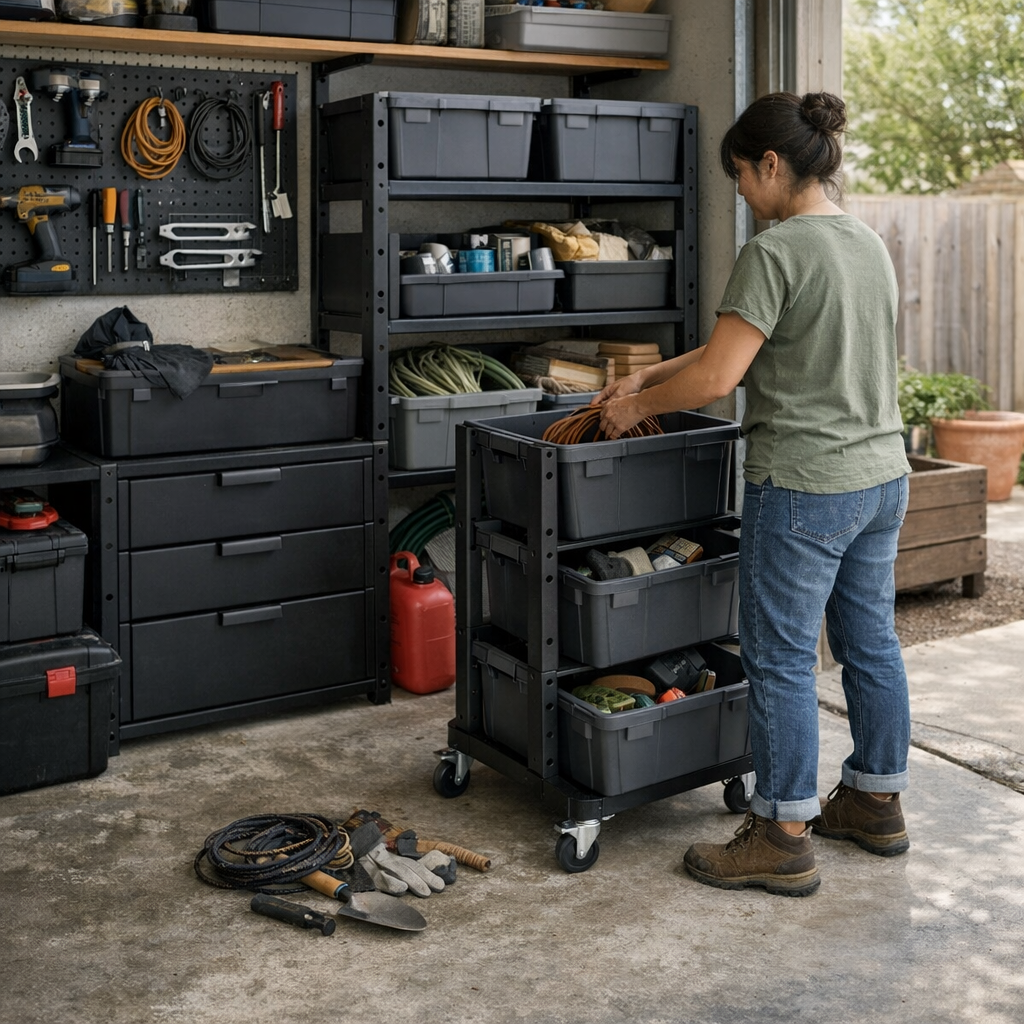
Every storage project starts with hope—a cleared garage, a new set of shelves, bins stacked neatly, and carts lined up along the wall. It looks finished, organized, maybe even photo-ready. But fast-forward a month, and the friction quietly returns: carts parked at awkward angles, tools stashed in dead-end corners, pathways narrowing with every project. The system didn’t collapse, but it didn’t stay out of your way either. It’s clear—what seemed like an upgrade is now just another obstacle to work around.
Why Clutter Creeps Back: Boundaries Beat Layout
The illusion of order comes easy, especially with a full run of shelves and modular racks. But what really tests a system is the churn—how it handles returns, overflow, and all the micro-decisions after a messy Saturday. Most setups fail not because they lack capacity, but because they lack boundaries. Every unclaimed gap, every edge without a stop, becomes a target for whatever you don’t know where to put. Tools slide under carts, gardening gloves settle into random bins, and that awkward wedge behind a stand becomes a black hole.
Modularity without limits quietly expands chaos. Without real boundaries, even the best-designed system gets blurry: bins get shuffled, carts creep into walkways, and shelves swallow stray screws, zip ties, and the odds-and-ends you plan to “sort later.” Order gives way by inches, not by disaster.
Where It Happens: Friction in Everyday Flow
Picture the cycle: Saturday starts clean, but by noon, tools cluster near the job, soil bags crowd the garden shed door, and carts drift—never quite back to where they started. By week two, that shelf run you carefully spaced is now blocked by a diagonal cart, and the far end collects broken planter pots and hardware you don’t want to deal with. The short route from bench to door is gone; now it’s a dance over extension cords and a sidestep past bins that don’t stack quite right anymore.
Finishing up takes longer than the work itself—bend under the rack for the lost trowel, scoop up random fasteners from the floor, and make one last trip to clear the path so you can finally call it done. Even when it looks tidy at a glance, the effort of putting things away multiplies. The cause? Boundaries that never get enforced—or never existed in the first place.
Overflow Finds a Home—Unless You Decide Where
The weakest point of modular storage is the blank space between the bins. Give overflow no clear destination and it will find the least convenient spot—on the path, in the corner, blocking cabinets. The setup that looked so spacious loses its function as countless items nestle in the easiest empty zone. Your tools aren’t lost, but every reset means more reshuffling, less movement, and growing irritation.
A loosely organized area doesn’t collapse overnight. Instead, it clogs the routes you use most. That mobile chest you roll out for projects? Two weeks later, it’s marooned across the walkway. The last shelf acts like a sponge: bits you don’t use often gather at the end, making the rest harder to reach. Nobody set out to make cleanup harder—but the setup keeps inviting mess in, with no signal for when enough is enough.
Scenes That Repeat (Too Often)
- Carts never line up— Each time you need room, you slide a cart just to get by. Now it’s blocking something else entirely.
- Shelf ends become junk drawers— No end cap means the last bin is where every “miscellaneous” part goes, until you can’t find what you need two bins deep.
- Corner black holes— Behind the cabinet sits a permanent pile of delay: spare hoses, rags, broken bits, and projects you lost interest in weeks ago.
- Endless reshuffling— The reset routine is just moving things around, not actually putting them back. Time drifts away, and nothing really improves.
These aren’t failures of storage volume—they’re failures of return flow and boundary. Order is subverted in slow motion, until what was clean is just polished chaos.
Setting Boundaries: Small Shifts, Real Payoff
The practical fix isn’t more shelving—it’s sharper lines. The difference: real, physical limits that let you control where overflow collects and how resets happen. Add a set of end panels; suddenly, every shelf has a hard stop, and bins can’t drift into infinity. Commit one cart as the “landing zone” for extras; now every stray item piles up in one spot, not scattered over four zones.
Making these tweaks, you’ll feel the effect instantly:
- Resets speed up— Anything out of place gets herded to one point, not left for a wandering cleanup.
- Walkways stay clear— Because carts return to a single, marked spot and bins don’t inch off the shelves.
- Clarity replaces guessing— Everyone knows what belongs where, and clutter that used to migrate just stops moving.
Why Open Layouts Miss the Mark
Open shelves seem flexible, but without stops or markers, they become the last stop for what nobody wants to deal with. Stackable bins become useless if they’re stranded across the room from where you unload or work. Just because you have floor racks and mobile chests doesn’t mean they help—unless each unit has a real home, their footprint grows every time you pivot around them. “Modular” can just mean “mess that moves.”
Functional Beats Finished: Storage That Handles Real Days
The real test comes on your busiest, messiest day—not at setup, but at reset. Smart setups act like a funnel: everything extra finds its way to one place, and the space stays clear for the next round of work. The best systems aren’t those that use every inch—they leave breathing room, cut down on extra steps, and never force you to reshuffle the same mess week after week.
If your cart, rack, and bins all have homes that work with your habits, resets shrink to five minutes—and the floor stays clear. If every corner feels busy and every shelf is overloaded, you’re just storing the mess, not solving it.
Micro-Adjustments for Real Setup Performance
- Assign a single cart or bin as the “catch-all.” Funnel every stray or overflow item here instead of letting clutter sprawl; deal with it during one tidy-up, not every time you need space.
- Install end stops or boundary panels. Even a simple edge keeps bins in line and stops overflow from bleeding into access areas.
- Mark parking spaces for mobile units. Tape lines or painted spots make it obvious—move the cart, then put it back. The rest of the space stays fixed and usable.
And above all, leave space where you can. The room to move, pivot, and put things away quickly is the true sign of a setup that serves you—not the other way around.
Find practical modular storage systems for garage, workshop, and outdoor spaces at StackNest.