
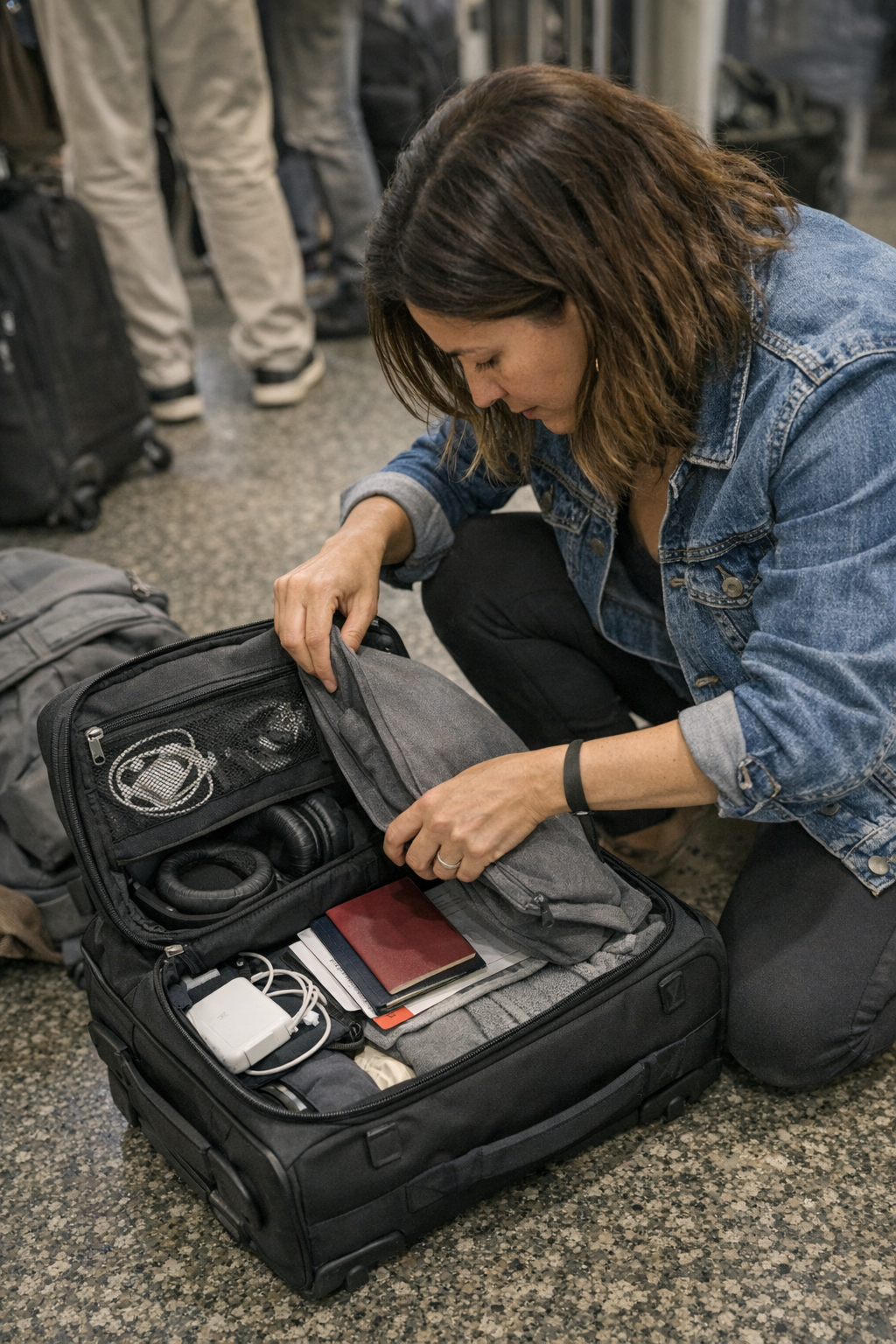
Perfectly packed at home, slow and clumsy under real pressure—this is the airport test for any carry-on “organization.” In your bedroom, every charger, passport, and wallet is slotted just so, zipped into crisp order. But the moment you hit security, that neat structure turns against you. Reaching for your ID means rooting beneath pouches you thought would help. The line moves. Your hand stalls. Suddenly, the system that looked efficient on your floor becomes a bottleneck—document checks, charger retrievals, and last-minute repacks now trigger friction, not flow. Carry-on order isn’t decided by appearance; it’s exposed (or unraveled) by real airport movement, repeated small demands, and every grab along the way. This is where the real cost of a “perfect” setup shows up.
The Hidden Challenge of “Organized” Carry-On Bags
Organization on paper rarely matches the reality of airport use. The route from visual order to actually smooth movement is lined with invisible snags. Unzip, pause—your passport’s buried under the headphones again. Charger? Two compartments away because it looked tidier there. Each friction point—wrist twist at boarding, document dig at security—doesn’t ruin your trip but interrupts momentum, multiplying into a low-level frustration you feel at every routine checkpoint.
This isn’t about travel stress, but structure-induced friction: The “missed” outer pocket, the moment you repack something incorrectly mid-trip, the nagging pause when you realize your layout creates a new reach obstacle instead of reducing mess. The outside of your bag still looks sharp. Inside, it’s a pattern of micro-stalls: a misaligned arrangement that adds seconds and discomfort, segment by segment, as your trip flows from line to gate to seat.
When Aesthetic Order Collides with Travel Reality
A “tidy” compartment layout often falls apart the moment routines start to repeat. At security, you intend to slide out a slim tech organizer, but it’s trapped under a pouch and tangled headphones. In the boarding rush, your boarding pass is sealed off behind zip-on toiletries that never left the spot they occupied at home. Every transfer exposes another overlooked block—the stacking that once felt organized now means three layers to move for one fast retrieval. No single choice derails you, but every extra unzip or awkward shuffle tells you: the order isn’t matching the actual travel flow you’re stuck repeating.
What causes this? Mismatched flow—arrangement made for visual comfort instead of the rhythm of movement. Hiding your passport under accessories, relying on main compartments for quick-grab items, or using layered organizers that bury travel tools you’re forced to access over and over. The pain isn’t a messy bag; it’s an arrangement that drags at every step, not once, but every boarding, every gate, every time you need the same object on the move.
Snapshot: The Repeated Reach
Airport connection. Crowded terminal. You need your ID. You know you packed it “correctly”—right zipper, bottom pouch. Yet, now it’s locked under a neck pillow and water bottle. The main compartment’s packed tight, forcing you to kneel or block the aisle as you dig. The line behind you compresses. This isn’t a random failure—it’s the product of a layout that always asks for extra steps at the exact moment friction returns. The same search, every time that checklist item is called for.
Small Delays That Add Up
Every delay takes a toll over time. Unzipping twice for the charger, re-layering pouches as boarding groups are called, fumbling for the right slot mid-aisle—these inefficiencies repeat with every leg. You might notice them shifting trays at security: tech pouch blocks easy access, or passport demands a two-handed reach atop a crowded bin. Across a whole trip, these moments stack: minutes lost, nerves frayed, missed rhythm.
This isn’t about missing a flight, but about carrying the weight of layered interruptions through every segment—tight layovers, shoulder-to-shoulder gates, restless boarding lines. Each time you tell yourself, “I’ll move that after this leg,” the cycle restarts. Visual order alone can’t unlock flow if the next routine move is always hidden behind a zipper-path or pouch pile.
Real Movement Tests the Setup—Not the Visual
At home, your setup checks every box—chargers zipped, passport sleeved, clean separation between tech and documents. But repeated travel is not a single test; it’s the same item accessed over and over, in different spaces, from standing airport lines to cramped seats. That clever hidden slot for your boarding pass turns into a delay. That compact, color-coded tech pouch proves hard to re-pack when you need your headphones mid-flight.
If your bag makes you hesitate before each retrieval—if you’re replaying the last time you nearly lost a document in the shuffle, or dreading the layered dig for a charger after a layover—your organization isn’t keeping up with your travel reality. The difference between looking orderly and actually moving smoothly is clear in the repeated moments your setup interrupts a basic action.
Example: Swapping Layers for Access
After struggling through security lines and missed calls to board, many travelers swap a multi-layered document holder for a single, top-zip pouch. From then on, documents are out in one motion—no sliding under accessories, no re-stacking pouches on the tray, no searching for that one piece of paper while people wait. The change doesn’t show from the outside, but it transforms the sequence: fewer errors, faster repack, noticeably less stress where it counts.
Recognizing Where Carry-On Friction Hides
Most friction hides in small design decisions you never notice until real use:
- Deep document slots: Unnatural wrist bends and forced reaches at every checkpoint.
- Overlapping pouches: Slow you down during security’s X-ray shuffle, forcing partial unpacking just to reach a cable or ID.
- Layered zippers: Create cascading time-loss; every retrieval means more zips, more missed timing.
- Tidy tech organizers: Look efficient, but if your most-used item is always on the bottom, neatness has become its own hassle.
These aren’t hypothetical problems. They’re repeat offenders—small, repeated blocks that pile up through every movement: walking between gates, clearing trays, or shifting seats in-flight. Micro-delays don’t hit once; they become the rhythm of travel with the wrong structure in place.
Packing for Access, Not Just Order
The real carry-on upgrade: Zero in on which items must be reachable in one move. Place them in outer pouches or top zippers—where you never have to move something else first. Avoid letting your best attempt at tidy packing turn into a tangle that costs you every time speed matters—even if that means going against your usual color-code or symmetry habit. A small visible mess beats a prolonged document search every time a gate agent’s hand is out.
Effective setups don’t add more compartments; they rearrange for flow. Position items for the actual movement sequence—airport checks, seating, tray pulls—not a static still life on your bedroom floor. You want to grab, use, and replace in one unbroken motion—not second-guessing which pocket or layer you’ve buried the essential in.
Paying Attention to Repeated Annoyance
The carry-on that keeps frustrating you—same access fumble, same document pause—is telling you something. When a routine repack or retrieval slows you down on every trip, it’s not a personal quirk. It’s a structure problem. The persistent memory of a half-blocked zipper or awkward seat entry is evidence: the layout doesn’t fit your repeated-use rhythm. And that’s worth changing.
Making Small Changes for Smoother Movement
Test a tiny shift: put your ID or boarding pass in the spot you can hit without moving the bag itself. Reduce leftover pouch overlap near your most-used slots. Try running through an actual “in-motion” cycle—stand in a hallway, walk through your routine, and note when you have to stop or repack. Most limitations in the flow appear when you mimic real airport conditions—not when nothing’s on the line.
The point isn’t creating a bag that wows at a packing contest. It’s about beating the grind of interruption. Any move toward faster, more direct access—especially for documents, tech, and things grabbed on the go—means less stress, less seat-edge juggling, smoother boardings and bin lifts, and a bag that quietly improves, rather than repeatedly blocks, your every move.