
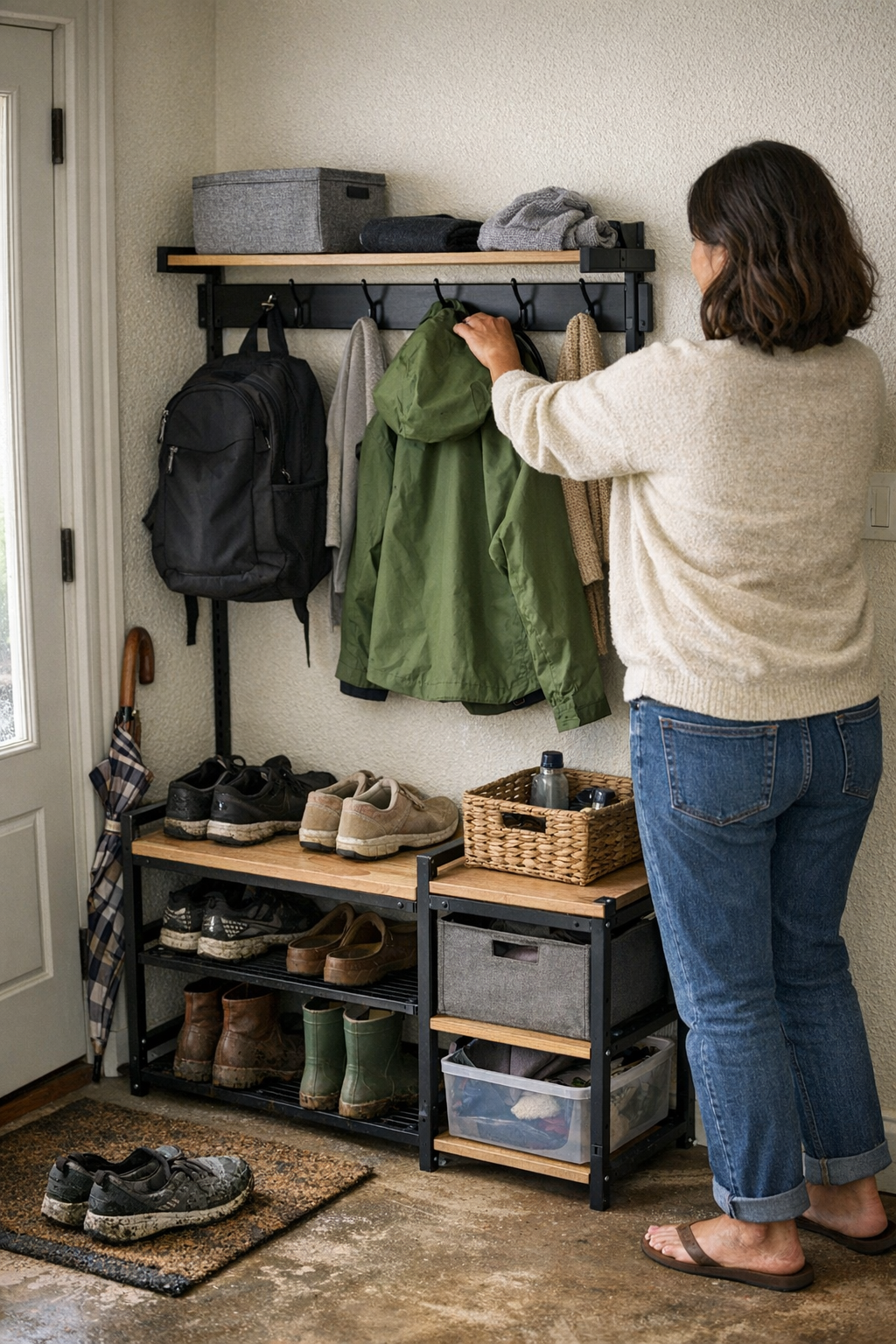
Every entryway claims to be organized until it faces daily use. Hooks line the wall, shoes start in neat rows, and for one quiet moment, control seems possible. But by midweek: shoes overflow into walkways, bags inch into door swings, and every “quick drop-off” leaves a bit more chaos piled at the threshold. The real test isn’t how door-side storage looks after a Sunday reset—it’s how it holds up when three people, wet boots, and unpredictable routines all collide in the same 40-inch zone. That’s where most surface fixes quietly break down, and where the difference between temporary stick-on storage and anchored setups becomes obvious—usually right underfoot, when even crossing the entry takes an awkward sidestep.
Why Adhesive Mounts Seem Like a Good Entry Fix—Until Real Life Hits
Adhesive-mounted racks and hooks are tempting for quick entryway upgrades—no tools, no drilling, just press-and-go vertical storage. In a guest hallway or under-light loads, they might even hold for a season. But once the entry turns into an actual re-entry zone—wet jackets thumping after a storm, backpacks tossed after a long day, shoes hitting the rack damp—the limits show fast. Moisture, temperature changes, and the daily repetition of returns quietly work loose the adhesive. Every swing of a weighted bag or splash from muddy shoes puts new stress on the strips. The “easy” fix that saved time on install starts demanding time every reset, as panels shift, hooks sag, and the path narrows again after each busy outing.
The Scene: When Storage That Looks Neat Starts to Fail
Picture a high-traffic entry barely wide enough for three pairs of boots side by side. At week’s start, adhesive hooks keep coats off the floor; the shoe rack manages a single row. But on Tuesday—rain. Someone boots in, coat drips, backpack lands hard on a hook, and suddenly the adhesive shifts. Shoes slip into the walkway, the hooks angle out, and the whole setup sags. Two days later, another reset: press the hooks, realign the rack, shove the shoes back. But the strips peel quicker each time. Instead of a clean entry, the threshold clogs with overflow: stray shoes block the door; bags clog the pinch-point; every pass-through means picking your way over yesterday’s mess. Quickly, the storage system becomes just as much friction as the clutter it was meant to solve.
Now, the entry transforms from passage to obstacle course. Each drop-off that was supposed to be frictionless instead triggers a mini-reset, and anyone trying to cross the zone shoulders a little extra frustration. Reset fatigue sets in; what started as hidden clutter just becomes visible irritant.
Hidden Breakdown: What Actually Goes Wrong with Adhesive Mounts
Real entry use isn’t kind to adhesive storage. Here’s how repeated transitions expose the cracks:
- Sagging hooks: Single heavy drops or soaked coats nudge hooks downward—at first barely visible, then unmistakable as tilt adds up day by day.
- Creeping clutter: As hooks lose their angle, items slip free, sliding bags and coats right back onto the bench or floor. Shoe rows break rank and spread, reclaiming floor space meant for passage.
- Blocked movement: Overflow starts at the edge: shoes across the threshold, bags teetering half-on, half-off the rack, every path narrowed until someone finally clears it—or detours around it.
- Resets get shorter—and less effective: Each attempt to stick, press, or nudge hooks back is a little less successful, while adhesive residue and wall wear collect quietly behind the scenes.
The promise of “low effort” dissolves into a routine of micro-fixes, each one achieving less. The entry doesn’t get easier; it just asks for more attention in smaller, more frequent bursts.
Anchored Hardware: Holding Up Against Real-World Routine
Anchored racks—screwed into studs, designed for repeat impact—are built for messy, high-traffic entries. The difference appears quickly: no creeping lean after a wet week, no rack slipping off the wall when a backpack is tossed a bit too hard. Hardware mounting turns the drop zone into a true reset zone—hooks remain level, storage stays in place, and shoes slide back out of the walkway instead of flooding it again. It’s not pretty for the sake of order—it’s stable for the sake of movement: daily pickups become automatic and resets happen in seconds, not out of obligation, but as a byproduct of a zone that works as intended.
One real-world shift: After swapping adhesive hooks for anchored racks in a cramped entry shared by three, the door swings clear each time, bags land and hang with no sag, and wet weeks no longer devour the whole system. Reset means moving items, not reattaching the storage itself. For once, the threshold relieves pressure—it doesn’t add to it.
Signs Your Drop Zone Needs a Stronger Solution
If your daily flow meets these symptoms, your storage setup is starting to surrender:
- Hooks tilt or peel the morning after humidity spikes or wet jackets hang all night.
- Shoes and bags migrate into walking routes, forcing detours at the door or around the bench.
- Reset means re-sticking or realigning panels more than once a week—and never quite solving the drift.
- You recognize your system by how often you prop it up, not by how smoothly it works.
Spot-check: If you see panel corners lifting, sticky residue spreading, or stray items piling up at the edge of the zone, the real friction isn’t your routine—it’s the setup that can’t keep pace.
Beyond Visual Order: Making Thresholds Work for Everyday Living
True threshold storage has to withstand impact, weather, and back-to-back returns. Looking tidy isn’t enough—if the drop zone blocks movement, demands daily rescue, or only works under ideal conditions, it’s not serving real-life needs. Hardware-mounted options—anchored racks, stable benches, vertical wall setups—aren’t just more “permanent.” They actually reset the friction: less overflow at the path edge, fewer rescue missions, less stress every time someone rushes the door. The real signal of a working setup isn’t perfectly lined hooks—it’s the moment you forget about the entry and just get through it.
If your drop zone is asking for constant repair, fighting seasonal changes, or scattering storage back into the daily path, adhesive may have done its job once—but it’s time for something that handles the pressure, not just hides it. That’s the shift from holding on to holding up—one that reclaims your entry flow for good.
Find transition-space storage solutions that hold up, not just hold on, at Betweenry.