
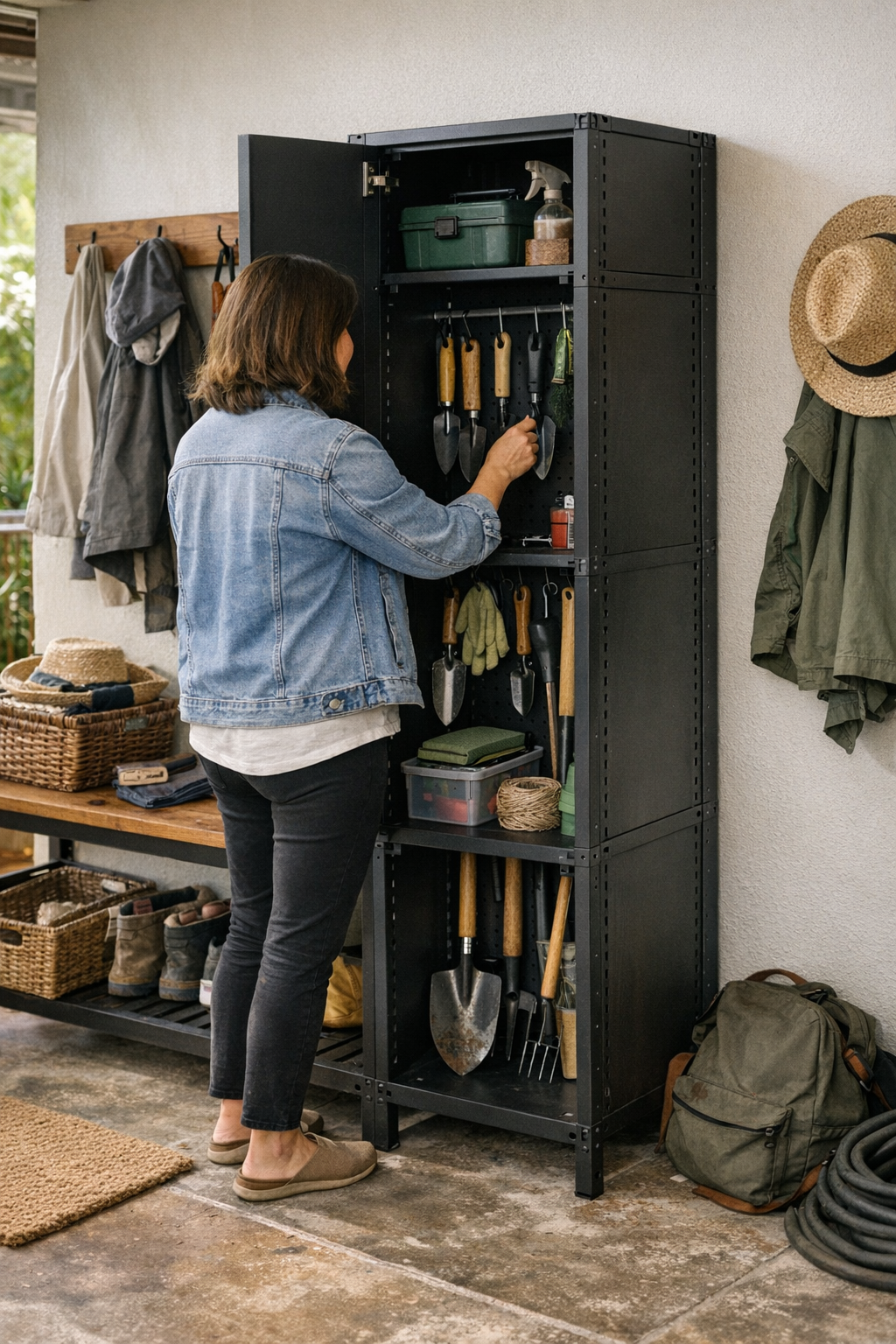
When “organized” becomes just another kind of clutter, it usually starts at the entryway’s open wall. A single tool wall, a broad shelf, or a dense run of hooks looks in-control on day one, but by Thursday, the real-life slowdowns return. You reach for a rake and find bags, boots, and mail wedged where tools used to go. Shoes spill out beyond their tray, bench space shrinks under the weight of quick drop-offs, and your reset efforts last only as long as it takes for everyone to pass through again. What looked like a solution turns into a choke point where routines snag and every “quick grab” gets slower.
The Drop Zone: Where “Organized” Stops Helping
Most entryway storage fails not because it lacks space, but because it blurs routines. Storage that’s just a wall of hooks and shelves invites the wrong kind of overlap the moment a bag is dropped or a child misses their shoe cubby. Instead of streamlining traffic, open setups quietly enable category drift:
- Kids’ shoes form a sprawl beneath tool hooks, forcing detours around the muddiest pairs.
- A sports bag, left “just for tonight,” squeezes into tool space and never leaves.
- Mail starts filling the glove bin, dividing the space until nothing matches the original plan.
Movement slows, bottlenecks multiply. Benches meant for seating double as overflow shelves. Every item left “just for now” collects until retrieval means wrestling gear out of someone else’s category. Each pass-through means a new object joins the jumble at the edge of the zone. The entryway keeps its shape, but the system crumbles each time real-life speed collides with pseudo-order.
Category Creep and the Disappearing Boundaries
This isn’t a decorative problem—it’s a function breakdown caused by category drift. When every inch of the wall is fair game, boundaries dissolve. Shoes migrate outside their tray. The nearest empty hook swallows garden gear, hats, or whatever can’t quickly find its exact home. The storage fills, but friction grows: you hesitate before dropping a bag, or end up blocking the path because nothing is ever where it should be.
Instead of a quick grab-and-go, you hover, shuffling boots aside, reaching over stray mail for a spade that’s half-buried by last night’s overflow. “Temporarily” misplaced stuff turns semi-permanent—not by decision, but by routine pressure. Each misplaced item nudges the whole area toward confusion.
Real-World Friction: A Morning Scene
Picture the post-school-run mess: bench covered in shoes nobody actually wore, a damp coat slumping over the gardening fork, the backpack wedged behind the cabinet and blocking the cleaning caddy. Every pick-up or drop means working around someone else’s last-minute shortcut. By the time you need a tool, you’re untangling layers of category creep—and the space that “looked organized” is now a slow obstacle.
Focused Tool Zones: Small Surface, Big Payoff
The real fix isn’t more wall space—it’s sharper boundaries. Vertical cabinets and tight tool zones at the threshold limit what creeps in. When only essentials fit, overflow is visibly blocked: shoes can’t pile up in front of garden tools, bags have nowhere to squat “for now,” and routines bypass the wall scramble entirely. Even a single tall utility cabinet defines what belongs—everything else can’t linger long enough to get stuck.
With just two or three defined drop zones—one for tools, one for shoes, one for daily bags—returns become fast, and retrievals don’t bottleneck. You grab a trowel on the way out or toss garden gloves back in without detouring past someone’s forgotten gym clothes. Those few seconds of routine flow add up: no more sifting for what’s buried, no more sliding around piles. With pressure high and the clock ticking, the entryway boundary holds instead of collapsing into a mixed catch-all.
When “More Storage” Makes Things Worse
Adding extra hooks or another bench tempts you with surplus, but in practice, every new open panel just resets the spread. If the edge isn’t enforced, temporary items turn permanent, and benches swap their seat for a pile. Shoes drift beyond the tray, bags edge out tools, and unsorted gear hops from shelf to shelf. Unless you’re ready to reset everything every time, extra surface equals extra mess—and the core slowdowns return faster than before.
How to Spot Weak Structure Before It Slows You Down
- Mail mixes with tools, and sports gear fills zones intended for garden supplies.
- Returning or grabbing anything means shuffling aside other items first.
- The area resets visually but falls apart within days under normal use—especially with multiple people and daily entrances.
- A subconscious pause before crossing the drop zone, bracing for the next pile or blocked path.
These signals don’t just mark a “busy” zone—they’re proof the setup handles everything and serves nothing, inflating the daily reset burden and shrinking usable flow.
One Small Change, Big Daily Difference
Switching to a single, vertical utility cabinet at the edge of test setups changed the entryway cycle immediately:
- Direct access: Daily tools are a reach away—never behind a maze of gear.
- Overflow prevention: Shoes and bags can’t pile up in the cabinet’s footprint.
- Predictable returns: Each category stays isolated. After a week, routines still flow and categories haven’t collapsed into each other.
- Quick resets: Even in a morning rush, you restore order in seconds and the threshold doesn’t clog.
No glamour—just a hard stop for category creep and the slow erosion of routine. The difference isn’t theoretical: less reshuffling, clearer movement, a setup that stands up to busy weeks instead of just photo-ready moments. “Looks organized” finally means nothing is in the way when you need to move.
Tighter Boundaries, Better Routines
If your drop zone slows things down, skip the next wall of hooks. Focus on what the space looks like after 48 hours of normal use—not after a perfect reset. Do boundaries hold, or does daily life wash them out? For high-traffic homes and tight transition spaces, a smaller, stronger zone anchored at the threshold resists collapse—and cuts the friction that generic wall storage keeps inviting in.